Circuit info
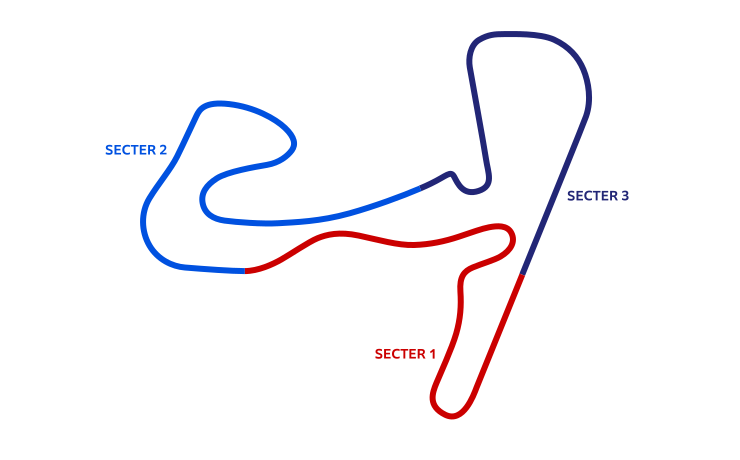
- Circuit Length
- 4.259 km
- First Grand Prix
- 1952
- Number of Laps
- 72
- Race Distance
- 306.587km
Location
- Address
- Burgemeester van Alphenstraat 108, Zandvoort 2041 JA, Netherlands
- Google Maps
History of the Circuit
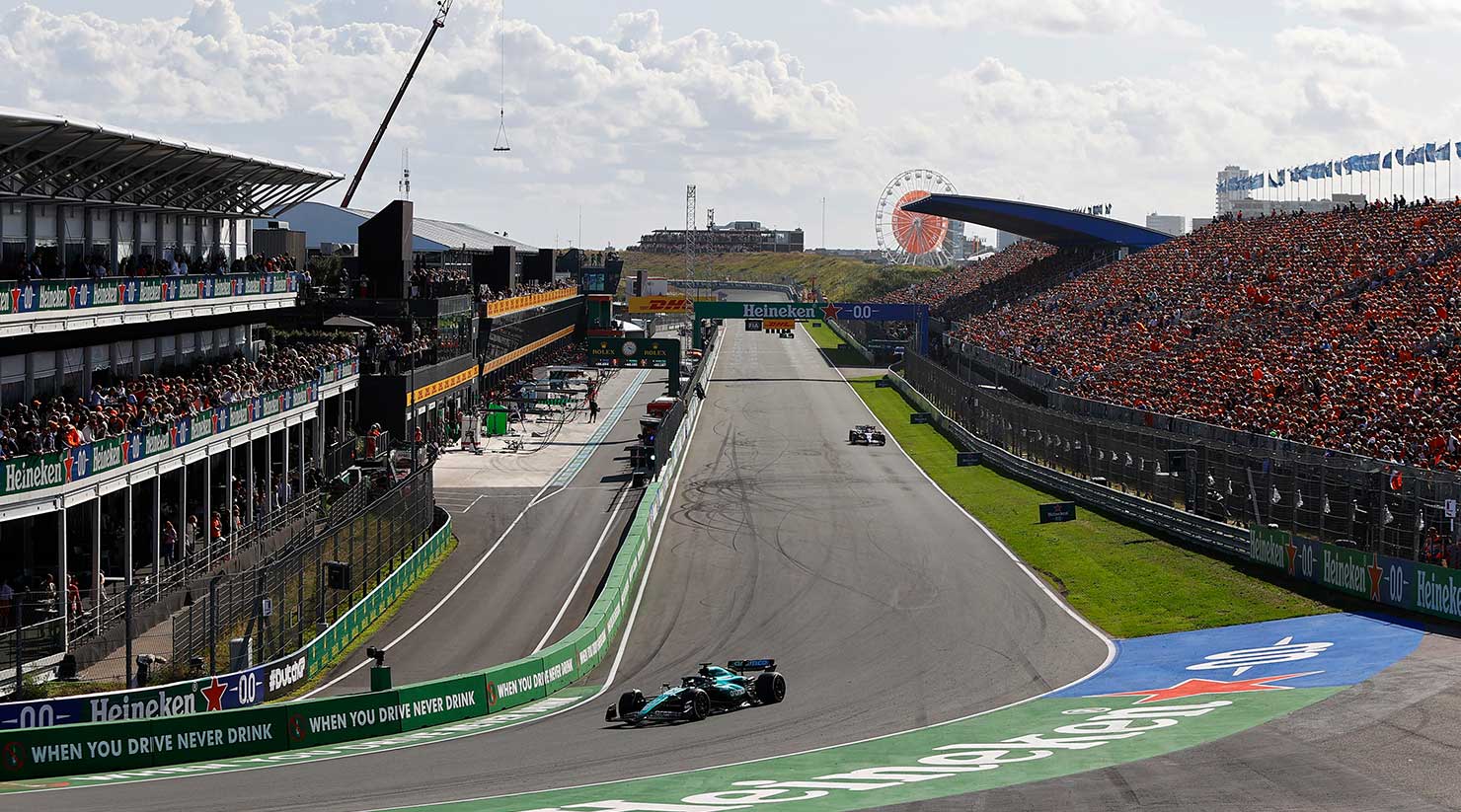
Located west of Amsterdam on the North Sea coast, Zandvoort is home to one of motorsport’s most distinctive circuits. The track was built in 1948 among the coastal sand dunes and originally featured a simple, high-speed layout dominated by long straights. The Dutch Grand Prix first joined the Formula 1® World Championship calendar in 1952 and was held regularly through 1985, with the exceptions of 1954, 1956, 1957, and 1972.
As F1 cars became increasingly fast during the 1980s, accidents became more frequent and the costs of safety improvements placed significant financial pressure on the circuit. Combined with concerns over noise, environmental impact, and aging facilities, the Dutch Grand Prix disappeared from the calendar after 1985. The circuit’s operating company eventually declared bankruptcy in 1987.
Businessman Hans Ernst took over the facility in 1988 and began rebuilding Zandvoort’s future. Part of the land south of the circuit was sold to fund a major redevelopment, which shortened the track from approximately 4.2 km to around 2.5 km. International racing gradually returned, highlighted by the hosting of the Marlboro Masters Formula 3 event in 1991. As many of its young competitors later progressed to F1, Zandvoort’s revival attracted considerable attention.
Another major reconstruction followed in 1999, extending the circuit to approximately 4.5 km and creating the foundation of the current layout. With its modernized facilities, Zandvoort successfully attracted international series including the DTM and WTCC, re-establishing itself as a world-class racing venue.
For a circuit long challenged by environmental and noise-related concerns, the emergence of Dutch driver Max Verstappen proved to be the perfect catalyst for a F1 return. Verstappen actively supported efforts to bring F1 back to his home country, participating in demonstration events that drew huge crowds and demonstrated the event’s potential. In 2019, the Dutch Grand Prix was officially announced to return in 2020. The COVID-19 pandemic delayed those plans, but in September 2021 the Dutch Grand Prix finally returned after a 35-year absence.
Circuit characteristics
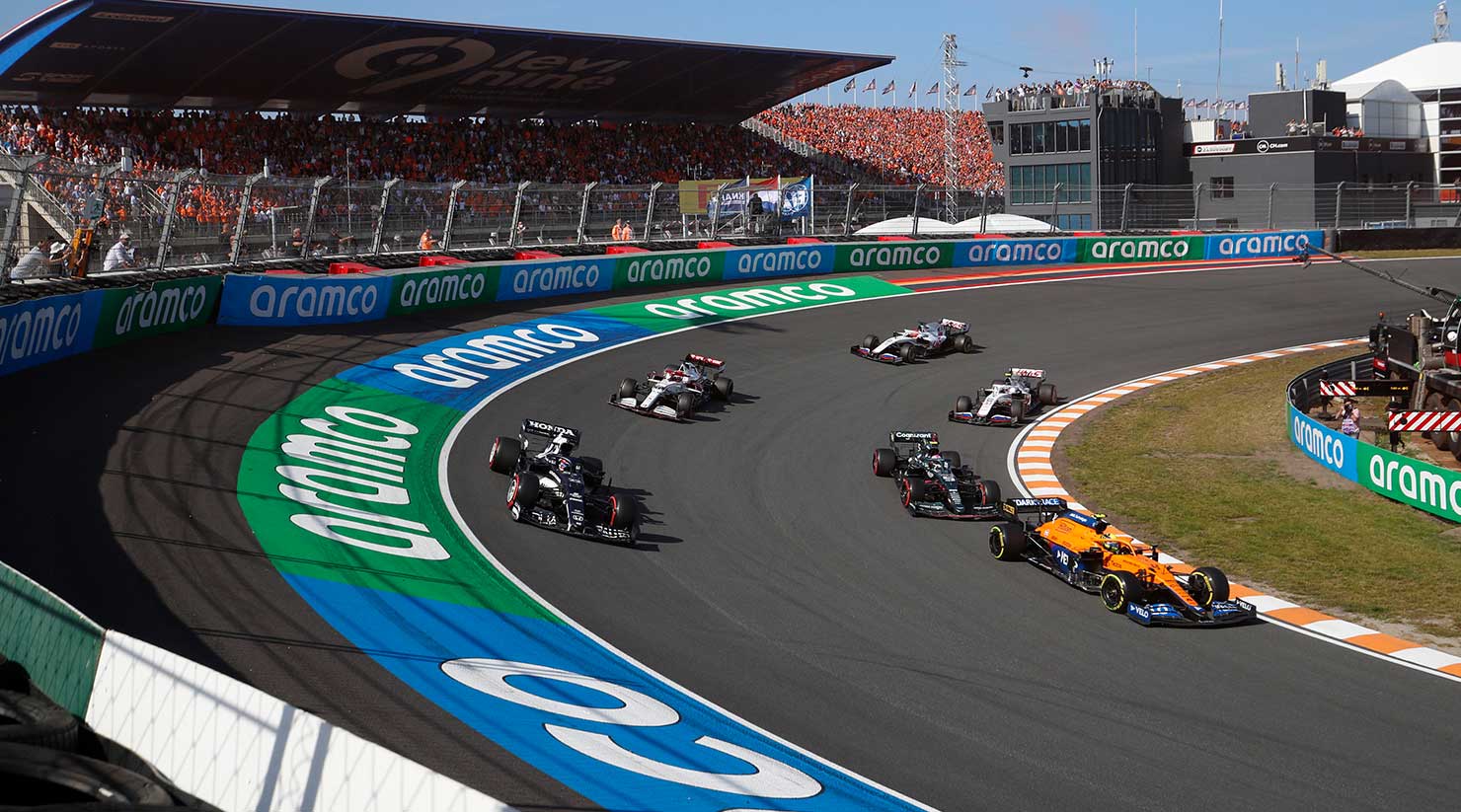
With its relatively short lap, narrow track width, limited runoff areas, and flowing sequence of high-speed corners, Zandvoort is often described as a modern-day old-school circuit. Its most distinctive feature is the use of heavily banked corners throughout the lap.
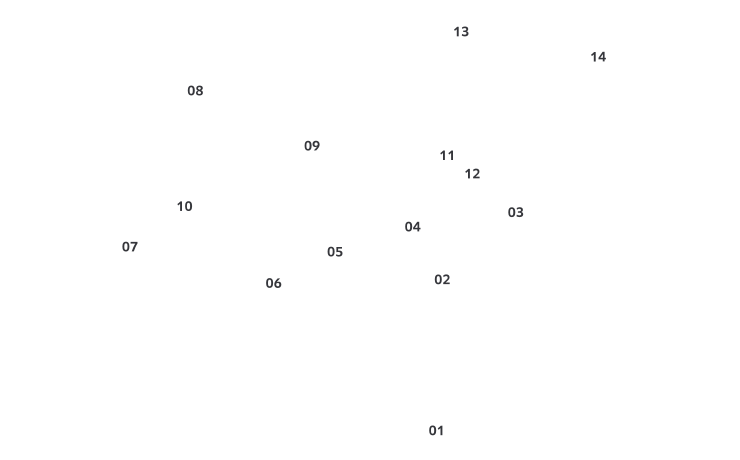
The circuit begins with the Tarzanbocht hairpin at Turn 1, located at the end of the main straight. This remains the primary overtaking opportunity around the lap.
After a sweeping right-hander, drivers arrive at Hugenholtzbocht (Turn 3), one of the circuit’s signature banked corners. Featuring a dramatic 19-degree banking, it offers multiple racing lines, with drivers choosing between the shorter inside route and the faster outside line.
From Hugenholtz through Turn 7, the circuit flows through a series of fast, rhythmic corners. Turn 7, known as Scheivlak, is another iconic banked right-hander taken at high speed and is widely regarded as one of the highlights of the lap.
Turns 8 through 10 form a technical section of medium- and low-speed corners, followed by the tight chicane-like sequence of Turns 11 and 12. The final corner, Turn 14, is the heavily banked Arie Luyendykbocht. With an 18-degree banking, it allows drivers to carry tremendous speed onto the main straight and plays a key role in setting up overtaking opportunities into Turn 1.
Zandvoort’s current F1 hosting agreement runs through 2026. In 2024, circuit officials announced that the Dutch Grand Prix would not continue beyond that date.
Memorable battles
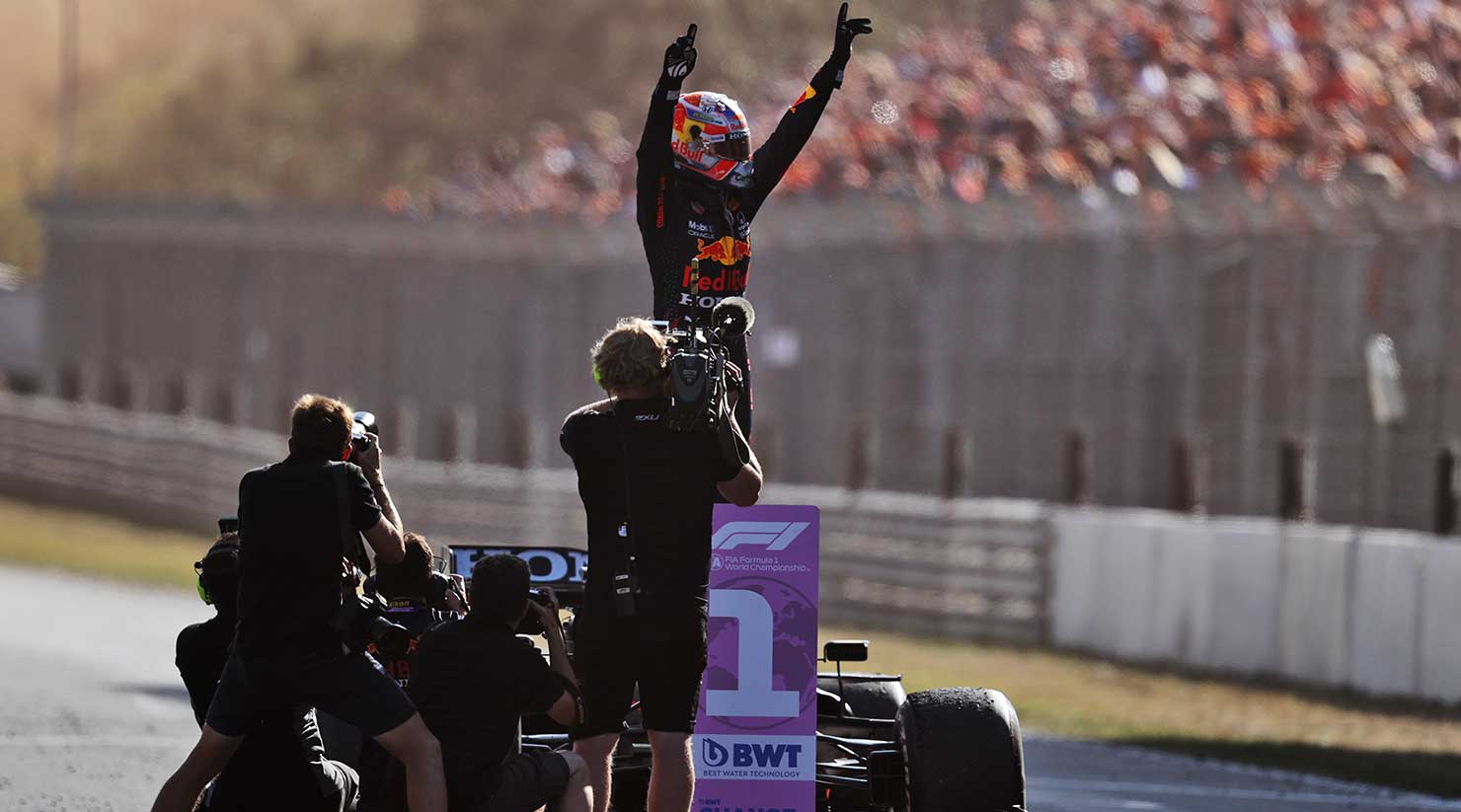
The sea of orange-clad fans supporting Max Verstappen has become a familiar sight throughout F1, but nowhere is their passion more visible than at the Dutch Grand Prix.
The atmosphere reached extraordinary levels when F1 returned to Zandvoort in 2021. Driving for Red Bull Honda, Verstappen arrived at Round 13 locked in an intense championship battle with Mercedes driver Lewis Hamilton. Entering the weekend, Verstappen had reduced the points deficit to just three and had a chance to reclaim the championship lead.
He delivered immediately by securing pole position ahead of Hamilton, sending the packed grandstands into celebration. Verstappen then controlled the race from start to finish, claiming his seventh victory of the season and retaking the championship lead. The celebrations continued long into the night as Dutch fans celebrated their national hero’s triumph.
The victory also brought widespread recognition for Honda, which had already announced that 2021 would be its final season of Formula 1® activity at the time.
Verstappen went on to win the Dutch Grand Prix again in 2022 and 2023, completing three consecutive victories at his home race while maintaining his position as World Champion.
- Fastest pole position lap
- 1 min 08.662s
Oscar Piastri (McLaren, 2025)
- Fastest Honda qualifying lap
- 1 min 08.885s
Max Verstappen (Red Bull, 2021, Pole Position)
- Fastest race lap
- 1 min 11.097s
Lewis Hamilton (Mercedes, 2021)
- Fastest Honda race lap
- 1 min 12.921s
Max Verstappen (Red Bull, 2025)
* Statistics based on the current 4.259 km circuit layout.
Honda Records
Explore Honda’s history of challenges and achievements across iconic circuits,
backed by race performance data.