Partnering with a World Champion
September 10, 1967: Round 9, Italy
RA300 co-developed with Lola wins its first race
 © HRC
© HRCFord Cosworth DFV era arrives, weight reduction becomes challenge
The second year of the 3-liter F1 era, 1967, brought major changes to both F1 and Honda. In the fall of 1966, Honda headquarters decided to reduce its F1 activity budget. Meanwhile, John Surtees, who had parted ways with Ferrari in June of that year, contacted Yoshio Nakamura expressing his desire to drive for Honda. Seizing this opportunity, Honda established Honda Racing, a new structure, as its front-line base within the British Lola company with which Surtees had close ties. This set the direction for a single-car entry with Surtees for 1967, announced on December 5. Only Nakamura, the director, would be permanently stationed in the UK from Honda, with foreign mechanics forming the core of the team, significantly reducing the costs associated with traveling between Japan and Europe.
Meanwhile, F1 reached a major turning point with the arrival of the V8 engine, the Cosworth DFV, backed by American Ford capital. Originally conceived by Lotus after its struggles in the 1966 season, it debuted in the following season with a win in Round 3, the Dutch Grand Prix, instantly becoming the fastest engine everyone coveted. A 90-degree V8, producing 400 horsepower even in its initial form, the DFV was simple and lightweight. Starting in 1968, Cosworth would begin selling the engine to interested entrants, leading many constructors to actively enter F1 with DFV-powered cars.
In contrast, the RA273 was simply too heavy. It finished 3rd at the season-opening South African GP, 6th in Round 6, the British GP, and 4th in Round 7, the German GP. However, it could not compete with the nimble Lotus-Ford, Brabham-Lepko, Ferrari, or Eagle-Weslake cars. Consequently, Honda Racing decided to undertake major modifications at their UK forward base. In July, Shoichi Sano (chassis) and Kiyoshi Kume (engine) were sent from Japan to the UK for this purpose. As in 1965, a major overhaul of the car was undertaken, but this time the work was done in Britain. The plan involved reusing the front section of the monocoque from the Lola T90, the previous year’s Indy 500 winning car, and integrating the RA273E engine. With Lola representatives including Eric Broadley and young engineer Tony Southgate joining the effort, the improved car, named the RA300, was completed by the end of August. Its weight was reduced to 590kg, and its livery was refreshed with a new white base featuring a red stripe.
 © HRC
© HRCHonda F1 claims second win after close battle
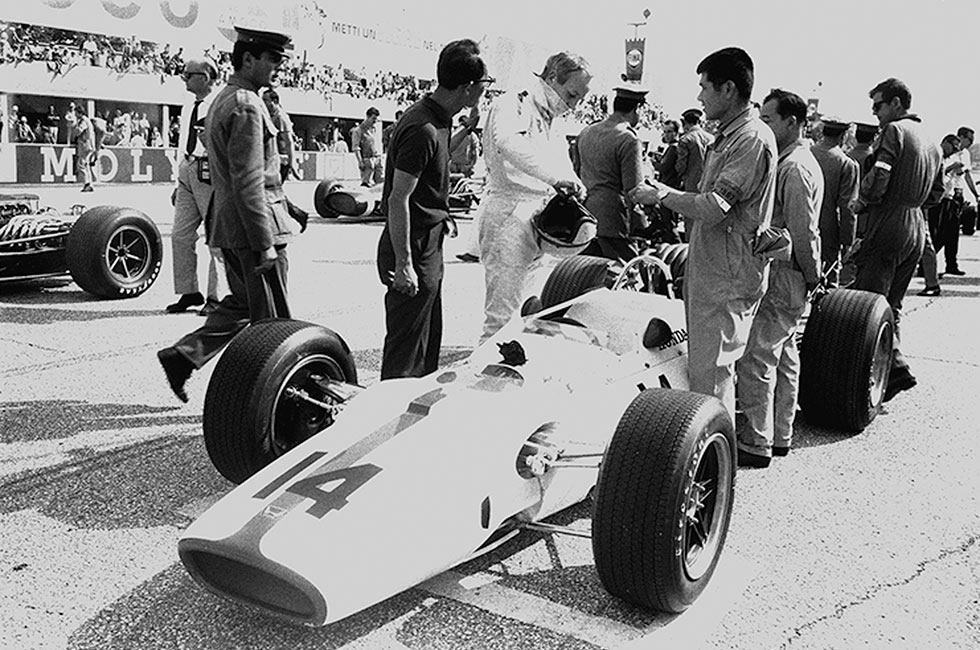
The RA273 was brought as a spare car alongside the RA300 for the Italian GP qualifying, after missing Round 8, Canada. Surtees drove the RA273 while the RA300 underwent initial troubleshooting, but ultimately decided to race the RA300. This new car secured 9th place out of 18 cars on the grid. At Monza, a track known for slipstream battles, qualifying position was not particularly crucial.
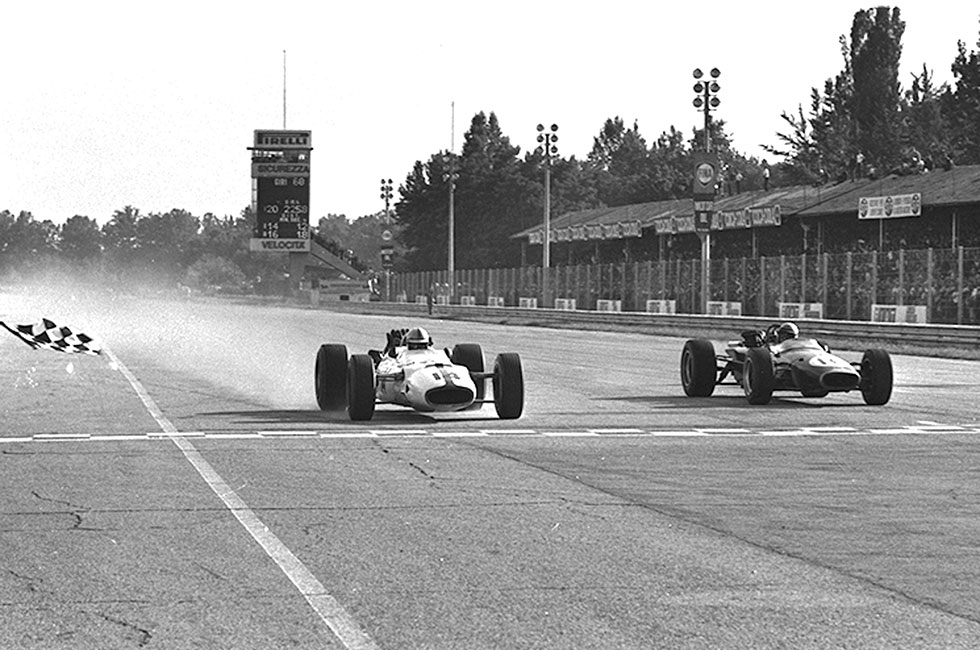
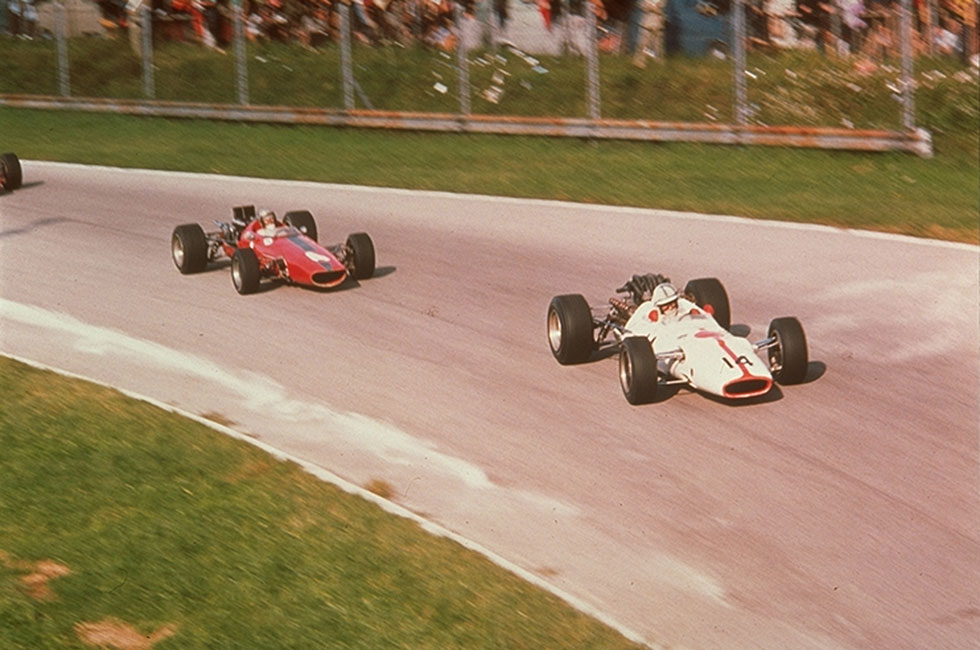
Surtees dropped to 10th on the opening lap, but in the early stages was battling for position within the second group, engaging in slipstream battles with Ferrari, Cooper, and McLaren. By Lap 14, he had climbed up to 4th. When the Lotus Ford duo of Jim Clark and Graham Hill, who had formed the leading group, dropped out or fell back due to mechanical issues, the final lap became a one-on-one battle with Jack Brabham (Brabham Repco). At the final right-hand Parabolica turn, Brabham dived inside and briefly took the lead. However, as Brabham drifted wide on the exit, Surtees cut across his line. On the final straight, Surtees accelerated on the inside while Brabham was on the outside, side-by-side. Both cars crossed the finish line almost simultaneously, with Surtees edging Brabham by a dramatic 0.2 seconds.
For Surtees, it was his first victory since the 1966 season finale, the Mexican Grand Prix. Surtees was the champion rider, when Honda first began challenging the Isle of Man TT races, and the motorcycle world championships in the late 1950s. Since he rode Italian-made MV Agustas during that era, his popularity at Monza was exceptionally high. The Italian fans’ fervor at the Italian GP was already greater than at other Grands Prix, but combined with this dramatic comeback, the post-race podium ceremony saw spectators flood the track in a huge commotion. On the podium, the widow of Ferrari’s lead driver Lorenzo Bandini, who had perished in a fire at that year’s Monaco GP, presented the newly established Bandini Trophy to Surtees, her husband’s former teammate.
 © HRC
© HRCThe RA300, like the RA272 (mod) two years prior, was exhibited at the Tokyo Motor Show in the autumn, instantly capturing the spotlight. Honda, riding the wave of the massive success of its 354cc forced-air-cooled four-stroke two-cylinder kei car, the N360, which was launched that spring, had sparked an “N-car” boom across Japan and was steadily growing into a major automaker.