Struggling with 3L F1 Car Development
September 4, 1966: Round 7, Italy
Late start for new regulations a stumbling block
 © HRC
© HRC3L regulations shake-up the season
After the 1.5-liter F1 era, which lasted five years from 1961, concluded with Honda’s first F1 victory, the 3-liter era began in 1966, doubling engine displacement. Given that F1 engines had been 2.5 liters from 1954 to 1960, this felt like a return to horsepower dominance. In response, Coventry-based Climax announced it would not produce a 3-liter engine due to financial difficulties. This created an unpredictable situation where the performance of teams previously using Climax engines would hinge on which replacement engine they chose.
Even teams which built their own engines and chassis, such as Ferrari (using its sports car-proven 60-degree V12), BRM (with its H16 engine resembling two stacked 180-degree V8 units), and Honda (with its newly designed longitudinal V12), struggled to reach the target 350-400 horsepower. leaving many teams to use provisional versions during the first half of the season. Ferrari used a 2.4-liter V6 engine, while BRM chose a 2-liter V8.
Meanwhile, the former Climax users, forced to rely on other engine suppliers, struggled to find new partners. Lotus partnered with BRM but raced with a Climax 2-liter V8 until the H16 engine matured. Cooper had secured the Italian-made Maserati 3-liter V12 early on, but it was hardly an advantage. Brabham used a V8 engine developed by Repco (based on GM Oldsmobile’s aluminum block), a company based in Jack Brabham’s home country, Australia, but its SOHC design delivered only around 300 horsepower. Its exceptional reliability compared to other cars, however, proved decisive. A string of wins mid-season propelled Brabham to claim the championship in commanding fashion. At 40 years old, Brabham claimed his third title (following Cooper, 1959-1960), becoming the only driver in F1 history to win the championship in a car bearing his own name. While most teams struggled with underdeveloped cars and low finish rates, Brabham turned this to his advantage with a cunning strategy focused on reliability.
Brabham was the first active F1 driver to step forward as a constructor, followed by two others during this period of F1 reform. American Dan Gurney (car name: Eagle) and New Zealander Bruce McLaren, both former teammates of Jack Brabham, were clearly inspired by Brabham’s success. Gurney entered with a British Weslake V12 engine, while McLaren used a scaled-down version of the American Ford V8 engine designed for Indy racing.
 © HRC
© HRCEven heavyweights shined with high-power
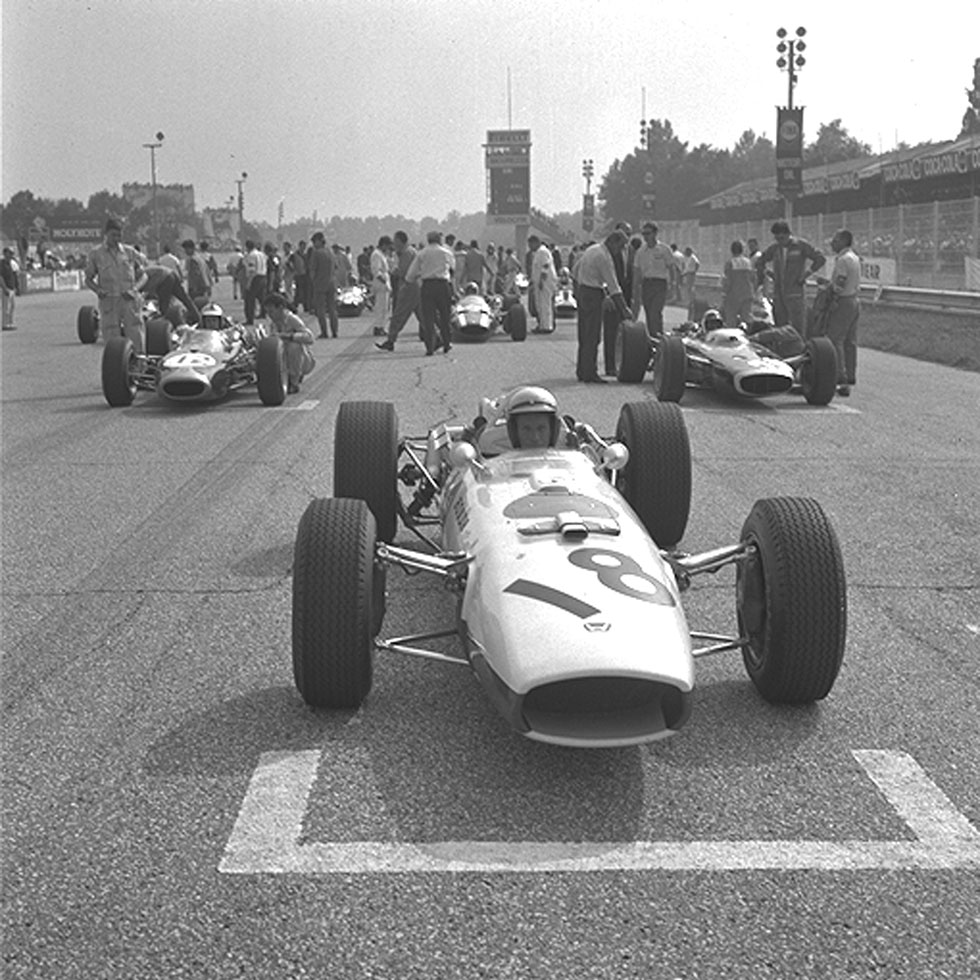
Honda’s new RA273 was finally completed in July. The chassis was redesigned as a full monocoque. While the wheelbase was slightly longer than others at 2510 mm, it was not particularly large. Combined with a new color scheme, it gave a stylish impression. This time, the engine was a longitudinally mounted 4-valve per cylinder 90-degree V12 engine designed primarily by Tadashi Kume, Shoichiro Irimajiri, and Nobuhiko Kawamoto, who boasted it would produce an impressive 400 horsepower, surpassing the competition. However, a major drawback was the car’s overall weight. In Round 7, the Italian Grand Prix, where 14 of the 20 starting cars were powered by 3-liter engines, scrutineering revealed that BRM’s car weighed 695 kg, Cooper-Maserati was 615 kg, Ferrari was 612 kg, Eagle-Weslake was 595 kg, and Brabham Repco was 554 kg. The minimum weight regulation at the time was 500 kg. The Honda RA273, officially listed at 650 kg, was reportedly measured at 743 kg—a full 189 kg heavier than the championship-winning Brabham.
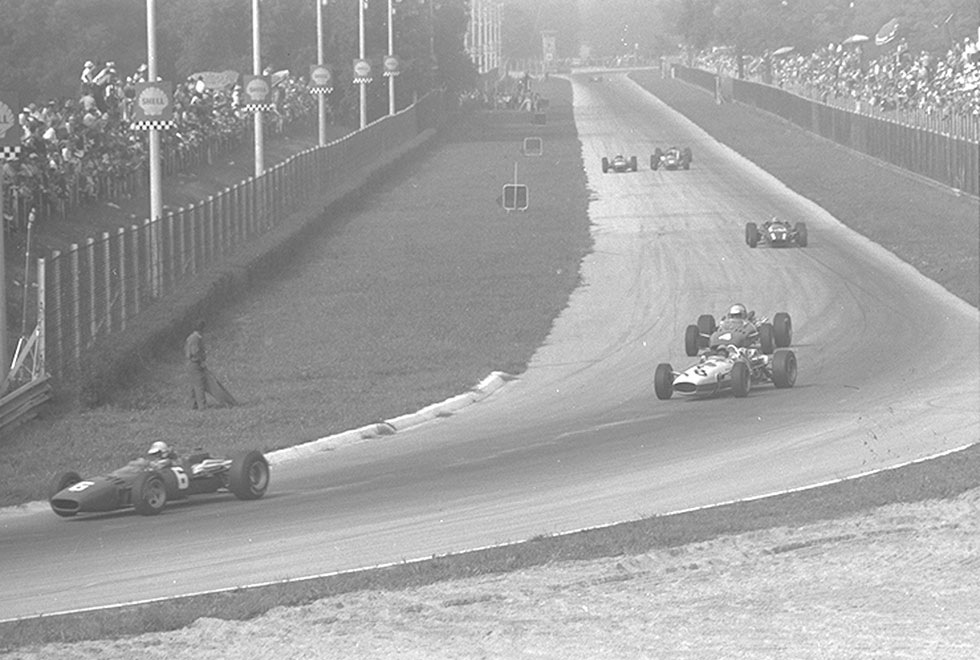
Only one RA273 was completed. After minimal testing at Suzuka in early August, it was airlifted to Italy. Richie Ginther was the sole entrant, qualifying seventh with a time of 1 min 32.40s. This was 1.10 seconds off pole position, which was quite respectable considering the car’s weight. In the race, Ginsberg moved up to fourth at the start and was second by Lap 13. However, the heavyweight car’s tires were unable to withstand the ultra-high-speed Monza circuit, bursting on Lap 18 and causing a major crash. The car sustained damage severe enough to bend the chassis, but Ginther managed to climb out unaided. He escaped with only a broken collarbone, a fortunate outcome in an unfortunate situation.
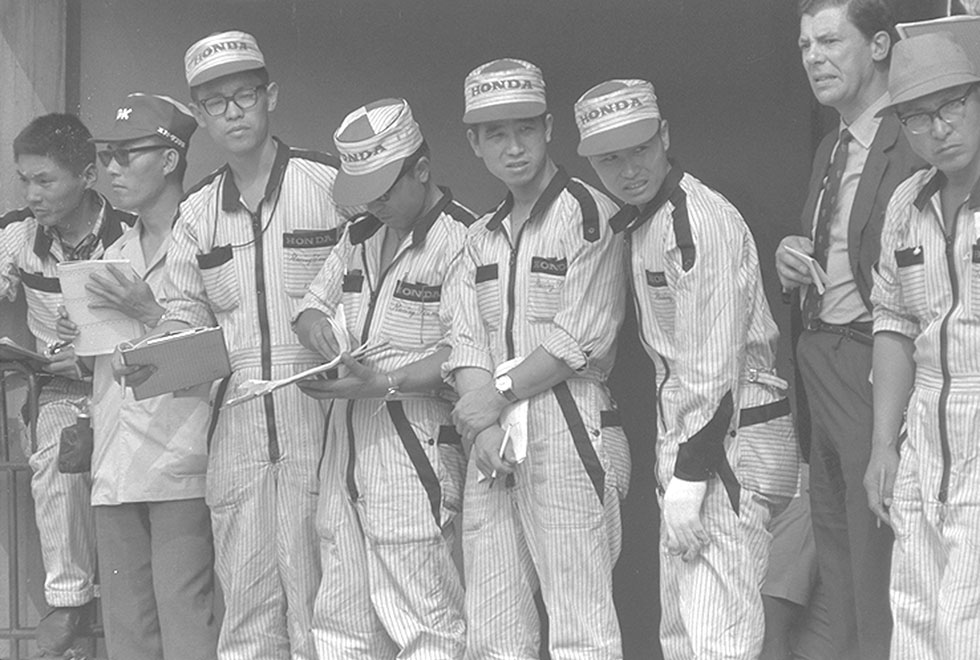
The team entered two cars for the subsequent Round 8, United States GP and the final Round 9, Mexican GP, with Ginther and Ronnie Bucknum driving. In Mexico, Ginther finished 4th and set the fastest lap. 1966 marked the temporary end of Honda R&D’s involvement, which had continued since Honda’s 1964 F1 debut.
 © HRC
© HRC