Striving for the First Victory
June 13, 1965: Round 3, Belgium
First points at a wet Spa
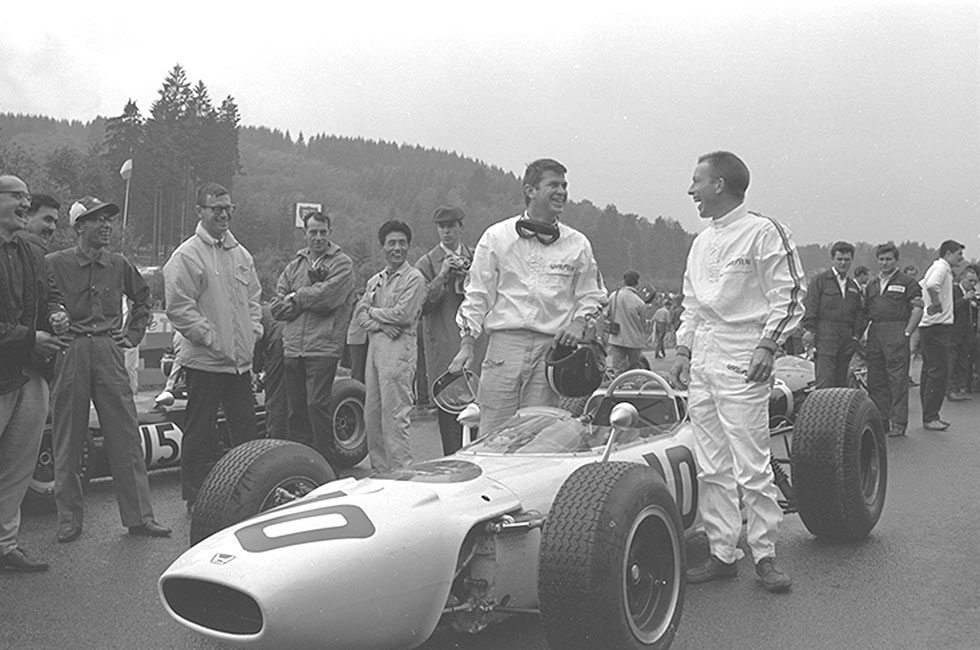 © HRC
© HRCRacing an evolved RA271
Honda’s first F1 points finish came in 1965, in Round 3, Belgium. Finishing sixth and earning one point, Honda had achieved points in its fifth race since debuting at the German GP the previous summer.
For its first full F1 season, Honda competed with the new RA272. Based on the unique transversely-mounted V12-powered RA271 from the previous year, the RA272 featured intricate improvements including suspension modifications (outboard rear suspension springs) and enhanced serviceability. Its driver lineup was strengthened to a two-car team, retaining Ronnie Bucknum from the previous year and adding the experienced American driver Richie Ginther. While Dunlop had effectively held a monopoly on F1 tires for about five years, Goodyear had just entered F1 as a tire supplier. Brabham and Honda were the two teams selecting these new tires. The team principal was changed from Yoshio Nakamura to Hisakazu Sekiguchi (who had served as chief mechanic during the early 1960s, including the Isle of Man TT races and in motorcycle world championship competition).
The team missed the season-opener, the South African Grand Prix (January 1), due to insufficient preparation. Instead, Honda began its1965 campaign at Round 2, Monaco, held at the end of May. It struggled with an unfamiliar street circuit though, resulting in both cars qualifying at the back row of the grid. In the race, Ginsberg broke his driveshaft on the first lap, and Bucknum also retired early due to a gear linkage failure.
Then came Round 3, the Belgian Grand Prix. The venue, Spa-Francorchamps, is a 14.1 km public road circuit set in the Ardennes Forest near the Belgian-German border. It is an historic site where the first Spa 24 Hours Touring Car Race was held in 1924. The word Spa (hot spring), is known to originate from this place. Until the 1970s, the race used the public roads connecting the villages of Francorchamps, Stavelot, and Malmedy. It was, however, deemed too fast and dangerous, leading to a shortened layout in the 1980s that evolved into the current configuration (still measuring 7.004 km per lap). The circuit is often hit by unpredictable rain typical of mountainous regions, known as Spa weather. When it rains, rivers and puddles form everywhere, increasing the danger. And on the day of the 1965 Belgian GP, the weather was indeed rainy.
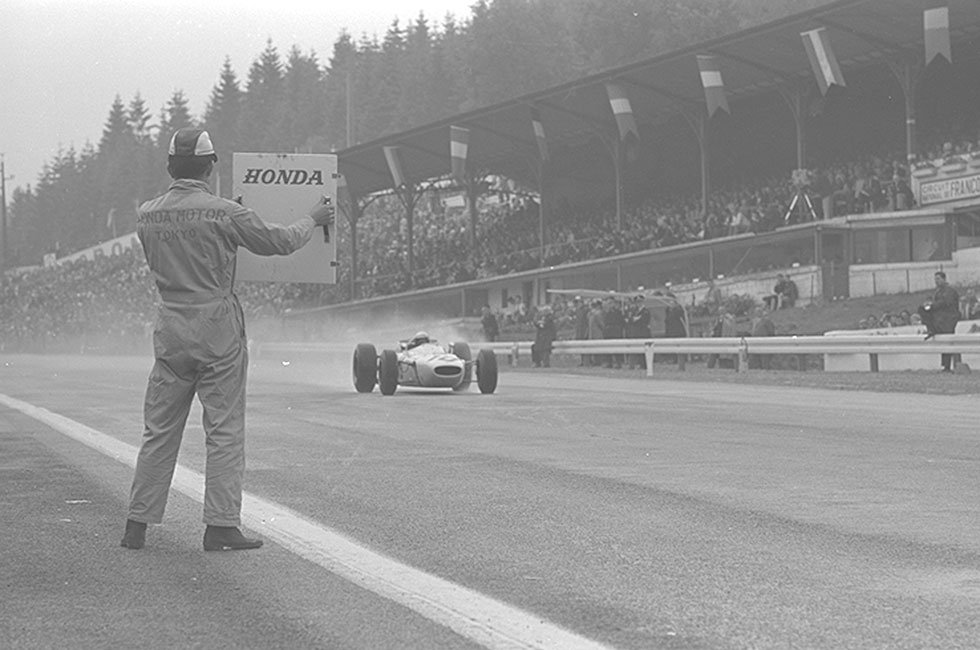 © HRC
© HRCBattle with the top teams results in sixth place
In the cloudy qualifying session, Ginther was 4th (3 min 49.0s) and Bucknum 11th (3 min 52.3s) out of the 20 competing cars, demonstrating their competitiveness. Pole-sitter Graham Hill (BRM) had completed the roughly 14km course in 3 min 45.4s, averaging 225km/h. The starting grid was positioned just before the notorious Eau Rouge turn, midway down the descent after La Source. National flags flew above the pits, including Japan’s.
Pole-sitter Hill led for about half of the opening lap, but Jim Clark (Lotus Climax), who qualified second, overtook Hill and quickly began to pull away. The British Coventry Climax V8 engine, which had been the dominant F1 engine since 1962, was typically a two-valve design, but only Clark’s Lotus was powered by the latest four-valve specification. Clark’s lead over second place stretched to 80 seconds, but he then seemingly controlling his pace, finished 45 seconds ahead after 32 laps. It was a complete solo run, and Clark achieved an impressive fourth consecutive Belgian Grand Prix victory. Second place went to rookie Jackie Stewart (BRM), also from Scotland, who overtook his teammate Hill on Lap 4. This was only Stewart’s third F1 race, and his flawless driving in the Spa rain was impressive. Third place went to Bruce McLaren (Cooper Climax). Hill ultimately finished fifth.
Honda also fought hard. Early in the race, Ginther was fifth behind Clark, Hill, Stewart, and John Surtees (Ferrari). He moved up to fourth after Surtees dropped out on Lap 6, but was overtaken by McLaren on Lap 7 and Jack Brabham (Brabham Climax) on Lap 14, ultimately finishing sixth, one lap down. At the time, points were awarded to the top six finishers. This race marked Honda’s first F1 points finish, earning one point. Meanwhile, Bucknum retired after just nine laps due to a gearbox failure.
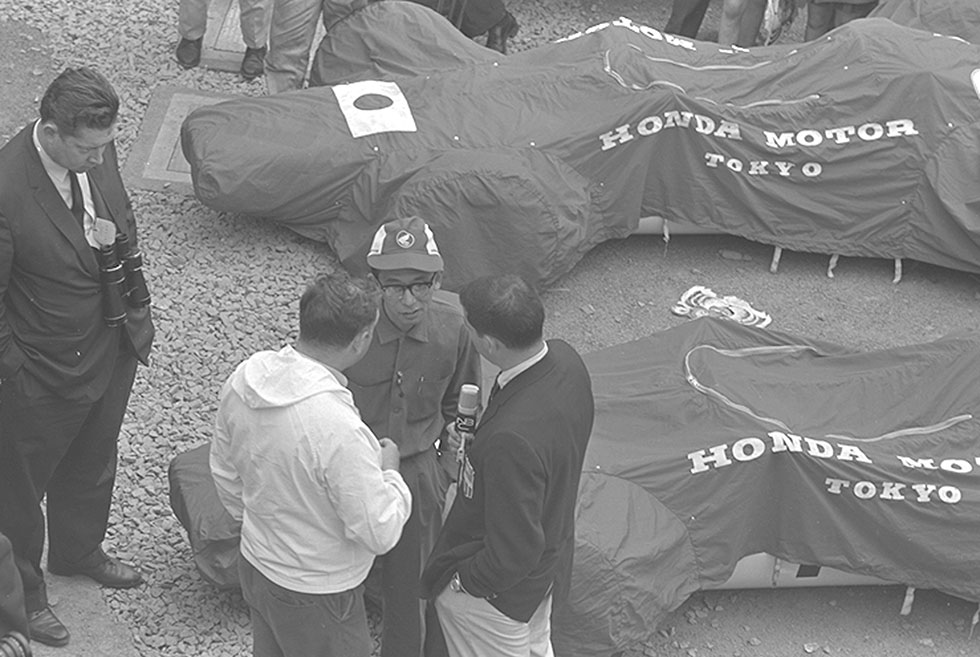 © HRC
© HRCOctober 24, 1965: Round 10, Mexico
Victory Through Determination in the Final 1.5L F1 Race
 © HRC
© HRCMid-season improvements
Honda had finally achieved its first F1 victory. It was a miraculous race as Richie Ginther, driving a modified RA272, led every lap. For Honda, this triumph came just 15 months after its F1 debut, in only its 11th race. While the high-altitude conditions of Mexico City played a part in this triumph, it was Honda’s relentless determination heading into the final race of the 1.5-liter F1 era that secured the victory.
By the midpoint of the 1965 season, a pivotal year for Honda, the team had only two top-six finishes. Consequently, the Honda team skipped the seventh race, the German Grand Prix in August, and undertook a major overhaul of the RA272 back in Japan. They lowered the overall center of gravity by tilting the transversely-mounted V12 engine forward by 20 degrees, completely redesigned the steel tube frame extending from the rear of the monocoque, and streamlined the bodywork. This RA272 (mod) version raced in the final three Grands Prix of the season. At Round 8, the Italian GP and the following round in the U.S. overseen by Hideo Sugiura (Honda R&D Director), the car failed to deliver the expected strong performance. At the United States Grand Prix, attended by President Soichiro Honda, Ginther’s seventh place was the best result achievable.
Then came Round 10, the Mexican Grand Prix, the final race of the 1.5-liter F1 era. The 5-kilometer circuit in Mexico City, the capital, was a relatively new track, having opened in 1962. Located at an altitude of 2,200 meters above sea, the circuit had low atmospheric pressure, making engine tuning difficult. Even established teams had little know-how. For Honda, this was precisely the opportunity it sought.
The championship had already been decided by Round 7, the German Grand Prix, with Jim Clark (Lotus Climax) winning the title. It was his second, following his 1963 victory. Clark again took pole position in qualifying, but his four-valve Climax V8 engine was underperforming, so he switched to a two-valve version for the race. Ferrari’s lead driver, the previous year’s champion John Surtees, was absent due to serious injuries sustained in a sports car race.
 © HRC
© HRCNakamura’s strategy was perfect
Honda entered this final race with Yoshio Nakamura, who had spearheaded the F1 project from its inception, returning as team principal. Though Nakamura had distanced himself from trackside that year (1965) due to corporate directives to focus on production car development, he volunteered to return to break Honda’s prolonged slump. Having been an engineer at Nakajima Aircraft before joining Honda, engine tuning at high altitudes was one of his specialties. The entire team arrived early at the venue. After negotiating with the organizers, they gained permission for the Honda team alone to conduct tests starting two days prior to race week, boosting staff morale. At that time, pre-race testing was possible.
In qualifying, Ginther was 3rd and Ronnie Bucknum 10th. In the race, held under clear skies with no wind, pole-sitter Clark lost speed immediately after the start and was dwarfed by oncoming cars. Meanwhile, Ginther, starting from the second row, surged to the front before the first turn after the long straight. By the end of the first lap, he had already opened up a commanding lead, pulling 180 meters ahead of his closest rival. The battle for second place was initially contested by Mike Spence (Lotus Climax) and Dan Gurney (Brabham Climax), but after Lap 20, Gurney pulled away and began chasing the race leader Ginther. Clark retired after just 8 laps due to engine issues. In Round 6, the Dutch Grand Prix, Ginther and his RA272 (mod) had led early in the race, but his pace dropped, and finished 6th. This time, however, it was completely different.
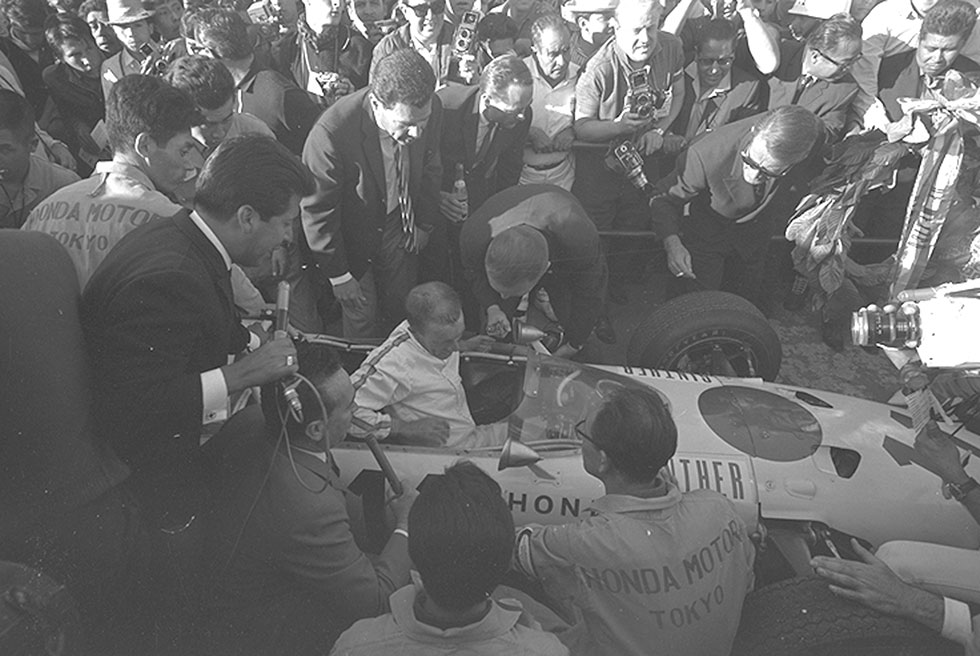
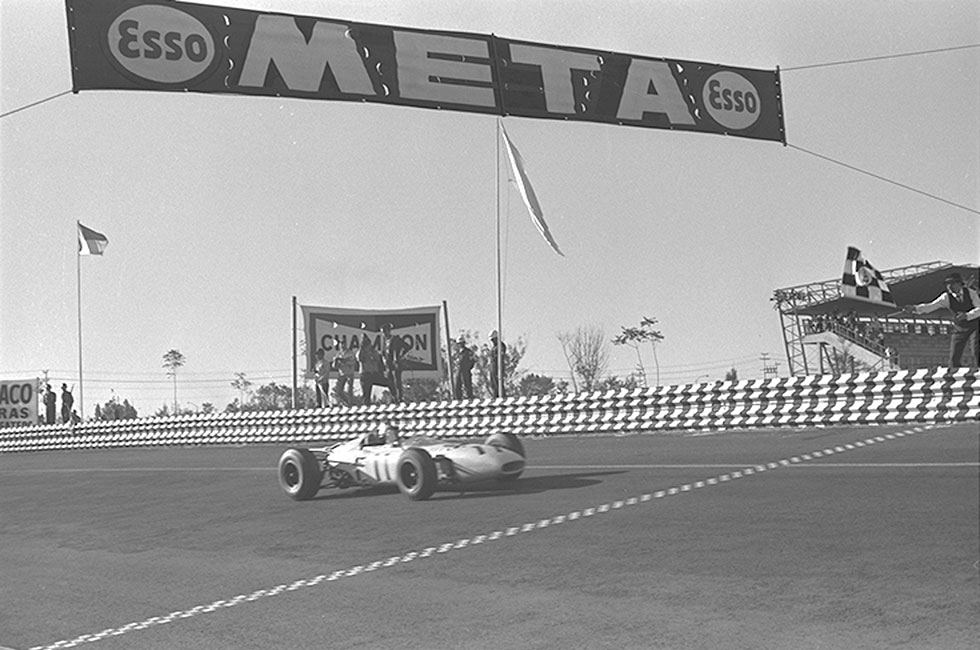
By the midpoint of the 65-lap race, Ginther held the lead, with Gurney trailing 5 seconds behind. At one point, Jack Brabham (Brabham Climax), who had lost significant time during a pit stop, positioned himself in front of Ginther to assist his teammate Gurney. Ginther, however, remained undeterred and passed him. With less than 10 laps remaining, Gurney increased his pace, setting a lap time of 1 min 55.84s on Lap 57 – faster than the fastest qualifying time – and closed in. Ginther responded by also pushing into the 1 min 56s range. Two hours and eight minutes after the start, the checkered flag waved for car number 11, Honda. Only 2.89 seconds later, Gurney crossed the line in second place.
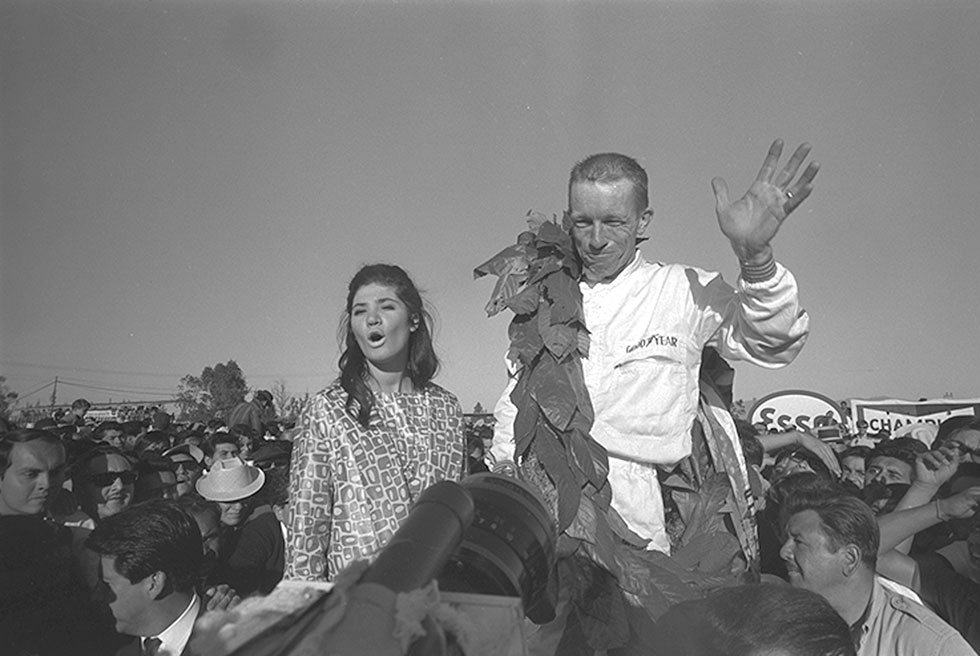
 © HRC
© HRCHonda’s first, major, victory
It was Honda’s first F1 victory, after leading every lap. For Ginther, who had achieved only eight second-place finishes in his four-and-a-half-year F1 career, this win finally ended his “eternal runner-up” jinx.
It was the first F1 victory for Honda, for Ginther, and for Goodyear. The other Honda, driven by Bucknum, also fought hard to finish fifth, securing his first points finish.
Nakamura sent a telegram to Japan reading “Veni Vidi Vici (I came, I saw, I conquered)” – the exact same phrase used by Julius Caesar to report his victory in ancient Rome. In an era without television or the internet, Honda headquarters and the Honda R&D were abuzz with excitement on the following Monday.
In post-World War II Japan, motorization was rapidly advancing during the 20 year period, and personal cars were booming. A last minute decision was made to exhibit the RA272 (mod) at the 12th Tokyo Motor Show held in Harumi. This F1 victory became the catalyst that propelled Honda, renowned as a motorcycle manufacturer, into significant recognition as an automaker as well.