First-Time Challenger in F1
August 2, 1964: Round 6, Germany
Honda’s F1 Challenge Begins at the Nürburgring
Classified 13th Despite Late-Stage Crash
 © HRC
© HRCFirst F1 challenge at the hardest track of all
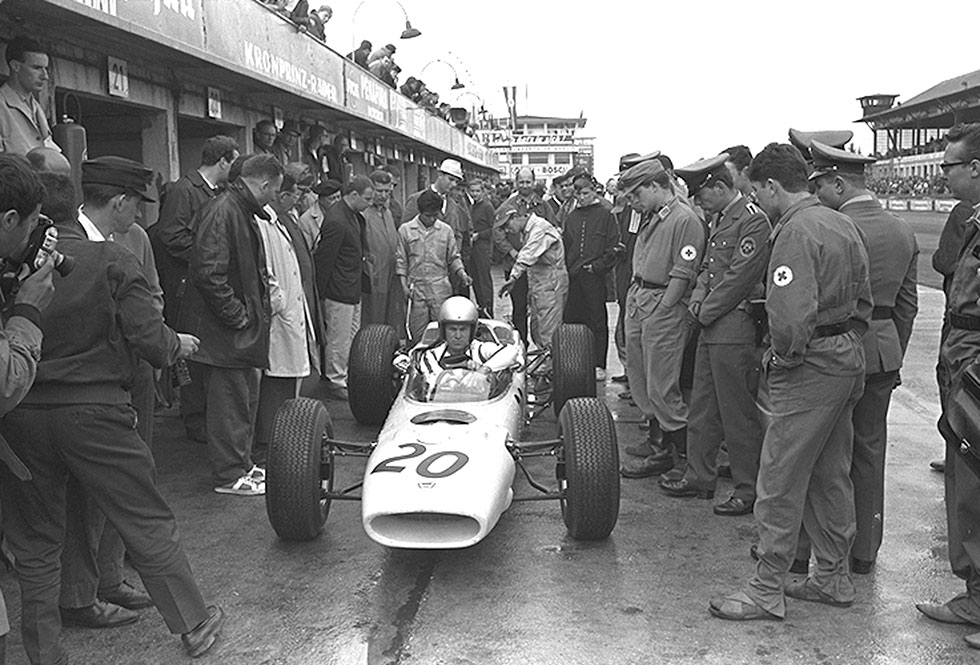
On August 2, 1964, Honda’s, Japan’s, and Asia’s first F1 car made its Grand Prix debut. The track was the notoriously difficult Nürburgring circuit, established in 1927 in the Eifel Mountains of central-western Germany. This mountainous 22.8km track, with numerous elevation changes, is still known as Green Hell, an iconic circuit. It is renowned as a notoriously difficult track, featuring a narrow width with 176 tight turns and jumping spots where all four wheels lift off the ground. There was no harsher place for a first F1 challenge. Yet conversely, no better place to quickly identify and address issues with the car.
The Grand Prix Drivers' Association (GPDA), however, had voiced its concerns about Honda’s participation in the German Grand Prix. They questioned whether it was wise for rookie American driver Ronnie Bucknum, and the untested Honda team, to debut at the Nürburgring. Indeed, danger was ever-present at the time; Dutch driver Count Carel Godin de Beaufort (Porsche) crashed during qualifying and died the day after the race. This concern was resolved when fellow American drivers Dan Gurney, Phil Hill, and Richie Ginther vouched for Bucknum’s capabilities.
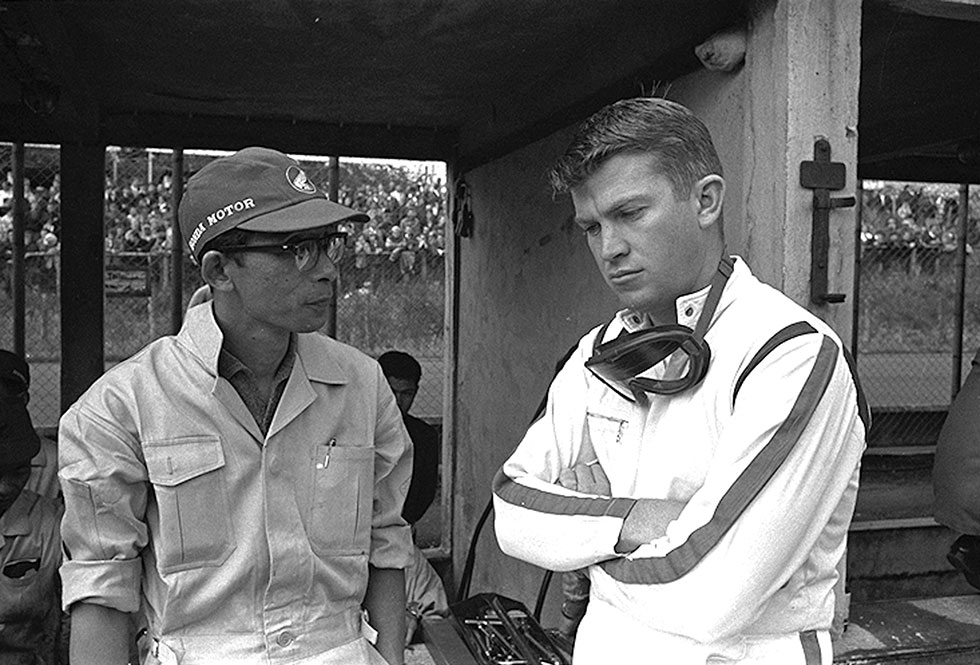
The German Grand Prix was the sixth of ten rounds in the 1964 season. Issued plagued Honda’s debut from qualifying. During the first Friday practice session, carburetor issues limited Bucknum’s best time to 10 min 04.1s. Though he improved to 9 min 34.3s in the afternoon, the car’s oil pan cracked. On Saturday morning, the engine seized just after the session started, forcing Bucknum to stop the car on the side of the track. The car was towed back to the pits after the session. The RA271’s poor serviceability meant swapping in a spare engine required four hours. Honda consequently missed the afternoon session, and with fewer than the mandatory five qualifying laps completed, was disqualified from the race. Honda team principal Yoshio Nakamura negotiated directly with the organizers, arguing that local German hopeful Gerhard Mitter (Lotus) qualified with less than five laps. As a remedial measure, a special session was arranged for Saturday evening, allowing Honda to satisfy the requirements and make its F1 debut.
 © HRC
© HRCFrom last on the grid to 11th
Under slightly overcast skies with a moderate breeze, 22 cars lined up on the 4-3-4 formation starting grid. The debuting Honda RA271 started from the back of the grid, on the far right of the seventh row. While pole-sitter John Surtees (Ferrari) on the far right of the first row qualified with 8 min 38.4s, Bucknum’s time was nearly a full minute slower.
The race was 15 laps. Following the starting straight, the track loops sharply to the right, then after passing the pit straight, plunges into the long and demanding Nordschleife (North Loop). This was an era without TV monitors in the pits. Crews had to wait anxiously, unable to know the situation until the cars returned about 10 minutes later.
In the early stages, Jim Clark (Lotus Climax), Dan Gurney (Brabham Climax), Surtees, and Graham Hill (BRM) formed the leading group, pulling away from fifth place. Just before the end of the first lap, Surtees took the lead in one swift move. Gurney fought desperately to hold his position, but misfortune struck when his engine overheated due to a piece of paper sticking to his front radiator. Clark also retired on lap 7 with engine issues. From there on, Surtees and Ferrari dominated, securing a second consecutive German Grand Prix victory. Hill was second, with Lorenzo Bandini (Ferrari) third.
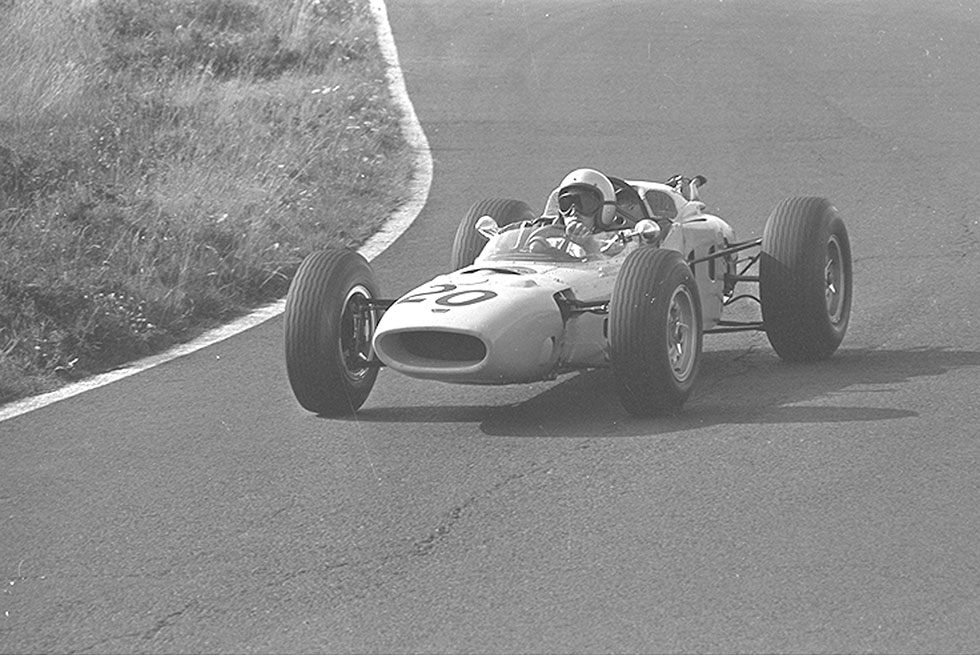
Amidst the drama, Bucknam’s Honda steadily climbed through the field. While many drivers pitted or retired early in the race, Bucknam was 13th after Lap 4, 12th after Lap 7, and 11th after Lap 11. His lap times improved from the 9 min 30s range in laps 3-6 to the 9 min 20s range from Lap 7 onward, with a best lap of 9 min 22.0s on Lap 11. On Lap 12, however, just before the Carousel, he crashed, hitting the embankment and losing both left wheels. Initially thought to be a driving error by Backnum, it was later determined to be caused by steering failure (knuckle arm fatigue). Having completed two-thirds of the race, he was classified as completing the race, making Honda’s debut race a 13th-place result.
 © HRC
© HRCSeptember 6, 1964: Round 8, Italy
Glimpses into the Essence of Honda Power
 © HRC
© HRCEntry with a Rushed Second Car
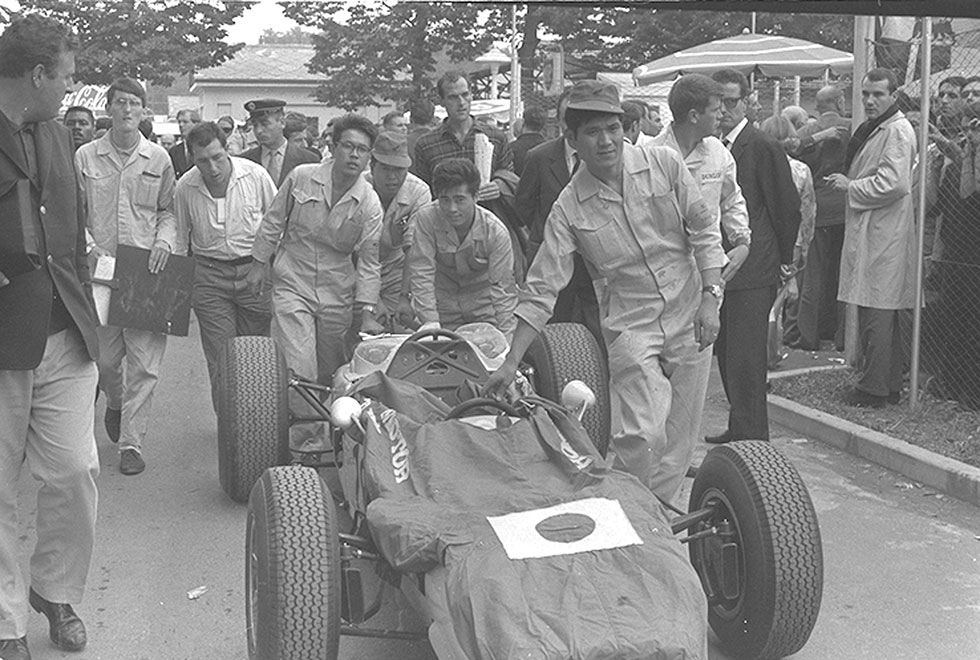
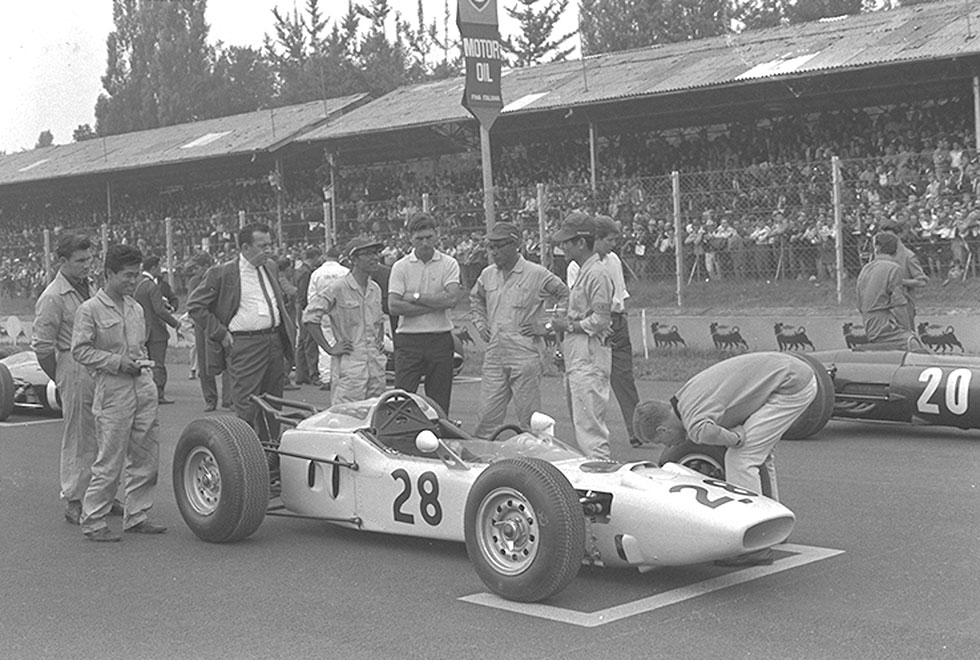
After crashing in its debut race, Honda rushed to build the second RA271 in Japan, aiming for its debut at Round 8, Italy, one month later. It was essentially identical to the first car, but the problematic 12-barrel carburetor was replaced with Honda’s own low-pressure intake manifold with constant injection.
Completing the car took time, delaying its shipment from Tokyo. Further delays with the flight caused Honda to miss the customs clearance deadline at Milan Airport. It seemed impossible to make it in time for qualifying. However, thanks to the customs officer’s leniency, the car arrived at the Monza circuit at midnight, allowing Honda to participate in the Italian GP with not a single moment to spare.
Despite the cruel circumstances, the No.2 RA271 posted strong lap times as soon as it hit the track on Friday, in stark contrast to the previous race. Monza is a high-speed circuit where power reigns supreme. Before the 1970s when a chicane was added, Monza was a flat 5.75km layout consisting solely of straights and high-speed turns. Every year, cars formed groups for slipstream battles. This was especially apparent during the less powerful 1.5-liter F1 era.
In its second race, the RA271 driven by Ronnie Bucknum was 10th in the 25-car qualifying. With 20 cars advancing to the race, Bucknum clocked a 1 min 40.4s lap, 3 seconds behind pole-sitter John Surtees (Ferrari). Qualifying on the second day, Saturday, was in the wet, and had the RA271 arrived at Monza just one day later, it would have faced a wet qualifying session and might have missed out on advancing to the race.
 © HRC
© HRCRecovering to fifth place in the early stages
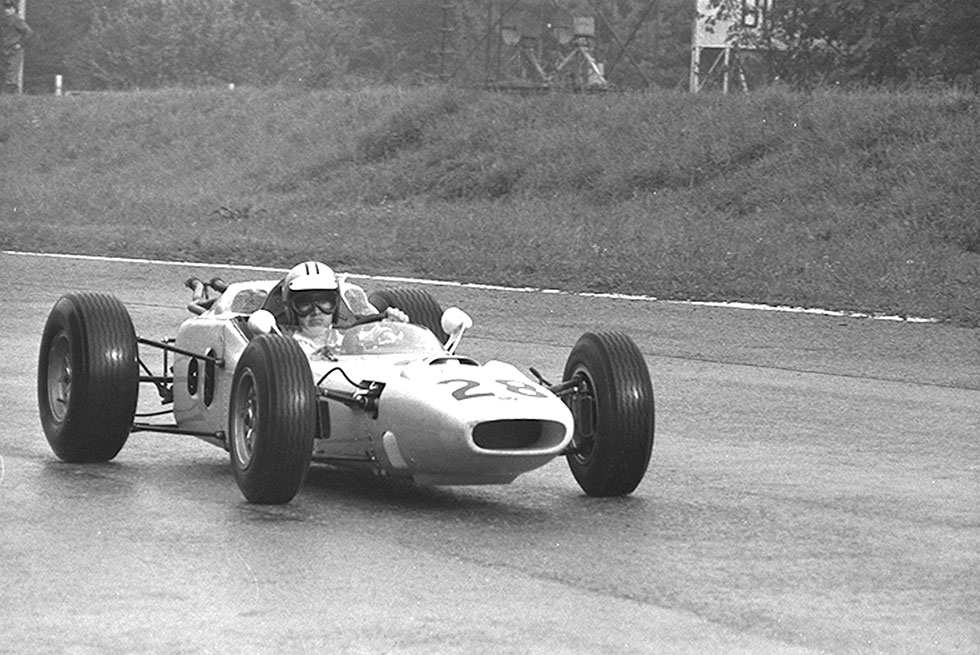
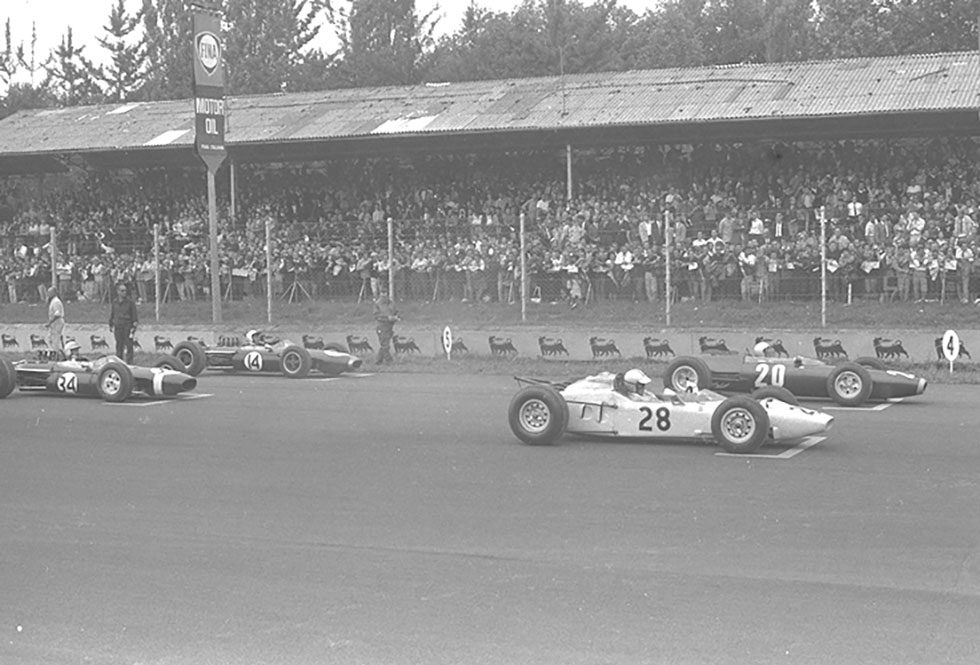
The race was a grueling 78 laps. Honda’s Bucknum dropped nearly to the back of the field at the start but launched a furious charge. According to the lap charts, he was 16th after Lap 2, but climbed to 15th the following lap, 13th on laps 4-5, 12th on laps 6-7, 11th on laps 8-10, 9th on Lap 11, and 7th on Lap 12, in a truly remarkable string of overtakes. Not only did he swiftly catch the second group, but on the straight entering Lap 13, he even passed Jack Brabham (Brabham Climax) and Giancarlo Baghetti (BRM), moving up to 5th place at the front of the second group. His brakes, however, began to fade severely. Unable to hold on, he pitted the following lap. Bucknum could not stop in time and overshot his pit position. Compounding the problem, his engine overheated, ending his race.
The front-runners had no issues, so Honda’s remarkable charge to fifth was attributed to the RA271’s potential, an astonishing feat. It was the result of the team’s instructions being to push as hard as possible, to test the cars limits rather than settle for a finish.
 © HRC
© HRCEveryone noticed Honda’s power
Local hero Surtees of Ferrari had won the race, his second following his German GP victory, propelling him into the championship fight. He would ultimately seize the title at the season finale in Mexico. Bruce McLaren (Cooper Climax) finished second in the series standings, Bandini (Ferrari) third, and Richie Ginther (BRM) fourth, just 0.1 seconds off the podium. When Bucknum had retired from the race, he was actually ahead of both third and fourth place. Ginther, in particular, was deeply impressed by Honda’s performance.
Bucknum's best lap was 1 min 41.5a on Lap 7. Considering the top four cars were posting times in the 1 min 40-41s range at that point, Honda demonstrated nearly matching speed. As it was only the second race for both driver and car, it was truly an astonishing performance. Furthermore, in an era dominated by V8 engines due to the 1.5-liter displacement regulation (though Ferrari did run its newly developed 180-degree V12 engine in qualifying), Honda’s high-revving 60-degree V12 engine produced a uniquely high-pitched sound. This became affectionately known as “Honda Music.”
This race provided the Honda team with a strong sense of accomplishment. However, the following year, 1965, marked the fifth and final year of the 1.5-liter F1 era that had begun in 1961. For Honda, entering F1 with the innovative idea of a transverse-mounted V12 layout, the pressure was on to deliver results quickly.
 © HRC
© HRC