Soichiro Honda, a true racing fan
 © Honda
Honda at the time was a rapidly growing mobility manufacturer celebrating its 16th anniversary. In 1964, the year when the Olympic Games were held in Japan for the first time, Honda’s employees had grown from an estimated 20 at the time of founding to 7,696, thanks to the global success of its Super Cub motorcycle launched in 1958. Honda’s capital had increased from 1 million yen to 9.09 billion yen, and its revenue for the period reached 45.352 billion yen.
While Honda had grown to become the world’s largest motorcycle manufacturer, its automobile production and sales had only begun the previous year, in 1963. At the time, its automobile lineup consisted of only two models: the T360 light truck and the S500 lightweight sports car. While these two models were suitable products for the start of Honda’s automobile portfolio, they were not enough to allow Honda to proudly claim it was a major automaker. Despite this, Honda announced at its 1964 New Year’s press conference that it would debut a Honda F1 car at the Monaco Grand Prix on May 10 of that year.
Despite the announcement, the news of Honda’s F1 debut hardly attracted attention in Japan, as F1 Grand Prix racing as a world championship category of car racing was mostly unknown in the country. As advertising or image enhancement for Honda went, it had no impact. If anything, its primary effect was as an internal promotion to boost the morale of all employees at Honda, which had only recently begun automobile production and sales. While the sudden challenge by Honda at the world’s highest level of racing was an exciting adventure, the obvious question was “Why?” The answer was remarkably simple:
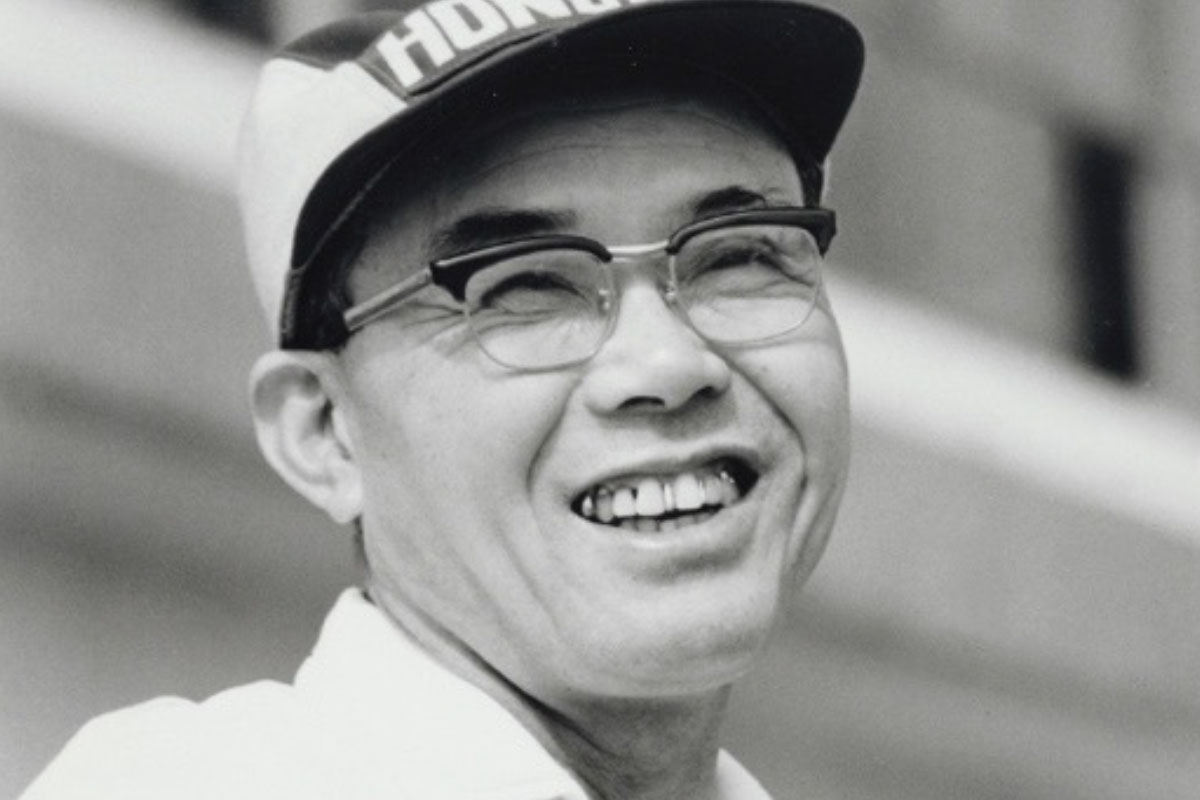
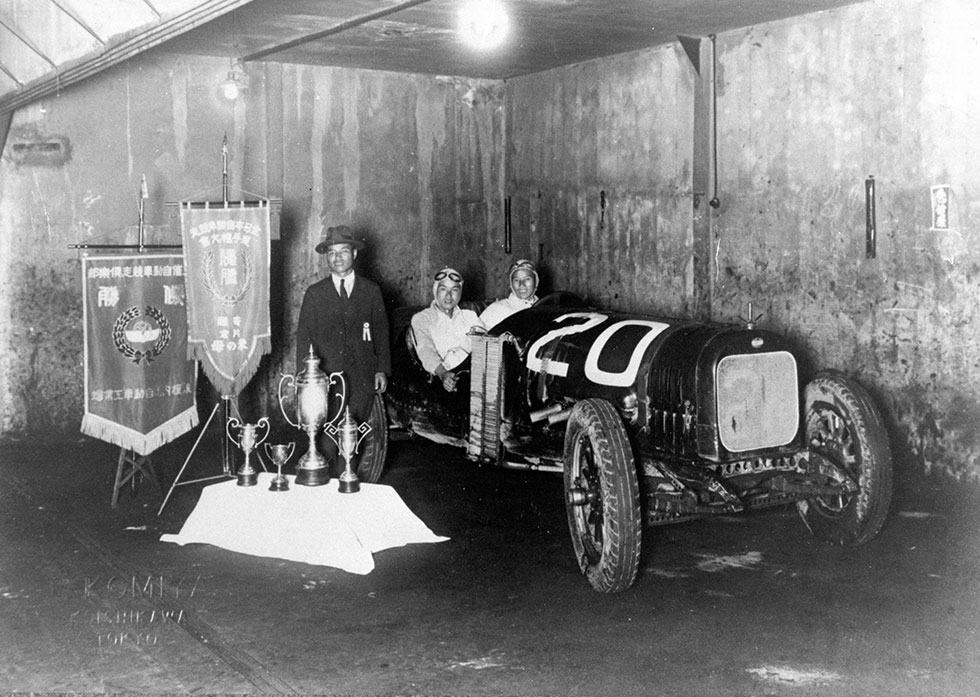
Soichiro Honda was a car racing enthusiast without peer. When considering the connection between Honda and motorsports, this enthusiasm is essential. Soichiro’s passion for racing was deeply ingrained. At age 10, he saw his first car race in his hometown of Hamamatsu. At 16, he began working at an automobile repair shop in Tokyo, which at the time housed Japan’s strongest racing team. There, he was involved in the development of racing cars, competed as a driver and mechanic, and eventually became the owner of his own factory, where he drove his own racing cars.
 © GrageTalk / Daiki Kobayashi
The Curtis, a car manufactured and raced by Soichiro Honda (center) at Art Garage
In the 1930s, before World War II, Japan’s racing scene was thriving, with dedicated racing tracks being built in the Tokyo metropolitan area. As a member of the strongest team at the time, Soichiro was well-versed in racing not only in Japan but also in Europe and the United States. He learned about the European Grand Prix races that would become the precursors to today’s F1 Grand Prix and MotoGP, as well as the 24 Hours of Le Mans and the Indy 500, through Japanese and European car magazines he subscribed to. These were the races he aspired to participate in. Soichiro was a man who had fully experienced the excitement of racing during his youth. So, when he established Honda Motor Co., Ltd. in 1948 in post-war Japan and began manufacturing motorcycles, he enthusiastically participated in Japanese motorcycle racing as if to enjoy his hobby. He even sent riders and machines to international races in Brazil.
 © Honda
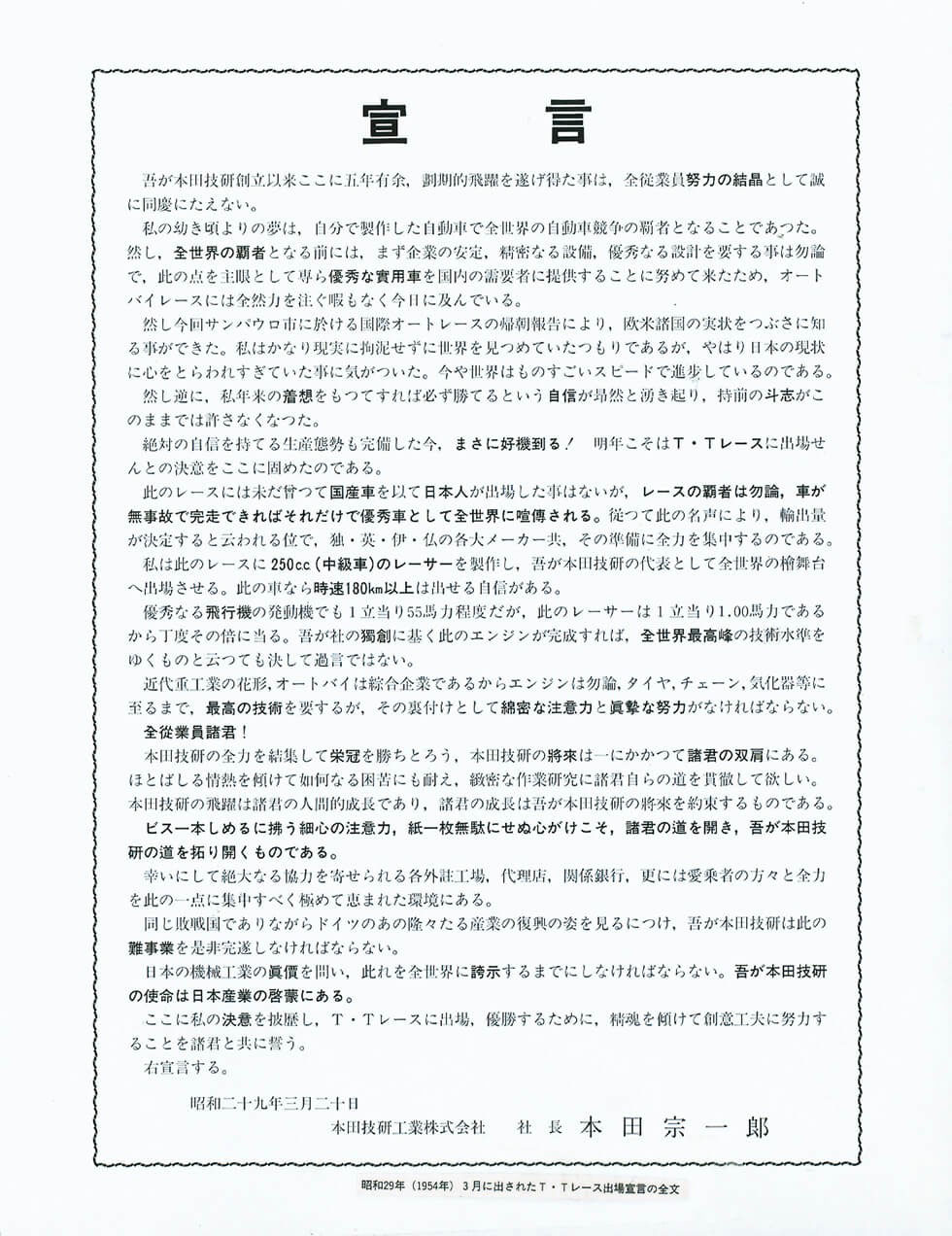
In March 1954, Soichiro declares Honda’s entry into the Isle of Man TT races
To be the world champion in car racing
In 1954, as Honda grew to become Japan’s leading motorcycle manufacturer and set its sights on becoming the world’s best, Soichiro issued a “declaration” marking the start of Honda’s challenge to the world of racing. The opening line reads:
”Since my childhood, my dream has been to become the champion of the world’s automobile races with a machine built by myself.“ This is the only time throughout Soichiro’s life that he “declared” his involvement in racing activities. It was a declaration to enter the World Grand Prix motorcycle series, but it obviously also targeted Formula 1, which was established as a world championship in 1950. (In Japanese at the time, “automobile” referred to both cars and motorcycles.)
Several years before officially announcing that Honda would participate in F1, Soichiro would casually respond to questions from Western media interviews with, “I plan to enter F1.” This was at a time when Honda had not yet begun production or sales of automobiles. While Japanese media had little interest in F1, European and American media were covering it as top news. This was because F1 had become the latest and most popular motorsport in these regions during the 1960s. It was reported as inevitable that Honda, which had been dominating and winning various classes of the World Grand Prix championship, would challenge F1 racing upon the start of its automobile production, and that it was only a matter of time.
Soichiro was fully aware of the international racing landscape and the feelings of racing fans at the time. Knowing that Honda challenged the World Grand Prix after becoming a motorcycle manufacturer, it was only natural that the company would challenge the F1 Grand Prix after becoming an automobile manufacturer. Soichiro wanted Honda to enter F1 Grand Prix racing to meet the expectations of racing fans worldwide, perform brilliantly, and become world champion. The time to realize that dream had finally come. This was the dream that Soichiro, who at 16 had aspired to become the “world champion of automobile racing,” was determined to realize.
 © Honda
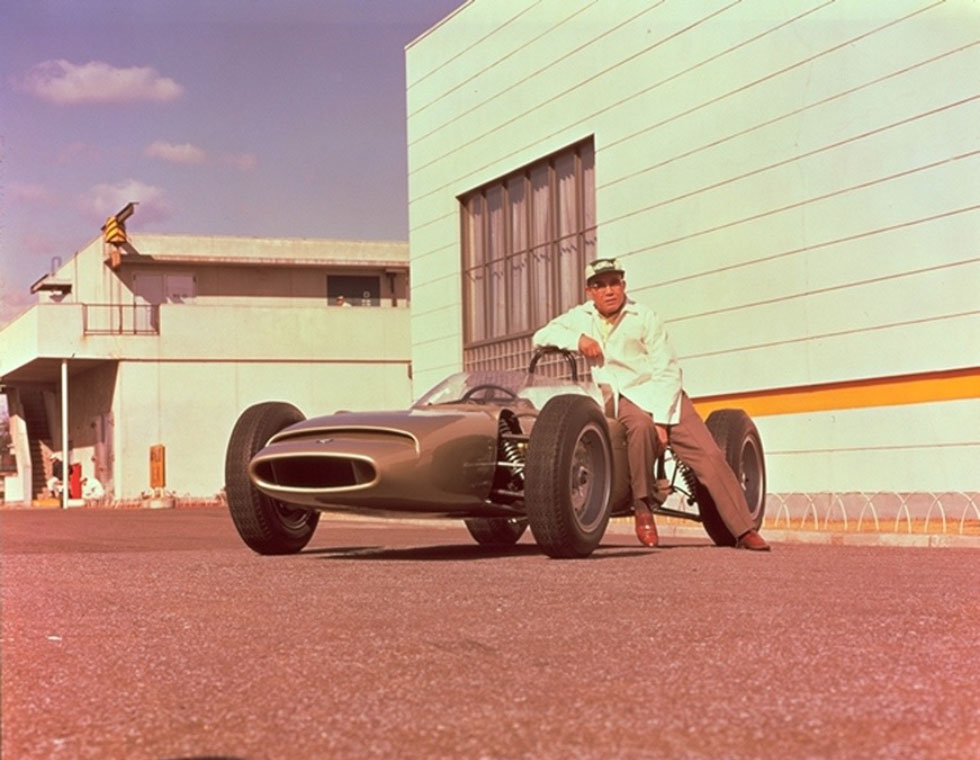
The RA270, Honda’s first F1 car, and Soichiro Honda