Cub Stories
Surprising Popularity in the Shadow of Expected Difficulties
In 1959, one year after the launch of the Super Cub in Japan, The American Honda Motor Company, a local subsidiary fully financed by Honda, was established in Los Angeles. Initially, the company had only eight employees, including the president, and only two were assigned from Honda in Japan. The other six staff members were locally recruited Americans.
However, as Takeo Fujisawa had predicted, American Honda had a difficult start. Honda initially started by exporting the Dream 250 and 305, the Benly 125, and the Honda 50 (C100 Super Cub), but only 170 units sold in the first six months. Americans preferred larger models, such as locally produced Harley-Davidson motorcycles powered by 900cc and 1200cc engines, as well as 650cc Triumphs and other makes imported from the U.K., whereas only a very small minority of avid fans paid any attention to Honda’s motorcycles.
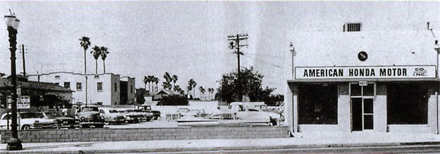
In June 1959, Honda's first overseas subsidiary, American Honda Motor Company, was established on W. Pico Blvd. in Los Angeles.
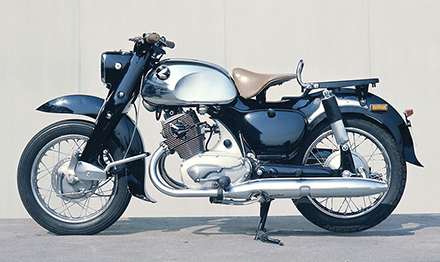
Honda’s top models at the time, including the Dream C75 (305cc), the C70 (250cc; photo) and the C90 (125cc) were exported
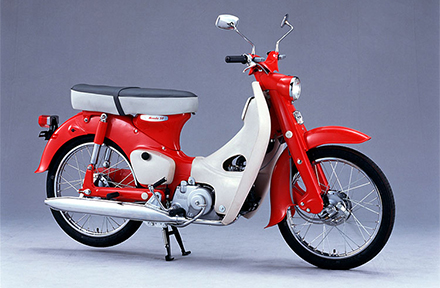
With its bright red and white colors, the CA100's tandem seat and lack of turn signals differed from the Japanese domestic version
One Honda motorcycle, however, grabbed the attention of American consumers. An internal report from American Honda at the time stated:
“Although nobody expected small bikes to sell well in such a large country, the Super Cub, which was added to the lineup as the Honda 50, has been surprisingly well received.”
This report found that one of the Super Cub’s appeal was its ‘toy-like familiarity.’ To Americans, vehicles that would be considered practical daily transportation in Japan appeared more like mobility playthings. America had yet to experience the widespread sale of small and inexpensive motorcycles that anybody could ride.
The differences in approach to lifestyle were also a major surprise. Americans would load the Honda 50 onto pickup trucks or camping cars when they went camping, hunting or fishing, and use it for getting around once they arrived at their destinations, much like a pair of rubber boots or hiking shoes. Many teenagers received the Honda 50 as a Christmas present, while students would buy the Honda 50 for personal mobility using the money they earned from part-time jobs.
At this time in Japan, households that owned a Super Cub were very much in the minority. Not surprising considering that the Super Cub was priced at 55,000 yen while the average starting salary of a company worker was about 8,500 yen per month.
Willy Toshiki, who was a part-time student working at American Honda and later rose to become vice president of Honda’s North American automobile sales department, said:
“The price of a Honda 50 was $295. The rent on the small, old student flat I was living in at the time was $40 per month, and my starting salary when I officially joined American Honda was roughly $500. The success of the Honda 50 meant that American Honda was very busy in those days. Staff shortages were so acute that even president Kihachiro Kawashima had to drive the delivery trucks once in a while.”
American Honda took its first big chance on the Honda 50. It expanded retail channels to include not only conventional motorcycle dealerships but also outdoor outfitters and sports shops. It prepared service manuals and conducted training at the dealers. It built up its parts inventory by flying in parts from Japan. It arranged loans and placed advertisements in newspapers and magazines. It also launched new models with specifications geared more toward hunting and fishing. And in February of 1962 it launched the CA100 export model, which was specially equipped with a tandem seat to comfortably carry a passenger. It even held conventions for dealers in the ballrooms of major hotels that until then had been off-limits to motorcycle manufacturers.
Super Cub Changes the United States
Thanks to these extensive efforts, Honda recorded sales of more than 1,000 units a month in 1961 (three years after its launch), and sold over 40,000 units the following year. The Super Cub was generating a boom in America.
In 1963, Honda launched the colossal ‘Nicest People’ advertising campaign with the catchphrases, “You Meet the Nicest People on a Honda” and “The Nicest Things Happen on a Honda.” The business goal that year was to sell 200,000 Honda 50s.
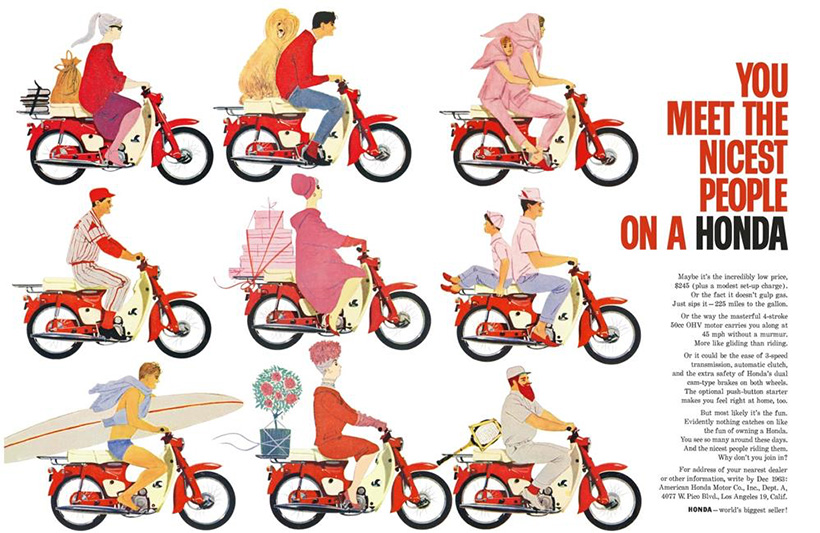
The Super Cub and its ‘Nicest People’ campaign became the driving force in the momentous changes seen in the American motorcycle market of the 1960s
Having established a beachhead in American society with the Honda 50, the aim was to achieve a total breakthrough by lavishly promoting the Honda brand together with the mobility of motorcycles and their ability to make life more fun and convenient.
A range of simple yet amusing color graphics were created illustrating men and women of various ages and lifestyles riding the Honda 50 together with the smartly presented catchphrases. These graphics were carried in America’s most popular graphic magazines of the time, such as Time, Life, Look and the Saturday Evening Post. Until then, it had been assumed that readers of the better known graphic magazines were not interested in motorcycles. However, American Honda didn’t flinch. They believed that by appealing to this class of readers they could raise the social status of motorcycles and generate an affinity for the Honda brand.
In 1964, Honda also launched a TV commercial campaign, and the Honda 50 became something of an American social phenomenon. It was truly experiencing a boom.
Life magazine soon carried a special feature entitled “America Falling in Love With Honda.” This trend-watching magazine, with a weekly circulation of more than 7 million, wrote that Honda motorcycles had brightened up American life and triggered a momentous change in thinking.
Moreover, the internationally popular American west coast surf sounds band, The Beach Boys released the song “Little Honda,” extolling the Honda 50 with the lyrics, “I'm gonna wake you up early, cause I'm gonna take a ride with you. We're goin' down to the Honda shop, I'll tell you what we're gonna do. Put on a ragged sweatshirt, I'll take you anywhere you want me to.” A cover version of the song released by The Hondells became a top-ten single on the American hit charts, and the Super Cub was soon making appearances on TV variety shows.
The ‘Nicest People’ campaign also triggered unexpected events in Japan. The country’s Prime Minister at the time requested a meeting with Soichiro Honda. Apparently the President of the United States had brought up the topic of Honda in diplomatic negotiations, telling Japan’s counterpart that, “Your country’s Honda has completely changed American life.”
The Honda 50—aka the Super Cub—thus clearly demonstrated its astounding potential to create such a major boom in America.
That said, this was a boom in the massive nation of the United States at a time when the country itself was riding a wave of consumerism. Booms are only temporary, and the Honda 50 was not a daily necessity for Americans; moreover, American society was about to undergo a period of major transformation from the late 1960s to the 1970s.
However, American Honda superseded the Honda 50 with the CT90, otherwise known as the Hunter Cub, followed the larger-displacement CT110 in 1980, and offered exceptional mobility on fishing and hunting trips, as well as a work vehicle on large-size farms, etc.
Having gained a foothold in the United States through the Honda 50, Honda began selling sporty on-road and off-road models ranging from 125cc to 750cc. The Honda 50 had played an important role in introducing the joy of motorcycles to the American public. By this time Honda had already launched its Civic automobile in the U.S., so the company had become a manufacturer of both motorcycles and cars, adding even greater enjoyment to people’s lives there.
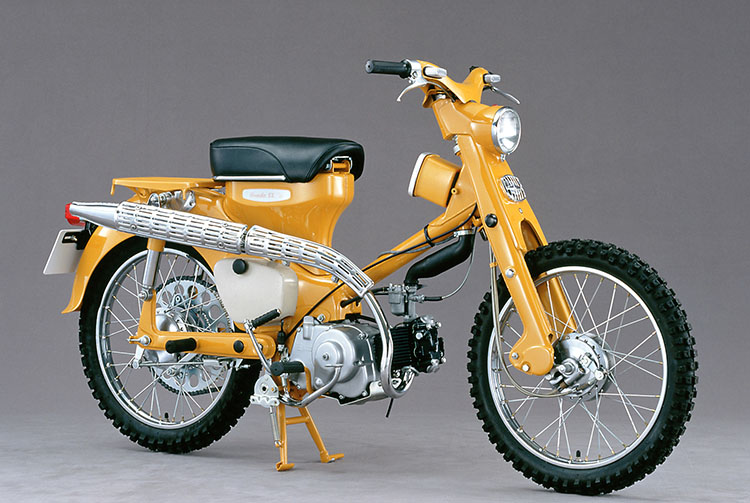
The 1963 C105H: Outfitted with block tires, double sprockets and a raised muffler to enhance its off-road riding performance, this model effectively showed a new side of the Super Cub