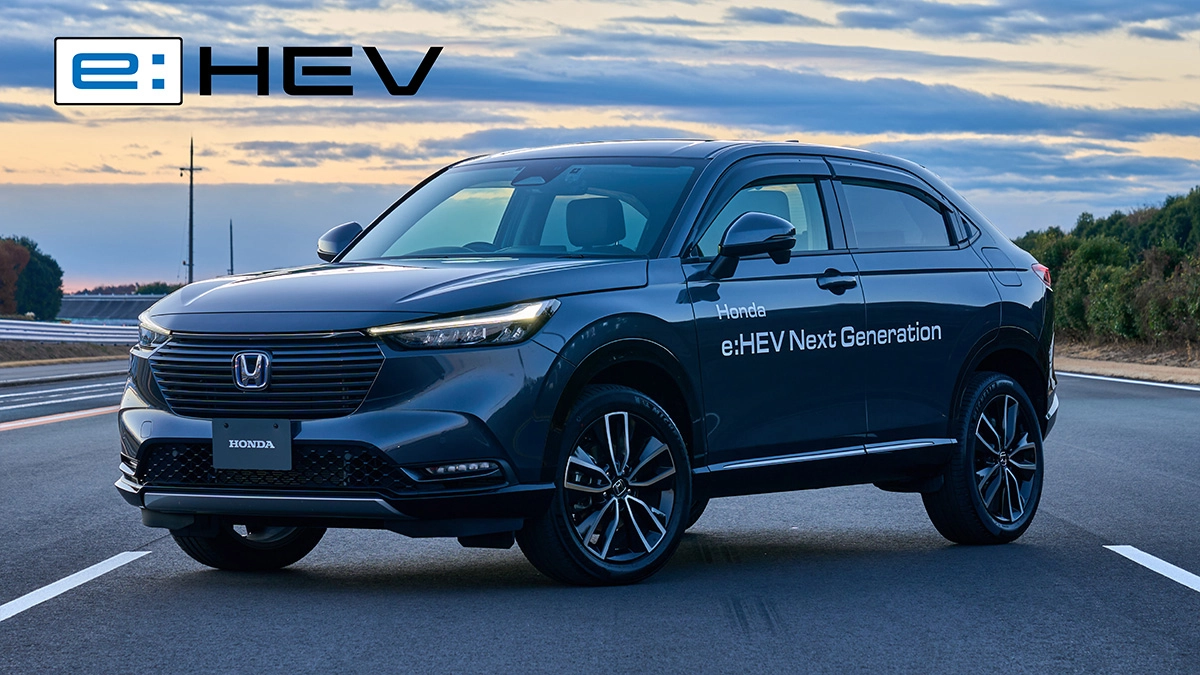
A Completely New Power Unit Control Technology: Honda S+ Shift
In 2025, Honda has added to its proprietary Honda e:HEV hybrid system a completely new power unit control technology: Honda S+ Shift.
While Honda S+ Shift replicates variations in engine speed reminiscent of a spirited manual transmission drive, its true aim goes beyond. Representing the culmination of Honda’s expertise in power unit control, Honda S+ Shift maximizes driver engagement, helping take the joy of driving to an entirely new level.
Driving Fun, The Honda Way
Together with our fundamentally human-centric Man-Maximum, Machine-Minimum philosophy, driving fun has always been at the forefront of the Honda approach to vehicle design, motivating generations of Honda engineers in our endless pursuit of new value creation.
But what exactly is driving fun? It may be a feeling of enhanced capability—achieving what the human body alone cannot. Or the sense of fulfillment when the car responds precisely to the driver’s intent. Researchers have long studied this subject, and recently brain waves are being used to try to quantify it. Yet joy is personal: each individual feels it differently, while of course some may not seek joy in driving at all.
Although the joy of driving may be difficult to define quantitatively, Honda hopes to help each driver discover it in their own way. This is what drives Honda’s ongoing development of new models and technologies.
Honda S+ Shift is a major new milestone in the way hybrid power units can be controlled to enhance the fun of driving electrified vehicles. Combining the tangible sense of acceleration and deceleration of a stepped transmission with precise energy management and shift control tailored to driving conditions, the new system helps create a heightened sense of driver engagement.
A Virtual Stepped Transmission Within the Hybrid System
Honda’s first two-motor hybrid system debuted in the Accord in 2013 and was further popularized in 2020 when it was implemented on the Fit (Jazz) compact car. While public attention focused on powerful hybrid systems being adapted for smaller cars and new engines and motors, a concurrently introduced but often overlooked innovation was implemented at the same time: Honda’s Linear Shift Control power unit control technology.
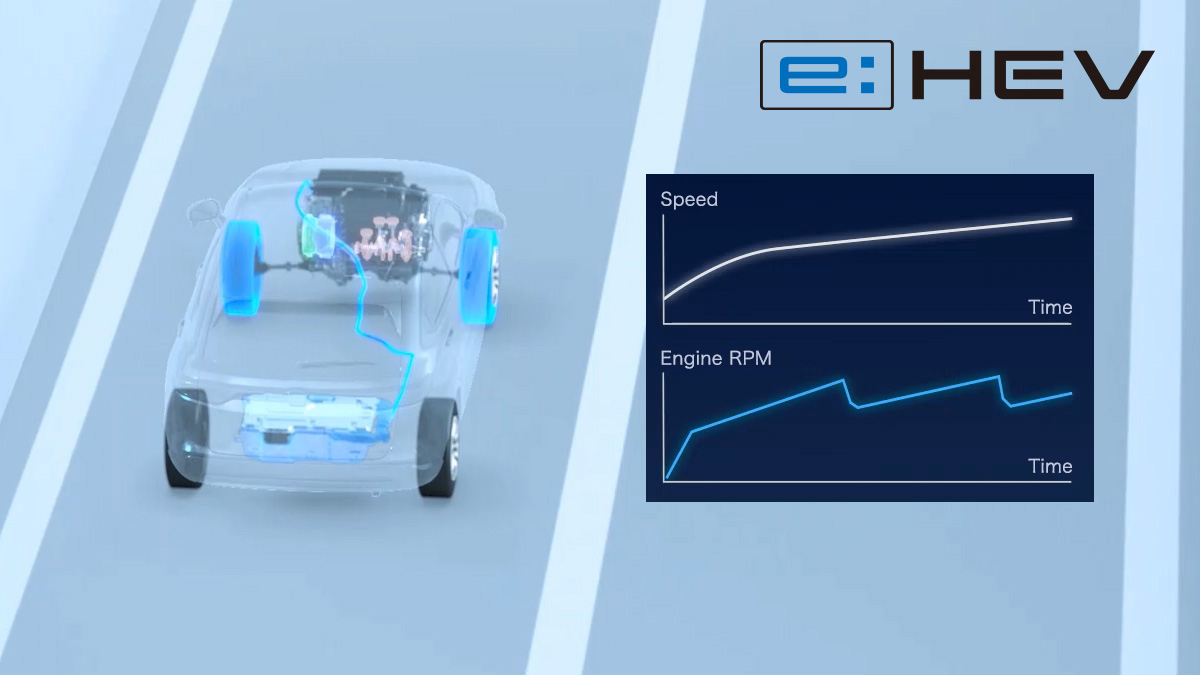
Under acceleration, Linear Shift Control varies engine speed to deliver a rhythmical engine sound replicating gear changes in a stepped transmission and provide an acceleration feel aligned with the driver’s expectations.
In 2022, Honda added Direct Acceleration to the hybrid system on the Civic. By activating engine power generation early, it improves acceleration response and further elevates the joy of driving hybrids.
As Honda refined and expanded the implementation of these control technologies to various models, new potential emerged. Fully leveraging the broader high-efficiency range of its engines, Honda is working determinedly to make driving even more compelling.


Under strong acceleration, Linear Shift Control first increases engine speed to match the driver’s power requirements, then controls engine speed to match the driver’s acceleration expectation. While this linearity between engine speed and acceleration expectation is the key, actual rpm level varies depending on driving conditions.
Honda S+ Shift, on the other hand, was developed based a new idea: creating a virtual stepped transmission within the hybrid system. Emulating stepped gears in controlling engine speed enables staged gear changes not only during acceleration but also during deceleration, thus reproducing the more tangible shift feel of a stepped transmission.
Combining this with existing Honda transmission control technologies like Prosmatec*1 and braking Step-down Shift Control*2 for CVTs endows Honda S+ Shift with smooth, well-timed shifts matching driver inputs. This in turn takes the added value of Honda’s proprietary e:HEV hybrid system to a new level.

*1 Honda’s proprietary progressive shift schedule management technology, first installed on the 1992 Inspire and Vigor.
*2 When the driver applies strong braking force, the CVT ratio is stepped down to secure engine braking force; combined with full-throttle Step-up Shift Control under strong acceleration. First implemented on the 2021 Vezel.
Honda S+ Shift Core Technologies (Step Shift Control and Sports Adaptive Control)
Honda S+ Shift helps vehicle response match driver expectation and input using two core technologies: Step Shift Control, which reproduces the crisp gear changes of a stepped transmission during acceleration/deceleration, and Sports Adaptive Control, which manages power delivery and gear shift schedules in accordance with driver input and driving conditions.

Step Shift Control
Step Shift Control varies both engine speed and drive force in steps, not only during acceleration but also in deceleration, reproducing the crisp shift feel of a stepped transmission.
Upshift Control
During an upshift, the generator motor is put in regeneration mode to increase friction against the engine, facilitating rapid decrease in engine speed. At the same time, the drive motor’s output is temporarily reduced. Together, these effects reproduce the distinct feel of an upshift in a stepped transmission, providing clear feedback to the driver’s acceleration input.

Downshift Control
When shifting to a lower gear, the generator motor’s electric power generation is temporarily adjusted to sharply raise engine speed, simulating engine blipping. In certain driving situations, the drive motor’s output is briefly reduced, reproducing the downshift feel of a stepped transmission.

Sports Adaptive Control
Sports Adaptive Control evaluates driving conditions based on driver inputs, longitudinal/lateral G forces and road gradient to determine optimum gear selection. It enables earlier downshifts and gear holds as required, allowing the engine to maintain higher rpm during cornering and ensuring strong acceleration response when exiting a curve.

Early Downshift Control
In response to the driver’s braking action, Early Downshift Control initiates an early virtual downshift to increase engine rpm. The generator motor harvests the resulting increased engine output, charging the battery in preparation for re-acceleration.
Cornering Hold Control
During cornering acceleration, the system proactively adjusts upshift timing in response to increasing cornering force. By holding virtual gears, it enhances the linearity between engine sound and throttle input, deepening the driver’s sense of unity with the vehicle. Maintaining high engine rpm ensures sharp acceleration response when exiting corners.
Control Logic and Flow
The control logic of Honda S+ Shift was developed by drawing on Honda’s extensive expertise in human-centric stepped transmissions, cultivated through the development of systems like the 9-speed dual-clutch transmission (DCT) of the second-generation NSX and 10-speed automatic transmission for the North American market. Honda S+ Shift provides the freedom to set the number of virtual gears and their respective gear ratios freely. It can also work in coordination with other vehicle functions. Honda S+ Shift can thus be optimized for application in various future models.
When switched on, Honda S+ Shift evaluates driver accelerator and brake inputs, vehicle speed, lateral G force, and road gradient, selecting the virtual gear that delivers the drive force the driver demands. Engine speed is governed by vehicle speed and the selected virtual gear, ensuring smooth, harmonious operation with Step Shift Control and other control functions.
Honda engines’ high efficiency over a broad operating window allows Sports Adaptive Control to more freely adjust target power generation and engine torque delivery in response to driving situations and battery state-of-charge.
Through this array of finely tuned control systems, we have been able to take the joy of driving to a new level while realizing the outstanding environmental performance of e:HEV.
Tuning the Entire Vehicle’s Driving Experience
Honda S+ Shift delivers ideally timed, exhilarating virtual gear shifts that seem to read the driver’s mind. Its appeal is further enhanced when cooperatively controlled together with other Honda technologies.
For example, together with the Active Sound Control system, it can provide an even more powerful engine sound inside the cabin. And when paired with the Drive Mode switch, it tunes the driving experience—from excitement in Sport mode to quiet refinement in Comfort mode, and more.
Honda S+ Shift is not only a unique-to-Honda power unit control technology, but also a core technology that helps tune the entire vehicle’s driving experience.
PRELUDE Equipped with Honda S+ Shift
Note: This information may be updated as details become available.
In the Prelude, the first model to feature Honda S+ Shift, paddle shifters enable a DCT-like shift experience. Coordinated with the meter display and Active Sound Control, Honda S+ Shift stimulates the driver’s senses, enhancing the driving experience. As a true specialty hybrid sports model, Prelude is all about maximizing the joy of driving.


Eight Virtual Gears, Like in F1
A virtual gearbox, Honda S+ Shift provides the freedom to set the number of virtual gears and their respective gear ratios freely. For the Prelude, the objective was to achieve an exhilarating shift feel. This led to eight virtual gears to best match the characteristics of the 2.0-liter hybrid system the system is paired with. The result is a pleasing sense of flow as each virtual gear passes on power to the next. The top 8th gear adopts almost the same overall ratio as when the engine directly powers the driven wheels, for a smooth, almost seamless transition from Hybrid mode to Engine mode and vice versa.

Paddle Shifters to Maximize the Joy of Sporty Driving
In the Prelude, the paddles―which in e:HEV models until now served to select preferred regenerative braking settings―double as gear shift paddle shifters. This is a first for a Honda e:HEV model. With Honda S+ Shift deactivated, the paddles allow the driver to select from a number of regenerative braking levels. When Honda S+ Shift is activated, the paddles function as paddle shifters, letting the driver shift gears virtually without taking hands off the steering wheel.

Selectable Across All Drive Modes
The Prelude features three predetermined drive modes—Sport, GT, and Comfort—along with an Individual mode that lets drivers register their preferred combination of settings. Honda S+ Shift can be selected in any of these modes. In Sport mode, the system amplifies the excitement of spirited driving. In Comfort mode, it adds a touch of power to the soothing atmosphere created by reduced engine speeds for a more refined and user-friendly drive.
Comparison of PRELUDE Drive Modes with Honda S+ Shift On and Off

Exclusive Digital Meter Cluster Design: Visually Enhancing the Driving Experience
Prelude boasts an exclusive digital meter cluster designed to visually enhance the driving experience. When Honda S+ Shift is activated, the Power Meter turns into a tachometer to visually convey changing engine speeds. When the paddle shifters are operated, the appropriate upshift/downshift guidance mark is illuminated, visually confirming at the same time that the paddles are in paddle-shift mode. The currently selected virtual gear number is also prominently displayed. The meter cluster also changes color according to the selected drive mode.

Active Sound Control: Adding Another Layer to the Driving Experience
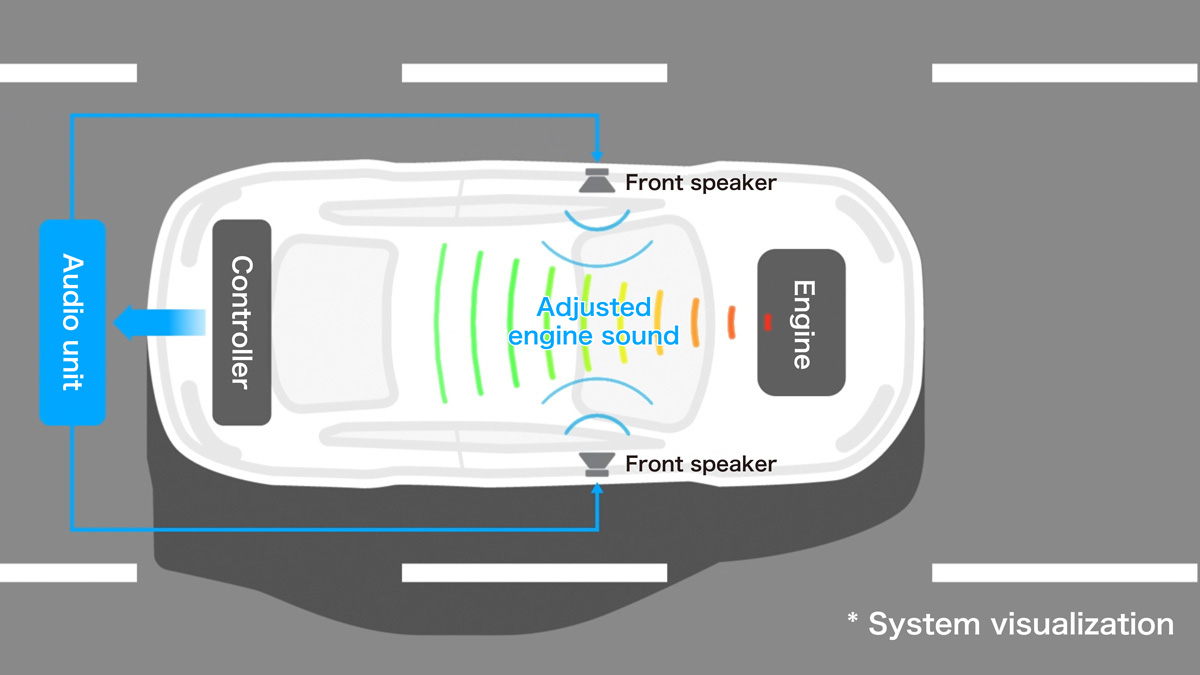
Active Sound Control plays sound synchronized with engine speed through speakers inside the cabin to further enhance engine sound quality. To maximize the appeal of Honda S+ Shift, Prelude’s Active Sound Control starts from lower rpms than before, further emphasizing the engine’s presence. This unique engine sound tuning over an extended range of engine speeds adds another layer to the driving experience.
Blipping sound
During downshifts, a sharp, quickly curtailed blipping sound replicating exact engine rev matching is emitted to emphasize engine responsiveness. Sound quality and front–rear speaker sound pressure balance are finely tuned for a truly realistic blipping sound.
Careful sound tuning
To deliver a distortion-free, pleasant sound, noise cleaning is performed before engine sound is meticulously tuned at each stage of the engine speed range. At lower engine speeds, the second-order sound component of the exhaust note is emphasized to create a powerful engine sound. At medium engine speeds, harmonic components linearly matching changes in engine sound frequency and sound pressure are instantly added in response to accelerator input, creating a sense of lightness. At higher engine speeds, a clear sound layered with overlapping harmonics heightens the engine’s free-revving feel. Near the red zone, a seventh-harmonic sound component is added to enhance the excitement of driving at the limit.