Idling Stop Does More than Reducing Pollution and Improving Fuel Efficiency
Idling Stop - a familiar function already found in many cars today. However, currently only Honda equips its scooters with this unique and useful function.
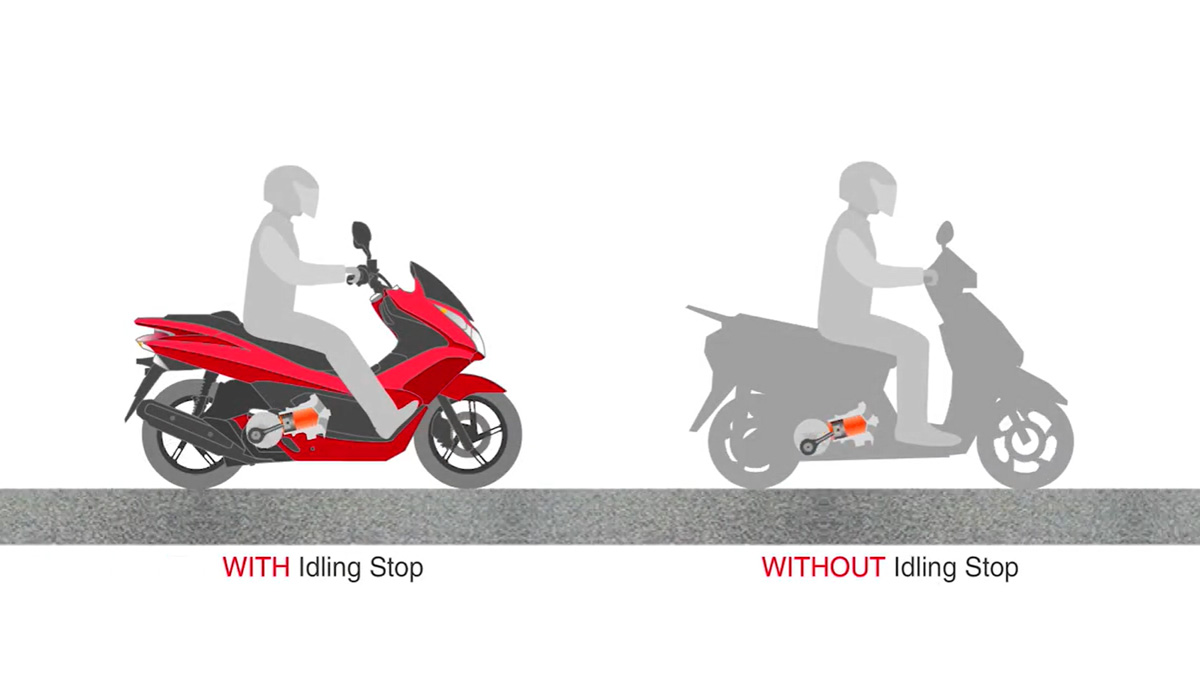
With this system, whenever a vehicle comes to a physical stop for a fixed length of time, such as when waiting for a traffic light, its engine automatically shuts off, thereby reducing fuel consumption and emissions of carbon dioxide, carbon monoxide and hydrocarbons during that time to effectively "zero." In other words, Idling Stop is friendly to both the environment and one's pocketbook.
However, Idling Stop offers even greater advantages, which further add to a rider's sense of excitement and exhilaration.
Idling Stop - Examining its effects and the sense of excitement it offers
Idling Stop - It doesn't just affect fuel economy and the environment. Let me tell you about the exhilaration you'll feel the instant you give it a try.
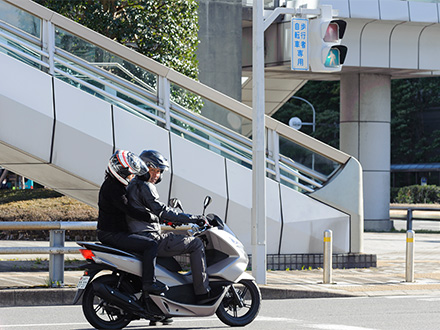
One day, motorcycle journalist Tsutomu Matsui went shopping with his wife aboard a new Honda PCX150 scooter. Each time they stopped at a red light, the scooter's Idling Stop function kicked in and turned off the engine.
Spotting a puppy crossing the street in the crosswalk, his wife commented "Isn't he cute? Look at the way he wags his tail!" - and from there lively conversation began to flourish.
It was at this moment that Matsui really began to notice the wider effects achieved by Idling Stop, from its environmentally friendly aspects of reduced pollution and fuel consumption to more unexpected features.
One day a while back, I decided to take the PCX150 out for a ride with a passenger onboard. One reason was that I wanted to see how the bigger version of the popular PCX (125cc) would behave. There wasn't any need to travel far. Once I get out on city streets, I quickly get a clear understanding of a bike's feel, including its acceleration, braking and riding comfort. So, I told my wife that I'd be taking her shopping without revealing the real reason for the trip.
Within a few minutes after leaving home, we stopped for a red light, and the scooter's Idling Stop function instantly switched into operation, turning off the engine. And at just that moment, the attention of these two animal lovers latched onto a small dog walking along the sidewalk nearby. We could distinctly hear his nails scratching the pavement as the dog sniffed around and 'greeted' a tree. Then the grass growing around its base made him sneeze. The daily life of this dog was communicated to us in both form and sound. "Isn't he cute? Look at the way he wags his tail!"
After this, a natural stream of conversation continued, making this couple's time together seem all the more worthwhile. However, a new question soon arose: What made our conversation so lively in the midst of the hustle and bustle of the city?
I know it's a bad habit of mine, but I really wanted to find an answer to that question, especially since it's part of my job. So, while my wife was doing her shopping, I continued working on analyzing the situation, and abruptly discovered the answer I was looking for. This was all a side-effect of the PCX's Idling Stop!
Idling Stop - Already a popular function in many cars, its effects are a significant reduction in fuel consumption as well as reductions in emissions of carbon dioxide, carbon monoxide and hydrocarbons to virtually zero. This is achieved by automatically stopping the engine when the vehicle stops for longer than a specified period of time, such as for traffic lights or train crossings, etc. To put it in simple terms, Idling Stop is friendly to both the earth and the pocketbook. In fact, many recent car models come equipped with this function. However, at present, only Honda produces scooters with Idling Stop installed.
About 20 years ago, while travelling in Germany and Switzerland on assignment, I had my first experience with a form of Idling Stop. At traffic lights, it seemed that everybody would simultaneously turn off their engines, and then restart them again when the light turned green. I distinctly recall feeling a sense of admiration for their conscientiousness about the environment, and I also felt as if I was doing something wrong if I didn't follow suit and stop my own engine.
When I asked about this, the person guiding me through the city answered, "This is the general rule of behavior when driving." In this way no exhaust gases are discharged while stopped for a red light, thus reducing both harmful emissions and fuel consumption. I thought this was a good idea and, as I'm one of those people who's easily influenced by something new, I decided to continue turning off my engine even after returning to Japan.
I dutifully stopped the engine at each red light. However, in those days people who physically stopped their cars from idling belonged to a distinct minority in Japan. So of course passengers would be surprised to see me stop the engine, and would ask, "Why do you keep stopping the engine? The amount of gasoline you save is not worth the bother." I replied that on a visit to Europe I was impressed by the efforts people made to stop engine idling, and so I was doing the same. This was really more about saving the air.
My passenger looked at me with a face of total bewilderment. She tried to force a smile so I wouldn't notice her effort to stifle herself from saying what was really on her mind, which was, "You're strange…" After this, as it grew more troublesome trying to explain my reasoning, I began to limit my personal "Idle-Stopping" to only when I was driving alone. However, I continued to try to stop idling whenever I was riding a bike.
In Tokyo, where I'd frequently have to repeat the cycle of stopping and restarting due to heavy traffic, the effort involved in Idling Stop operations soon became difficult. I did my best in the hopes of doing some small good for the environment, but it required a lot of concentration on the timing of my restarts so I wouldn't become an annoyance to other drivers, and that got to be more and more stressful. Therefore, the number of times I stopped my engine's idling gradually decreased, and I eventually gave up altogether. I soon found it very hard to carry on by sheer force of will alone.
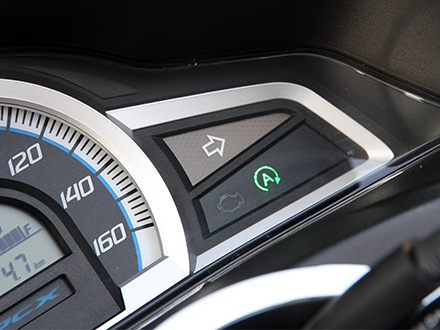
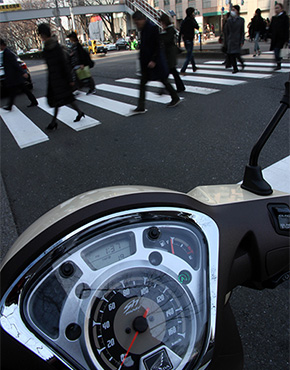
The green 'A' warning light on the instrument panel
indicates when Idling Stop is in operation.
Because of this personal experience, I found the Idling Stop function built into the PCX to be really superb. I no longer have to explain it to other people, and the scooter performs the process of protecting the environment and saving fuel automatically.
Now, allow me to briefly explain what it is about Honda's Idling Stop feature that I find so excellent.
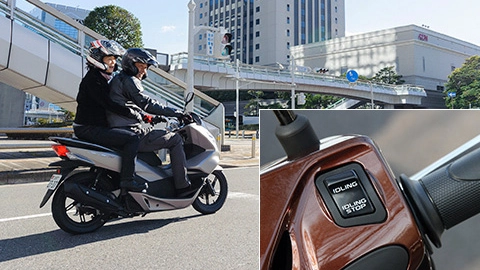
First, operation is as easy as it can be. The only thing I physically need to do to turn it on is flip a small switch on the handlebar. Everything else is the same as normal. As the temperature of the engine's coolant rises and the engine is determined to be fully warmed up, the Idling Stop function automatically switches into operation whenever the vehicle is stopped and waiting for a signal to change.
The function is designed to automatically start working after a specified time interval (of only a few short seconds) after the bike stops, taking into consideration other cases where the bike might stop temporarily, such as at stop signs, or when making a U-turn after a stop. This exacting time interval is absolutely exquisite.
When the throttle is turned with the right hand, as one normally does when accelerating from a green light, or when the cars ahead start moving, the sensor instantly detects this minute operation and the engine restarts like magic, allowing the bike to quickly begin to move. Any sense of delay has been completely eliminated from the PCX's Idling Stop function, making it totally stress-free.
This engine restart at the very instant the throttle is turned offers one more big feature: It's not accompanied by the usual cranking sound of a starter motor. In fact, the engine seems to restart without any sound at all, which makes it amazingly comfortable to use at every stop.
This silent starting was achieved by incorporating an original Honda-developed technology that uses the AC generator (or ACG, which is normally turned by the engine) as the starter motor, thus eliminating the need to turn over the engine via a separate motor and gears, etc. Instead, the engine starts by utilizing the magnetic characteristics of the ACG to rotate the motor with no mechanical parts coming into contact, thus no cranking sound is heard when the engine is started.
Somewhere in the back of every rider's mind rises a quiet prayer that the engine catches whenever the sound of a starter motor is heard. The lack of any such cranking sound liberates one from that anxiety, and makes this the second reason why Honda's Idling Stop restarts are stress free
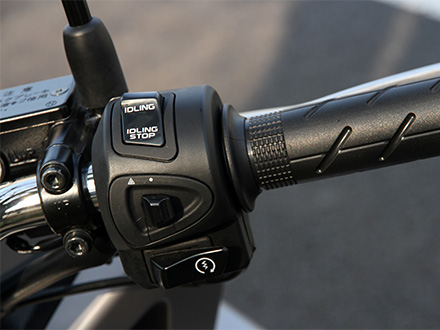
The 'IDLING STOP' switch prominently
positioned on the right-side handlebar allows
the function to be manually turned ON or OFF.
In other words, the Idling Stop function featured in Honda's scooters-which includes the PCX150, Sh mode, and LEAD 125, as well as the PCX-automatically contributes to a cleaner environment without giving any stress to their riders.
Back to the beginning of the story, and our lively conversation, this seemed to be a side-effect of the relative silence brought about by the engine stopping. Even in the midst of the hustle and bustle of the city, this remarkable silence sneaks up on a couple whenever the engine of the bike they're riding stops. That silence made it possible to actually hear a dog's footsteps. If the engine had remained running, we never would have noticed it. With the engine running, riders tend to only pay attention to waiting for the signal to turn green. Even if some sort of conversation starts with a tap on my shoulder, I tend to only reply "Yes, what?," and then only listen to the voice instead of turning to look behind me.
Put simply, the silence brought about by this Idling Stop gradually relaxed both our minds, and allowed the two of us to better share the experience of the world around us with no time lag. Thus, even brief conversations were filled with a new sense of joy and satisfaction. And as the opportunity for conversation increased, our ride changed completely, and began to feel more like being out on a date together.
There were also other unexpected side-effects. For example, whenever the Idling Stop did its job on the streets of Tokyo, I found I could hear the birds singing in the trees, the sound of fallen leaves blowing down the street, or in summer, the whisper of the wind drifting through the branches. Even the chirping of insects made me conscious of the 'nature' that still exists in the city. Momentary relaxation!
Further, since I could hear all the sounds surrounding me, I could sense the presence of people rushing to make it across a pedestrian crossing. This improvement in my hearing ability further made me conscious of the importance of giving proper consideration to driving safety.
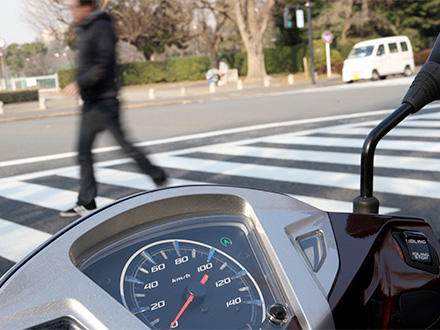

On the move, while the PCX's exhaust and mechanical noise are sufficiently quiet, and its presence is only felt as vibration, that interval when the engine is stopped not only reduces its environmental impact, it also makes conversation between rider and passenger more lively, while enabling the rider to better to pay attention to surrounding conditions. I can't help but think that discoveries like this help to reveal what a truly great technology this is.
I've heard that quite a few riders of scooters equipped with Idling Stop tend to ride with it switched off. They may be doing this intentionally for fear of running down the battery with frequent restarts, or perhaps be concerned that the restarts will have an annoying delay. However, such concerns have been perfectly laid to rest by this advanced system. I really think that when all the beneficial effects of stopping the engine when not on the move are considered, it would be a real waste not to take advantage of this technology. I want to stress that Idling Stop is not only good for the environment and improving fuel efficiency, it also helps create a pocket of silence that provides other lasting favorable effects.
For those who are still worried about delays in restarting, I recommend you visit a Honda dealership for a test ride. And if you want to experience for yourself the degree of quiet achieved during an engine stop, you can experience a quasi-Idling Stop by simply sitting on one of these scooters in a city showroom. It's much easier than you'd expect to experience this excellent operation and exhilarating feeling.
User Reviews
What do riders think about the Idling Stop function? Do they change idling operation using the ON/OFF switch? We asked them these questions and more.
PCX
Male, 30 years old
Since this latest PCX model automatically disables the Idling Stop function whenever the battery charge falls below a certain level, I can ride with complete confidence even when leaving the switch ON all the time. By the way, why isn't this Idling Stop function more widely used on motorbikes other than Honda's?
Male, 30 years old
Many things we couldn't have imagine a few years ago are now quite common. For instance, separating out recyclable garbage. I searched for bikes that offer the same Idling Stop function found in many passenger cars, and eventually I discovered this Honda model. Although I chose this scooter partly for its excellent low-impact environmental qualities, I've since become fascinated by the pleasure it gives me when traveling from place to place. Surely one's motorcycle should also be selected based on its environmental performance. I'm completely satisfied with the choice I made.
Male, 24 years old
Although I've recently noticed many cars and buses stop their engines using some sort of Idling Stop function, whenever I hear the loud noise they make when restarting, I immediately feel a sense of pride and superiority when I ride my quiet-starting PCX. I feel like all those cars are totally behind the times.
However, when stopped at a red light, I often see other people riding the same model of PCX that I ride, but not using the Idling Stop function. Which is a shame, since it's really a wonderful function.
PCX150
Male, 47 years old
I usually ride this scooter to commute to work and back. While waiting for the light to change in residential areas at night, the silence I hear thanks to the Idling Stop function gives me a feeling of peace-of-mind that's difficult to describe. This is the first time I've ever experienced anything like it in all my years of riding a bike. The perfect timing of the engine restart in response to a small turn of the throttle is especially impressive. Fuel efficiency is also good, and overall I feel really happy that I chose this scooter.
Male, 53 years old
Although I was initially thinking of getting a larger scooter, seeing this 150cc model around town a few times perked my interest, and eventually I bought one. I'm really satisfied with its design and equipment, which seem to be intended for a higher class of bike, and I'm particularly impressed by its Idling Stop function. My car is similarly equipped, but I find that the PCX150's restart characteristics more closely match my own feelings when riding. This Idling Stop function should be especially welcome to riders like me who attach a great amount of importance to environmental impact. Although I've not been so impressed by similar functions found in cars I've driven, the PCX's Idling Stop always fills me with a feeling of oneness and astonishment.
LEAD125
Male, 41 years old
Basically, depending on traffic conditions, I leave the Idling Stop function ON all the time. However, when a traffic light looks like it's just about to change, I tend to physically turn the Idling Stop OFF at its switch on the handlebar.
Female, 32 years old
Will the engine always restart without fail? At first, I had a lot of anxiety about the engine turning off in city traffic while waiting for a light to change. However, I've since learned to take the Idling Stop function for granted while waiting for signals. Because of this, I even make it a practice to stop my car's idling when I drive. I feel happy to be able to think that I'm making even a small contribution to reducing the world's exhaust emissions.
Sh mode
Male, 40 years old
Taking advantage of a move from an urban area to the suburbs, I bought this model for my expanded range of activities. When selecting it, I was first attracted by its design, operating capabilities and riding ease. I thought at the time that the Idling Stop was simply one of many non-descript features, but as I've gotten to use it more, my consciousness changed to see that it's also making a small contribution to a cleaner environment. It's easy to operate and doesn't feel the slightest bit distracting or uncomfortable. I'm especially impressed with the timing of the engine restart when I twist the throttle to go again.
Male, 38 years old
I bought this scooter for running errands. Since I've had several models of scooters before, I chose this one based on its ease of use. Sometimes I go riding together with my young son on the back, and he thinks it strange that the engine automatically stops and starts again, even though I'm doing nothing to make the engine stop. I tell him, "Yes, it's magic!," and this running joke adds some lighthearted amusement to our conversations and rides together. I know the Idling Stop function is environmentally friendly, but the pleasant quiet moments it creates are also appealing.
Tsutomu 'Ben' Matsui (b. 1963, Tokyo)motorcycle journalist
Since 1986, motorcycle journalist Tsutomu Matsui has contributed interviews, riding impressions and first-hand race reports to a host of magazines and specialty motorcycle publications. He has also ridden in the Paris-Dakar and Baja 1000 rallies.

Idling Stop System — Technology Picture Book
The Idling Stop System automatically turns the engine off at traffic lights and other brief stops, reducing CO2 emissions when the vehicle is stationary. New technologies and precision engine control ensure smooth engine startups.