Reducing unwanted noise while driving lends to a sophisticated interior space
Road noise, engine noise, wind noise. All kinds of sounds infiltrate the cabin while driving a vehicle. Active Noise Control shuts out this low-frequency noise to realize superior quietness, contributing to a comfortable and sophisticated interior space. Active Noise Control is compatible with not only engine-powered vehicles, but also e:HEV models. For example, enormous benefits can be achieved in EV drive mode, when road noise is more obvious as the engine is not running, and in engine drive mode, when low-frequency engine noise is likely to carry into the cabin because of the high torque generated at low engine speeds. The system also contributes to reduction of vehicle weight due to the ability to cut down on body reinforcement materials and damping materials usually employed to prevent low-frequency noise.
Noise cancelation using phase-inverted sound reduces low-frequency sound
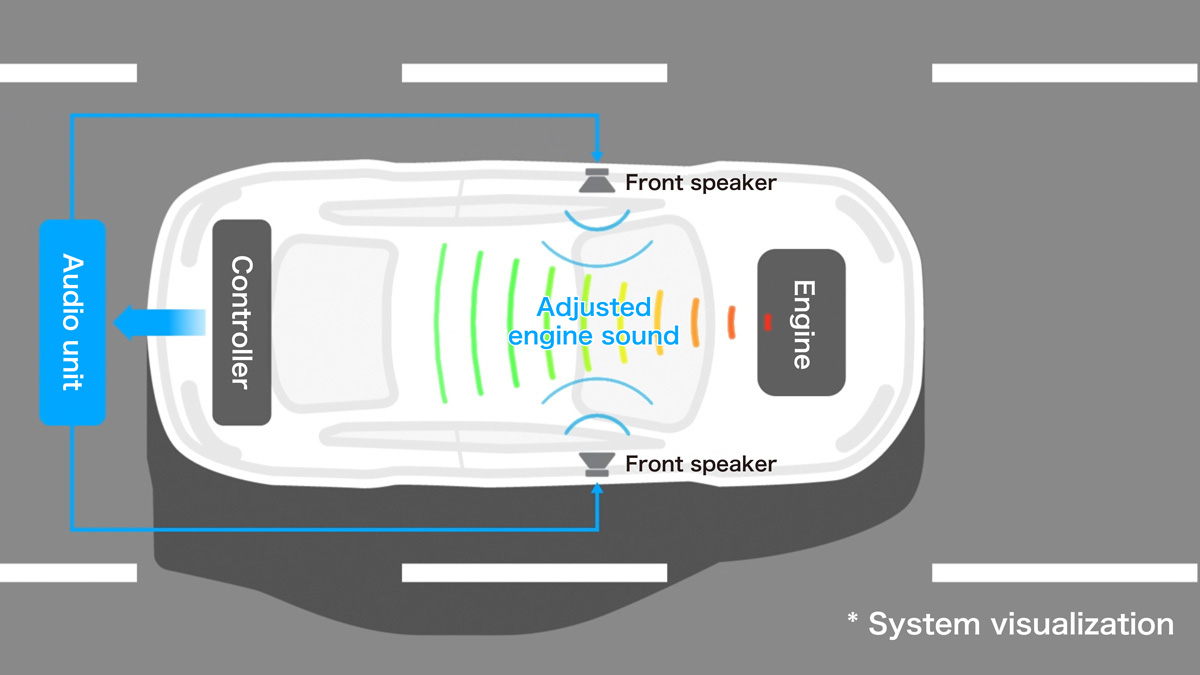
Active Noise Control takes engine speed data and information from microphones inside the cabin and uses a controller to synthesize a canceling signal with an opposite phase to the noise. The canceling signal, emitted from audio speakers as sound, reduces unwanted noise based on principles of sound interference.
Reduction of engine humming
Humming that originates in the engine indicates that the frequency of the noise and engine rotation are in sync. The frequency to be controlled is therefore identified from the engine rotation pulse. Precision is enhanced through constant analysis of inputs from microphones in the front and rear of the cabin and by updating the canceling signal accordingly.
 *The quantity and location of microphones and
speakers may vary depending on the model.
*The quantity and location of microphones and
speakers may vary depending on the model.
Reduction of road noise
While driving a vehicle, inputs from the road surface are conveyed to the vehicle body via the suspension, producing road noise. Active Noise Control uses microphones inside the cabin to identify road noise frequencies that need to be canceled. To reduce those identified signals to a minimum, a canceling sound, in the form of a phase-inverted signal, is played through the speakers.
 *The quantity and location of microphones and
speakers may vary depending on the model.
*The quantity and location of microphones and
speakers may vary depending on the model.
Both sound and vibrations are detected to suppress a wider range of road noise
Besides using microphones to detect noise, Honda also developed a system
equipped with three-axis vibration sensors that detect vibrations coming
from the tires. Low-frequency road noise to be canceled is picked up with
high precision from among the cabin noise and tire vibrations, helping to
enhance quietness over a broader range of frequencies. Importantly, the
system reduces oppressive road noise caused by rough road surfaces.
To properly detect tire vibrations, the vibration sensors are located in the
body frame around the four wheel houses. The microphones are located in the
ceiling close to the ears of all occupants on either side of the vehicle.
The microphones on both sides are also used to estimate the sound in the
middle of the ceiling, creating the effect of having six microphones.
 *The quantity and location of microphones and
speakers may vary depending on the model.
*The quantity and location of microphones and
speakers may vary depending on the model.
Seat-by-seat control optimizes noise reduction based on occupancy
Honda has realized seat-by-seat control to automatically switch between noise canceling sounds according to which seats are occupied. Seat occupancy sensors and seatbelt sensors in the rear seats are used to determine if there are occupants in just the front of the cabin, or in both the front and rear. Active Noise Control ensures the optimal noise canceling sound is used in each case. When only the front seats are occupied, noise reduction is controlled to achieve the maximum effect in the front of the cabin. When there are occupants in both front and rear seats, a balanced noise canceling sound is produced so all occupants can partake in conversation and listening to music.

*Active Noise Control does not shut out all noise. Effects will also vary from person to person as everyone hears noise differently.