SPACETIDE 2025
Honda’s Challenge: From Earth to Outer Space
Honda’s mission of “expanding the possibilities of people’s lives” is now heading beyond Earth toward outer space.
We propose a vision of sustainable activities in space, with a focus on our three mainstays of a circular renewable energy system, robotics, and reusable rockets. This inevitable challenge for Honda is an extension of the history that we have developed until now, and is expressed in that vision.
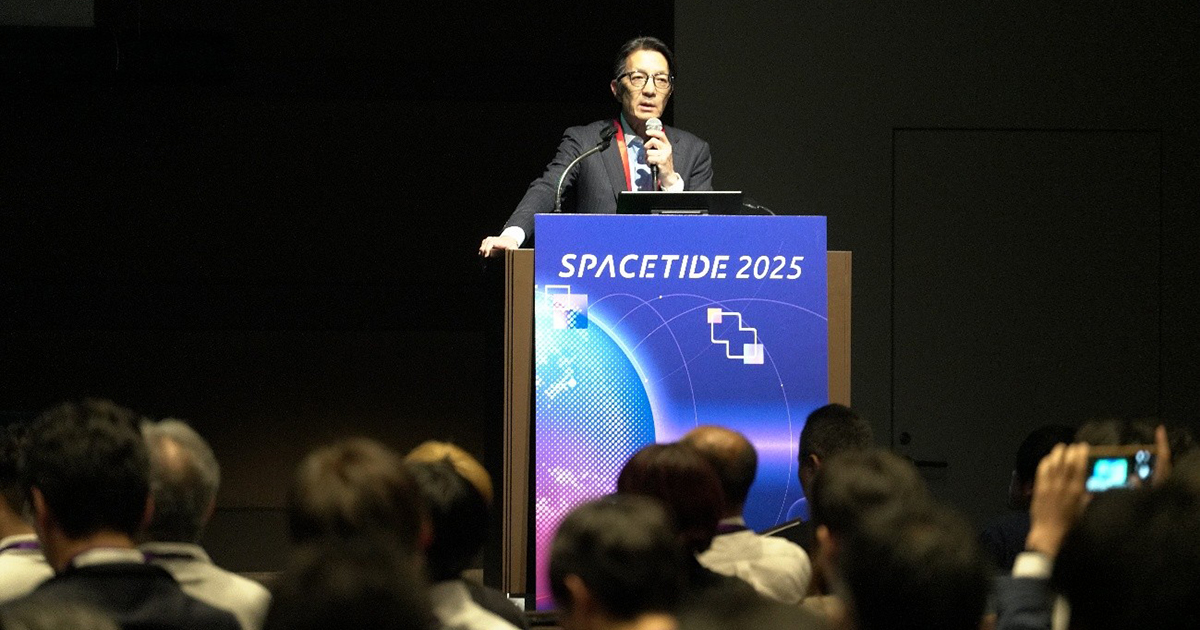
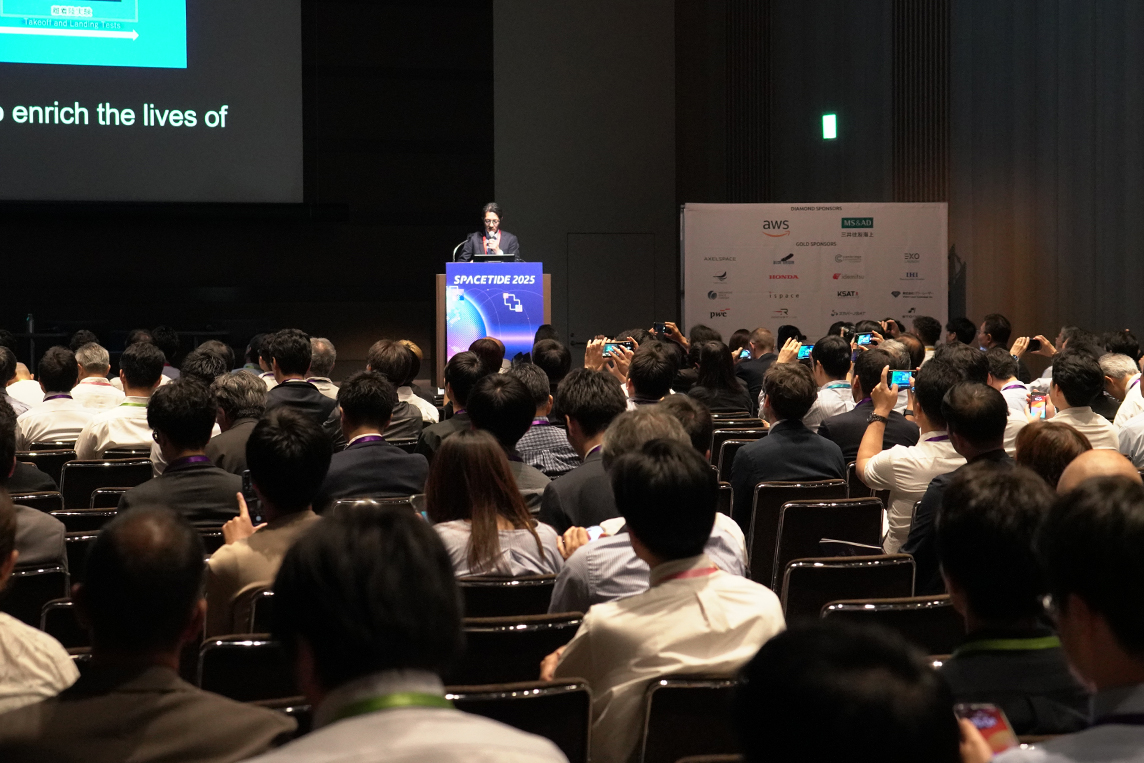
Keiji Otsu, President and Representative Director of Honda R&D, made one of the keynote speeches at SPACETIDE 2025, the leading international space business conference in the Asia-Pacific region. Taking on challenges, which is something that is rooted in Honda’s DNA, has advanced our technological development based on the fundamental philosophy of “being useful for people.” In this context, President Otsu talked about the details of our technological development in space and the prospects for that development.
What’s About
What Is SPACETIDE?
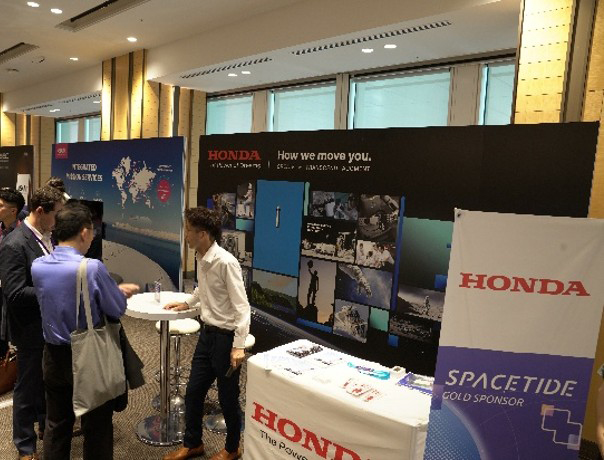 SPACETIDE is an international conference dedicated to space business originating in Japan. It is one of the biggest events of its kind in Asia, at which participants such as space startups, global corporations, investors, and government bodies gather in the same place. Since the conference was first held in 2015, it has continued to communicate information from the frontline of business, technology, and policy, based on its mission to “make outer space a new industrial frontier.” Honda is also participating as a sponsor, and through being granted this opportunity, we are attracting attention by presenting our space development initiatives to the world.
Paving the Way for “the Right Kinds of Challenges”: Space as an Extension of Honda’s DNA
At the beginning of his keynote speech, President Otsu talked about Honda’s philosophy of “being for people,” which is something we have always valued. He emphasized the fact that since Honda was founded, we have advanced technological development with the attitude that “we should consider whether or not a particular project is the right thing to do before attempting to profit from it.”
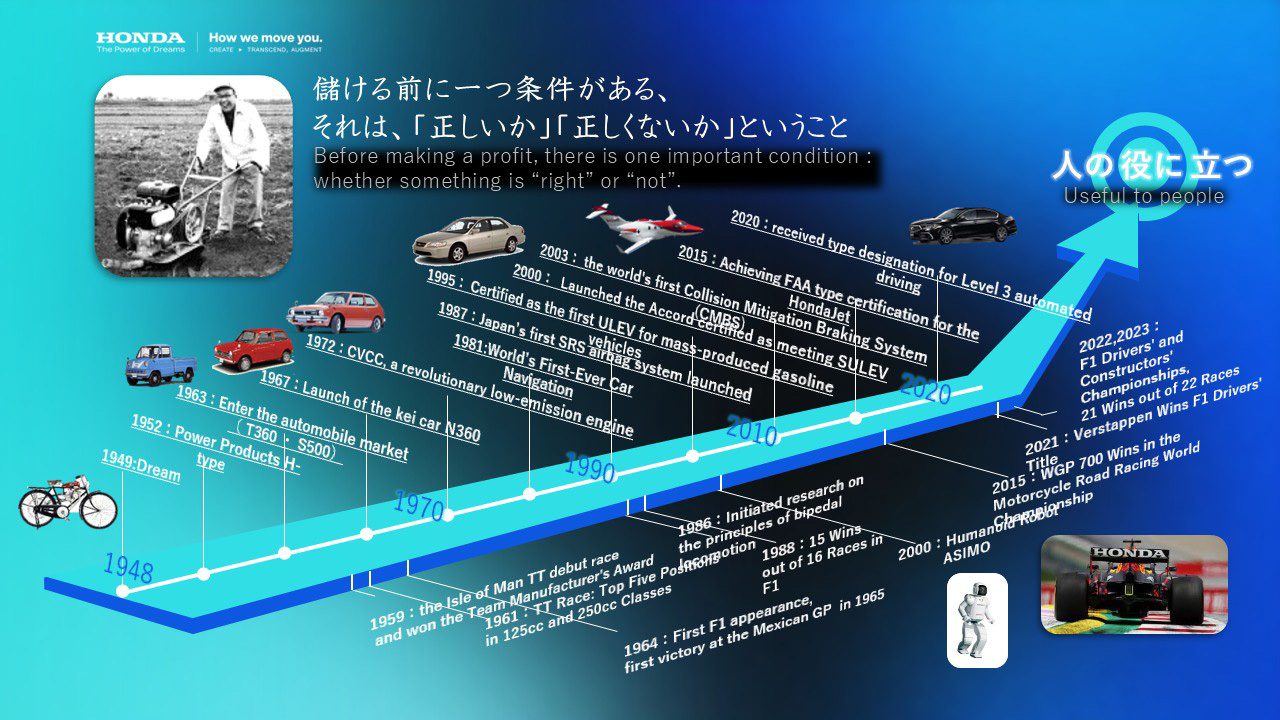
Our history of initiating challenges on land, on the sea, and in the sky is backed up by this attitude. These challenges have included Formula One, in which we were involved from the dawn of the format, and world’s first technologies such as our CVCC engine, which complied with the strictest environmental legislation of its time, the Muskie Bill, our car navigation system, and our Collision Mitigation Braking System (CMBS), not to mention HondaJet, our original airborne mobility solution. All these challenges were in fields that “nobody else had yet taken on.”
“Honda has already expanded its business activities on land, on the sea, and in the sky, so it should come as no surprise that space has arisen as the next field for realizing our potential.” As demonstrated by these words from President Otsu, the field of outer space is in no way a reckless endeavor for Honda. Based on a perception of the history and philosophy that Honda has built up, his words make perfect sense.
Supporting the Future with Three Technologies: Honda’s Space Challenge
Regenerative Fuel Cells: The Circular Renewable Energy System
Stable supplies of electric power, oxygen, and water are essential for humans to continue their activities in the environment of outer space. By applying technologies such as the fuel cells and water electrolysis that Honda has cultivated on Earth, we are developing a system for the circular use of water, hydrogen, and oxygen, and for storing and supplying energy.
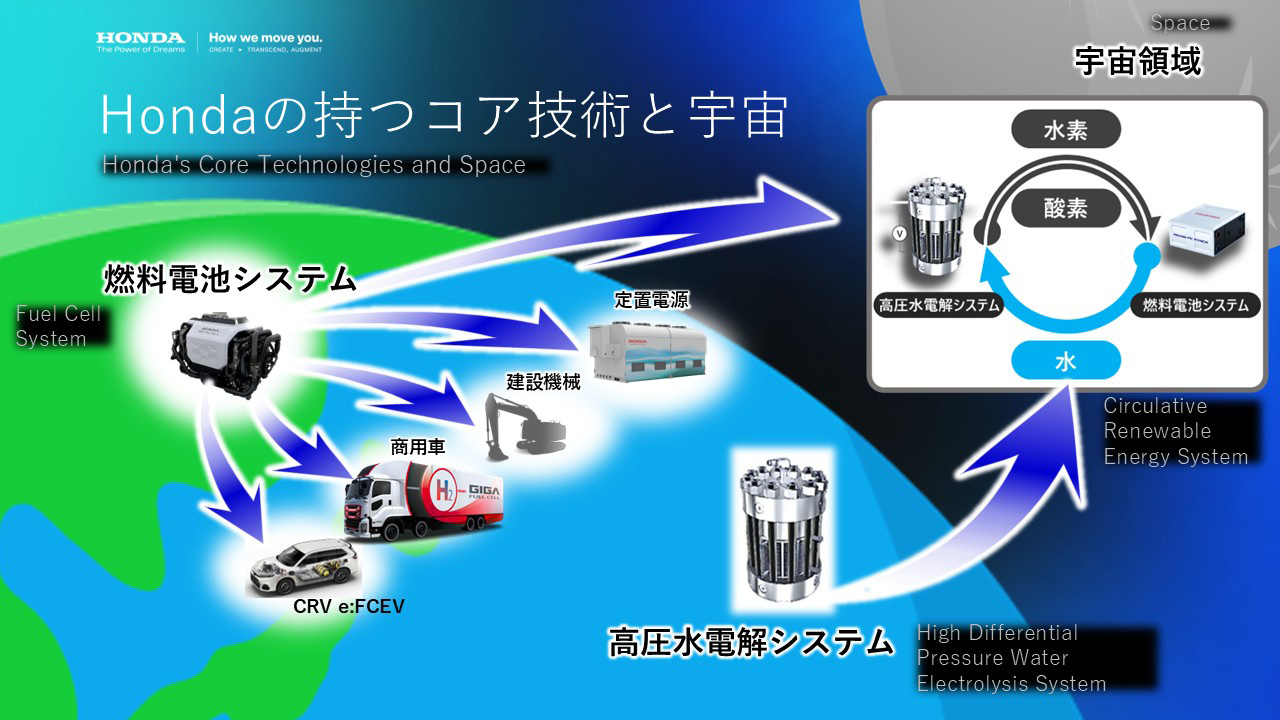
During the day, electricity is generated from solar power, while water electrolysis generates and stores oxygen and hydrogen. At night, the stored oxygen and hydrogen are used to generate electric power, so that living quarters and mobility are supplied with electricity while the lunar surface is also being developed—a mechanism that was described in President Otsu’s speech in an easy-to-understand manner.
“We are conducting tests in a microgravity environment on the International Space Station (ISS), with the aim of enhancing these technologies and their reliability,” continued Otsu, thereby clarifying the progress of verification tests on the ISS.
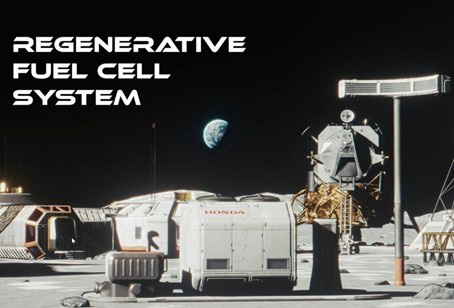
These tests are based on technologies we have cultivated for use on Earth, for example, a fuel cell electric vehicle (FCEV) and stationary power stations. Honda has worked on the research and development of fuel cell systems for over 30 years, and our unique high differential pressure water electrolysis system enables the supply of high-pressure hydrogen at 70 MPa, even without the use of a compressor. Otsu also emphasized the fact that effects can be demonstrated by combining the technologies of fuel cells and the high differential pressure water electrolysis system, even on missions that necessitate reduced payloads.
Robotics: Taking the Human Hand into Space
The robotics technologies that Honda has cultivated over many years are another important mainstay of our space development. Development is proceeding based on the dual concepts of “maximizing the value of time” and “expanding physical functions,” although our “avatar robots,” whose goal is engineering that reproduces the movement of the human hand via remote control, are a kind of “4D mobility” that transcends physical space.
This can be referred to as a technology that “takes the human hand into space” to mitigate risks in the harsh environment there, allowing even complex work to be undertaken via remote control.
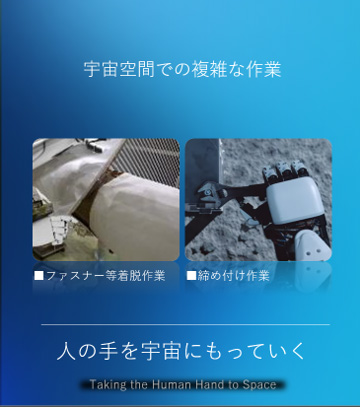
Of course, working in outer space entails many problems, such as delays in communication, and as one example of a solution, President Otsu referred to the development of a technology in which AI supports the operation of remotely controlled work.
Humans assessing a situation and deciding on a course of action while AI assists with the more detailed movements allows work to be smoothly undertaken in cooperation with a robot. Thanks to this AI support technology, even if there are communication delays, the AI appropriately assists in achieving the correct amount of force, grip position, how an object is held, and so on, and will likely enable work to be undertaken in space.
Furthermore, one of Honda’s new initiatives involves taking on the challenge of refueling satellites. As Otsu explained, “By extending the operating life of satellites and reducing the number of launches, we can contribute to a circular economy in space.” In his speech, he also talked about the co-development with Astroscale Japan Inc. of a refueling port connecting system. He expressed his strong motivation in relation to this, saying, “Our goal is to demonstrate the system in around 2029.”
Sustainable Rocket: The Reusable Rocket
Steady progress is also being made with research and development of a reusable rocket. We have begun conducting a phased schedule of combustion, hovering, launch, and landing tests, and we are confirming each element one at a time, from engine ignition to combustion, thrust control, position control, and the deployment of landing legs.
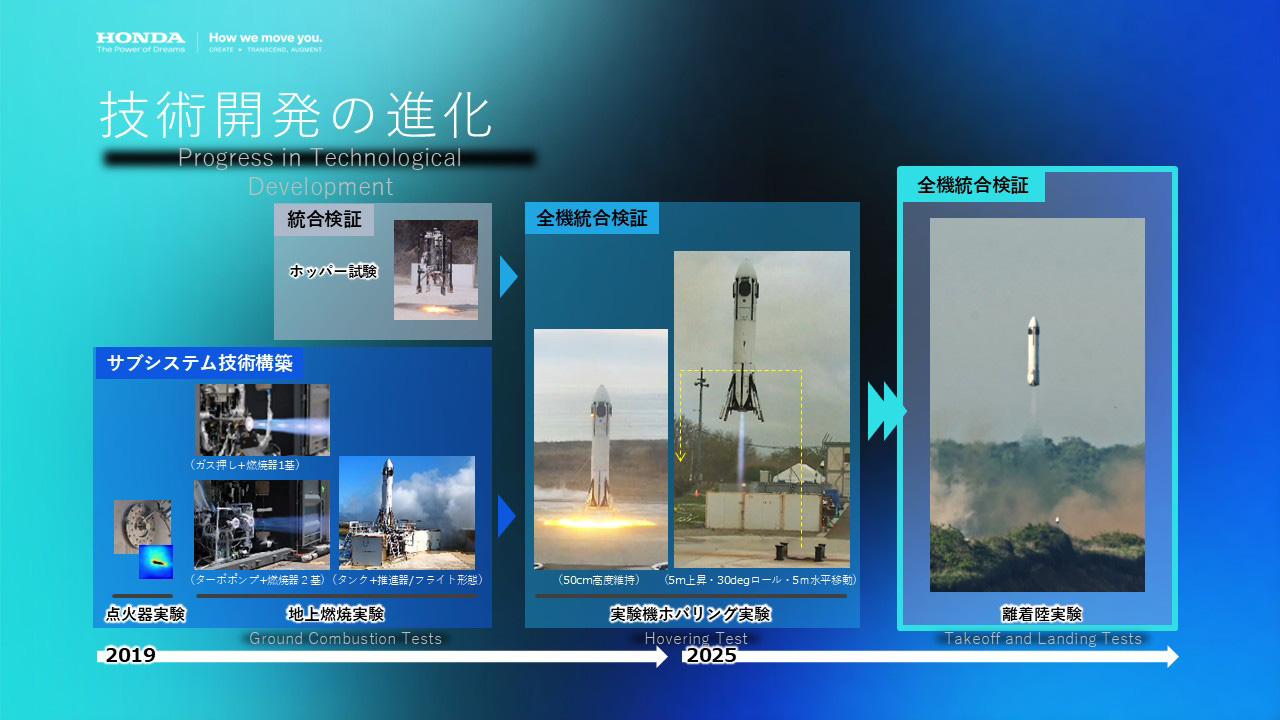
President Otsu also showcased footage of a launch and landing test conducted in Taiki, Hokkaido in June 2025. Members of the audience were amazed to see from the footage that, having set an altitude of approximately 270 m, measurement error at the landing site was shown to have an accuracy of 37 cm.
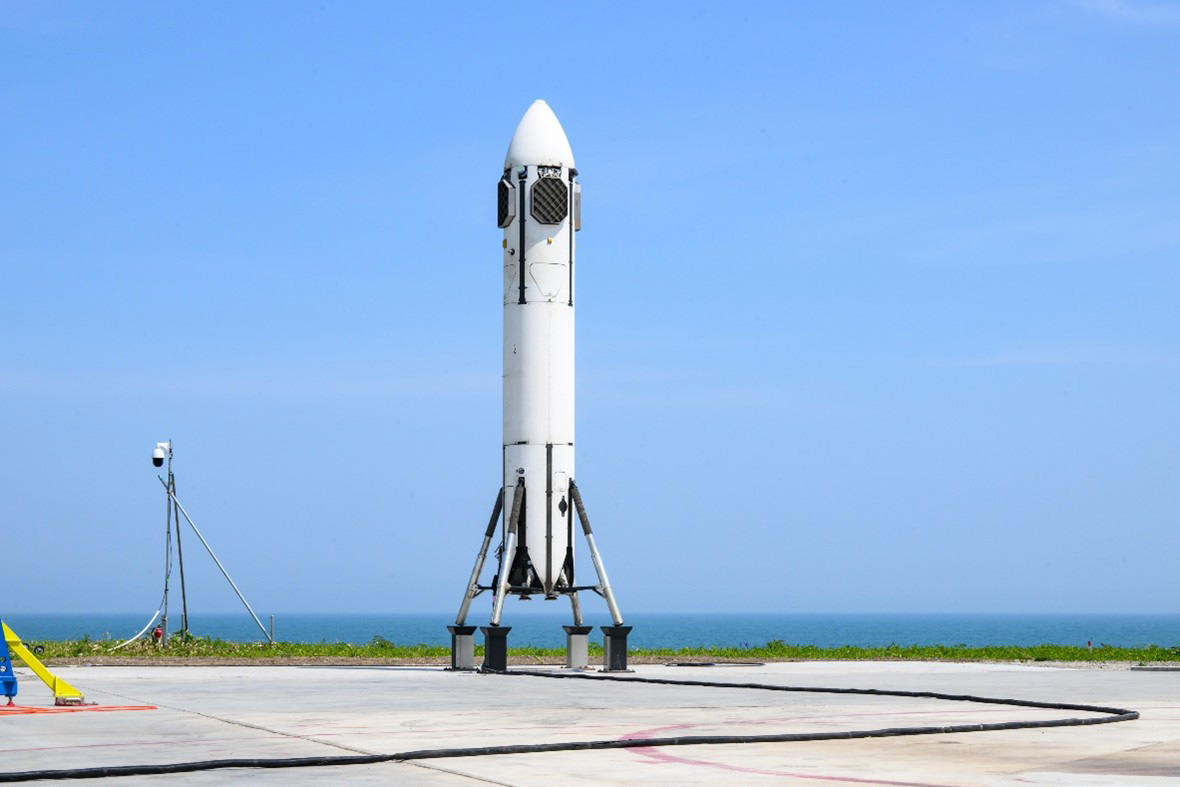
Launching satellites with the rocket has a high degree of affinity with the technological fields that Honda is working on—for example, our connected technologies for mobility—and will lead to the generation of new value.
The use and application of data is progressing in various contexts in modern life, and in the future, there are expected to be even greater quantities of such data. As a consequence, the amount of energy (electric power) needed for processing will increase exponentially.
This in turn will make rockets with the ability to launch satellites into space even more convenient. President Otsu also explained the idea that as a result, the use of satellites will increase, and this will promote the use and application of data via outer space in a way that is not dependent on energy generated on Earth.
In this way, if we can realize highly convenient transportation, outer space will enrich the lives of people on Earth. Through his speech, President Otsu described a vision of the future that Honda will create as an extension of the technological development that we are steadily accumulating.
To Expand People’s Potential: The Future that Honda Anticipates
The motivation for Honda’s space development is clear. It is an extension of our philosophy of “enriching people’s lives.”
Fuel cells are directly connected with mobility and households on Earth, robotics support the freedom to undertake various activities without being restricted by their location, and rockets enable highly convenient transportation. Following on from the joys of mobility on land, on the sea, and in the sky, utilizing the technologies we have cultivated in outer space is a natural development for Honda that will enrich people’s lives.
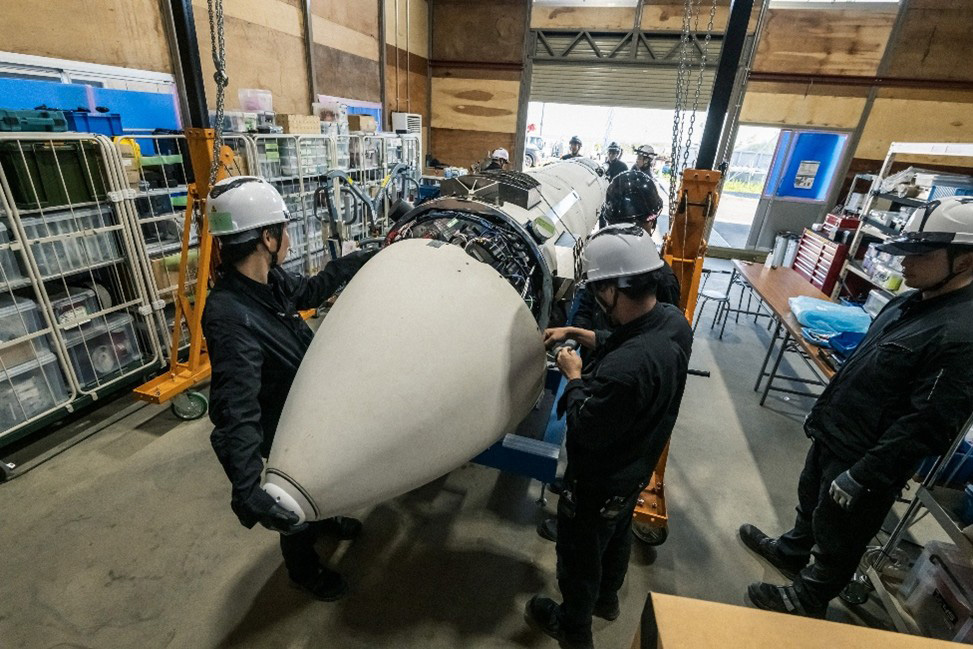
As can be seen in our verification tests on the ISS and research in collaboration with Astroscale, we are actively cooperating with various partners. In the limitless field of outer space, we are not just taking on challenges independently but also opening up new pathways while co-creating with a diverse range of fellow organizations.
“Honda is a company that is capable of creating anything if it is for the world and for people,” said President Otsu. “Going forward, we will continue to accept the challenge of producing technologies that are of use to people in order to enrich their lives.”
He concluded his keynote speech with the universal sentiment of “technology for people,” which is shared by everyone at Honda, and the mood in the venue, which overflowed with a sense of anticipation for the challenges of outer space, was memorable.
From Earth to Space and Back Again: The Challenge Continues
Honda’s challenge toward outer space, which was demonstrated at SPACETIDE 2025, is no mere pipe dream. Rather, it is a realistic initiative that follows in a direct line from our technologies on Earth.
Built on the foundation of the DNA that has existed since Honda’s founding, and with the philosophy in our hearts of “being for people,” we have expanded the scope of our challenges on land, on the sea, in the sky, and now toward outer space. As well as supporting the sustainability of human endeavors, our three mainstays of a circular renewable energy system, robotics, and reusable rockets can lay claim to being technologies that enrich the lives of people on Earth.
The challenges faced by Honda are not limited to its corporate activities. They are also initiatives that “expand the possibilities of people’s lives.” From Earth to outer space and back again, we will continue to take on challenges that connect people’s lives with the future.