
| Organizer | Society of Automotive Engineers of Japan, Inc. | ||
|---|---|---|---|
| Venues and dates | PACIFICO Yokohama (Yokohama City, Kanagawa Prefecture) from Wednesday, May 27, to Friday, May 29, 2026. Aichi Sky Expo (Tokoname City, Aichi Prefecture); from Wednesday, June 17, to Friday, June 19, 2026.
|
About the Automotive Engineering Exposition

The Automotive Engineering Exposition is the largest specialized exhibition for automotive technology. It is organized by the Society of Automotive Engineers of Japan, Inc. Since it was first held in Yokohama in 1992, the event has expanded to include an exhibition in Nagoya since 2014 and an online exhibition since 2021.
With the event bringing together the latest technology and products centered on global companies, Honda has also exhibited its latest mobility technology and products since the first exhibition. Honda R&D Co., Ltd. also showcases some of our latest research results in the Honda booth.
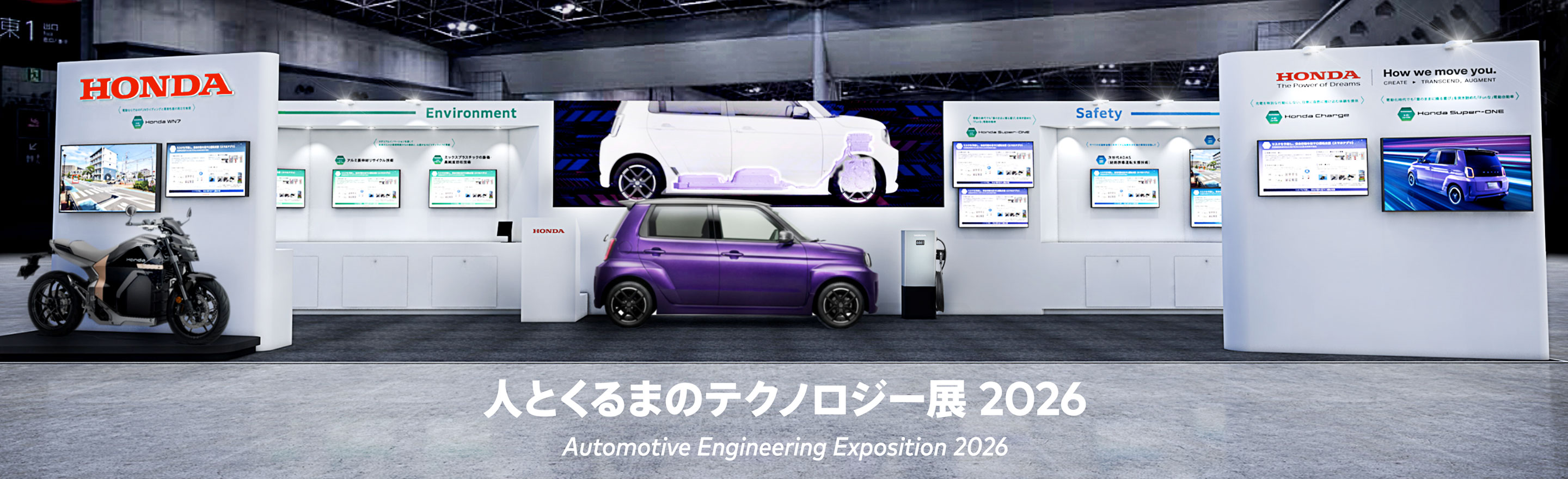
This page features the display panels and videos from the 2026 event.
Honda Booth
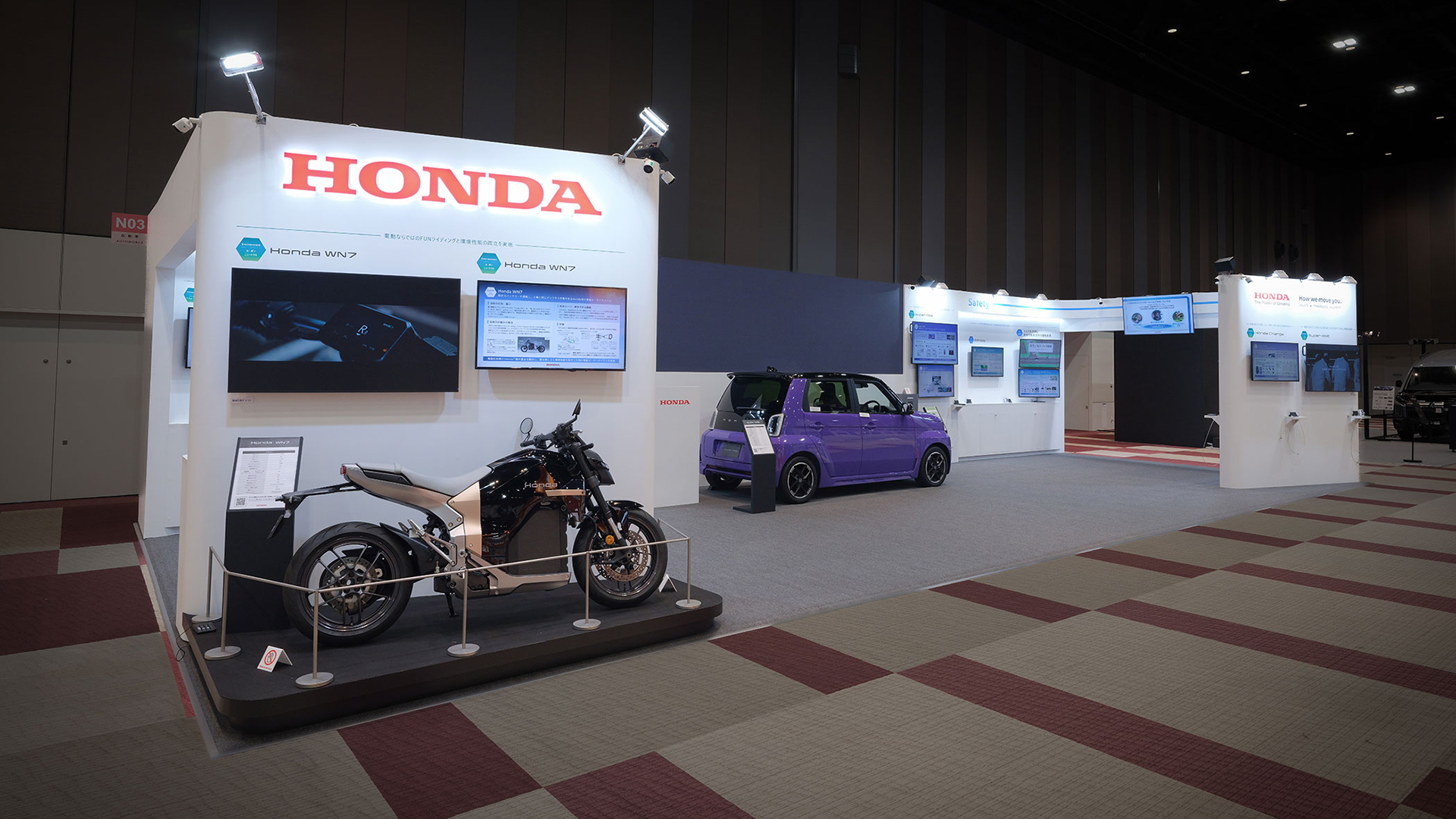
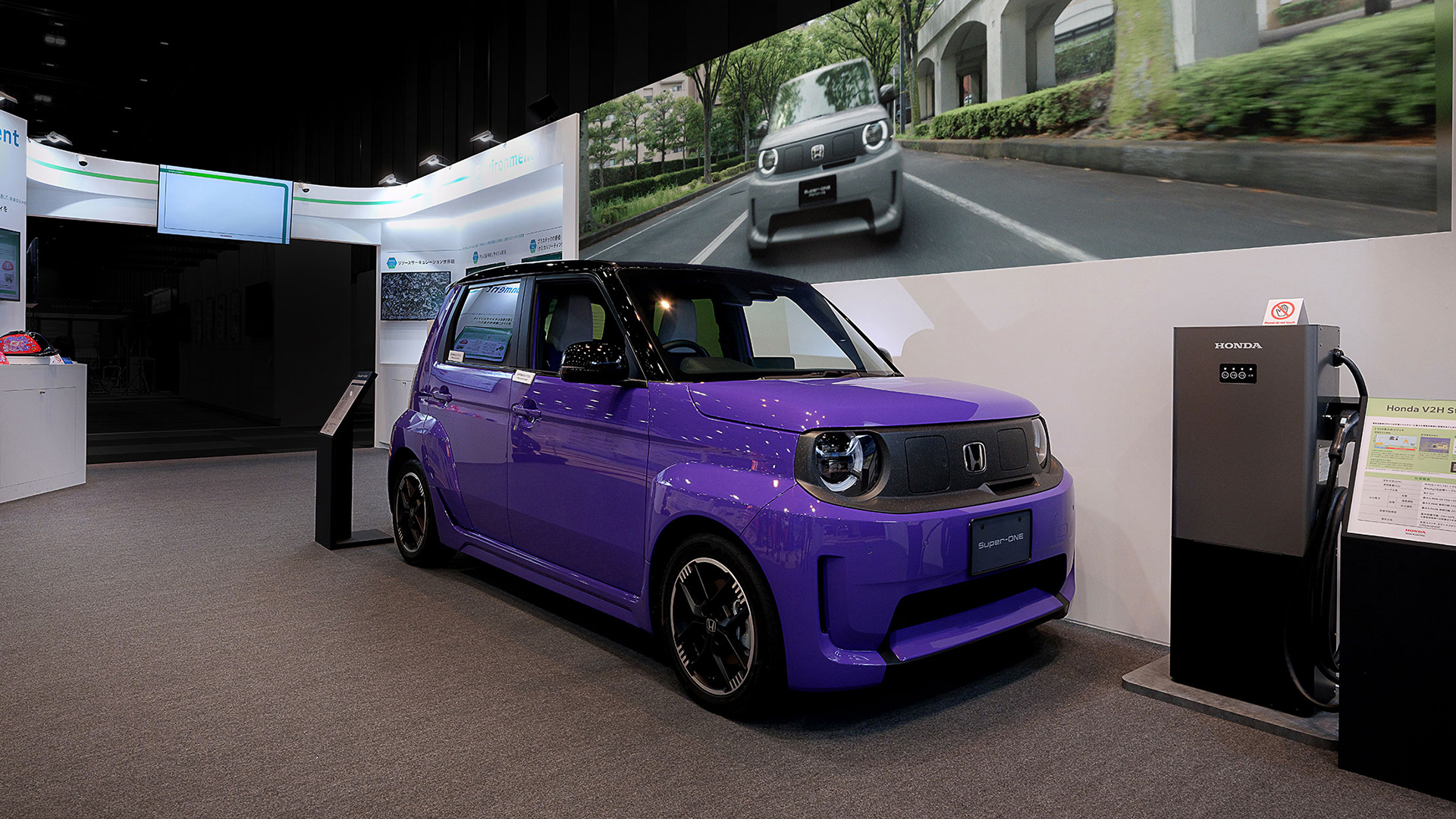
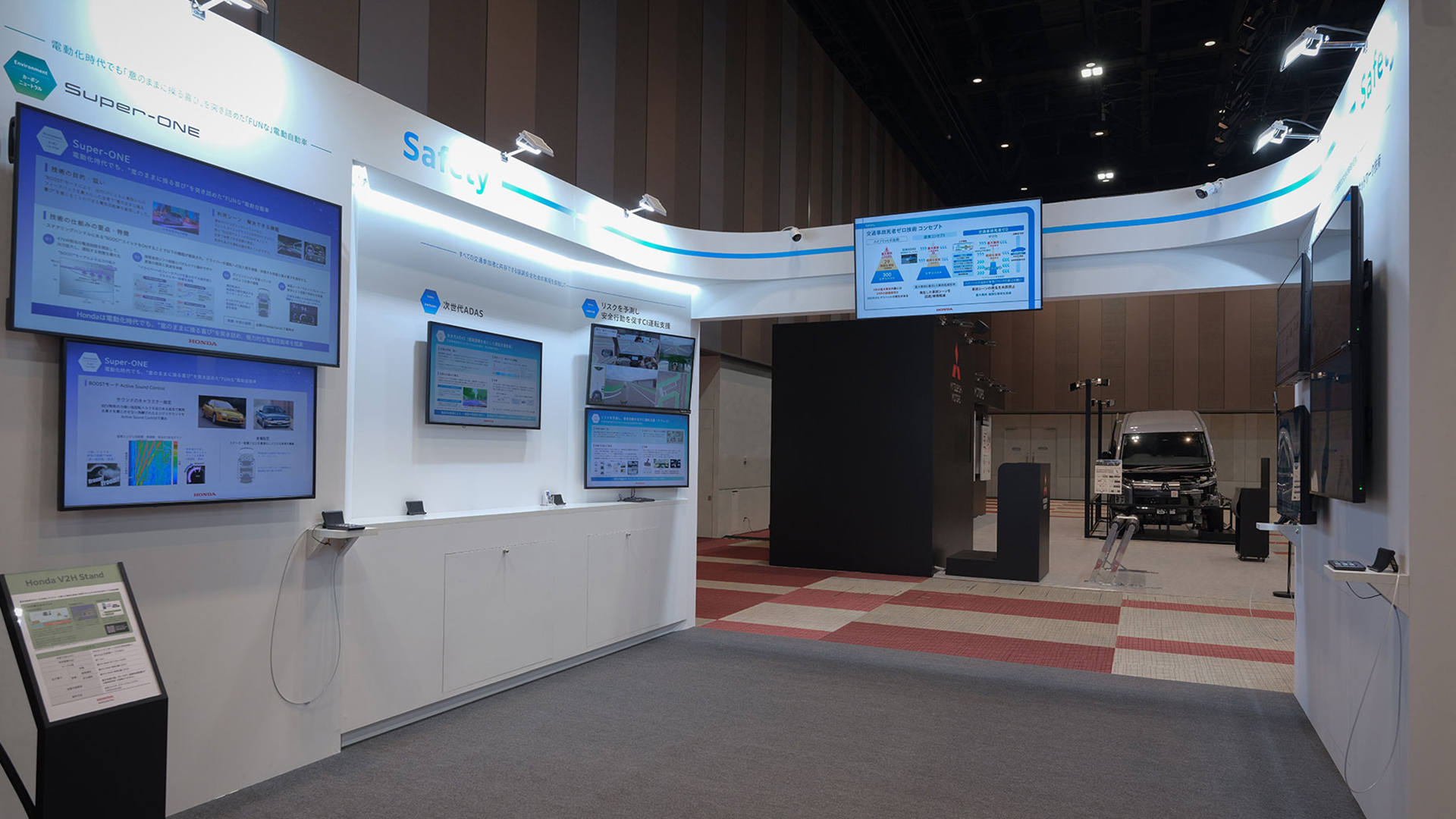
In addition to technology aimed at achieving carbon neutrality and zero traffic collision fatalities by 2050, Honda exhibited the Super-ONE EV that allows drivers to feel “The Joy of Responsive Driving.” and the Honda WN7 next-generation high-performance electric motorcycle that was unveiled in the fall of 2025.
Exhibition Overview
※The documents posted are in Japanese only.
Environment Evolution of Honda’s Environmental Technology aimed at achieving Carbon Neutrality
Super-ONE
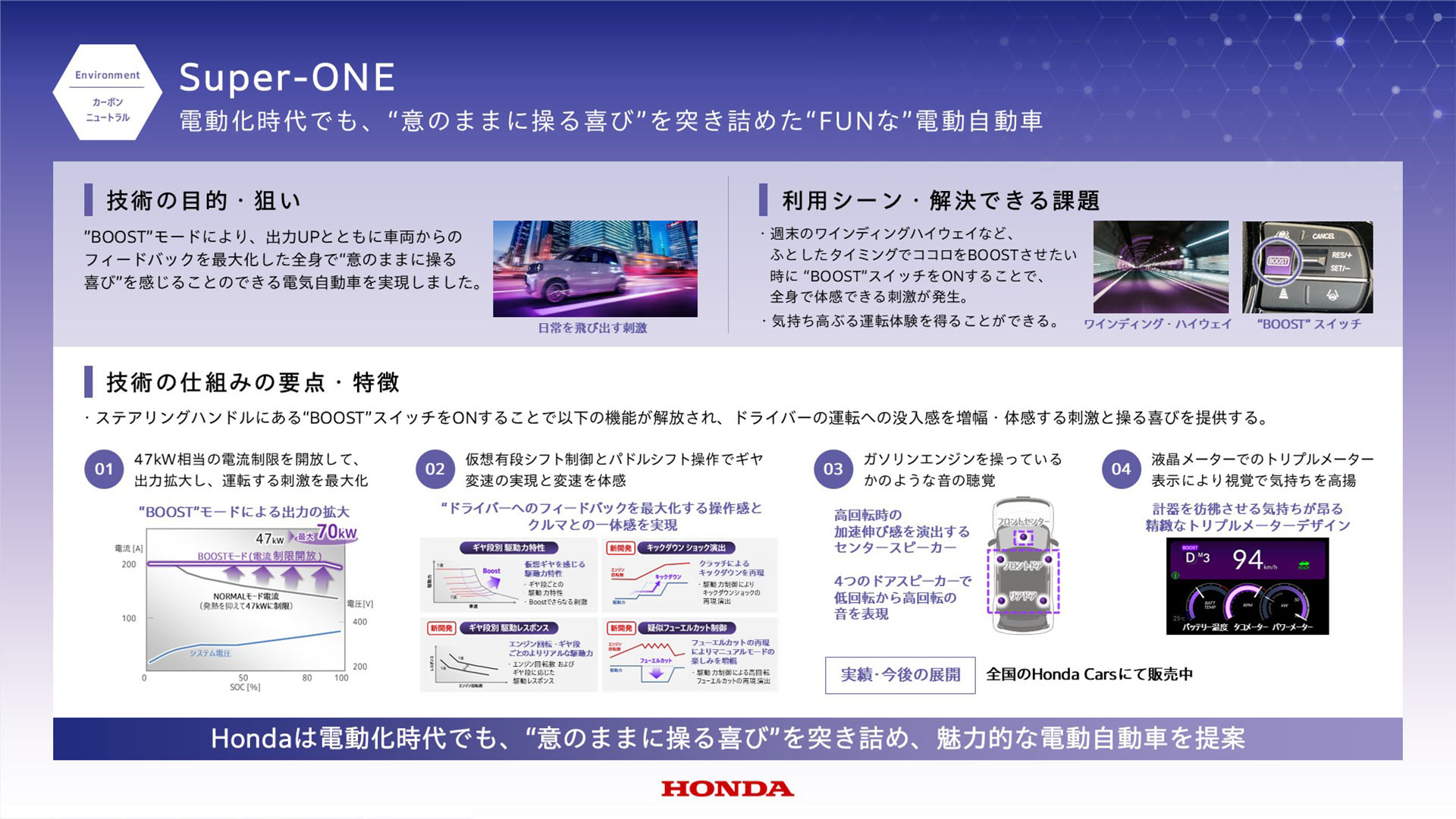
We present the Super-ONE EV. Based on the e-Dash Booster concept, this vehicle aims to allow drivers to feel “The Joy of Responsive Driving.” In addition to increasing power output approximately 1.5-fold with the BOOST mode, it maximizes feedback from the vehicle by combining active sound control (ASC), virtual stepped-shift control, and a triple-meter display.
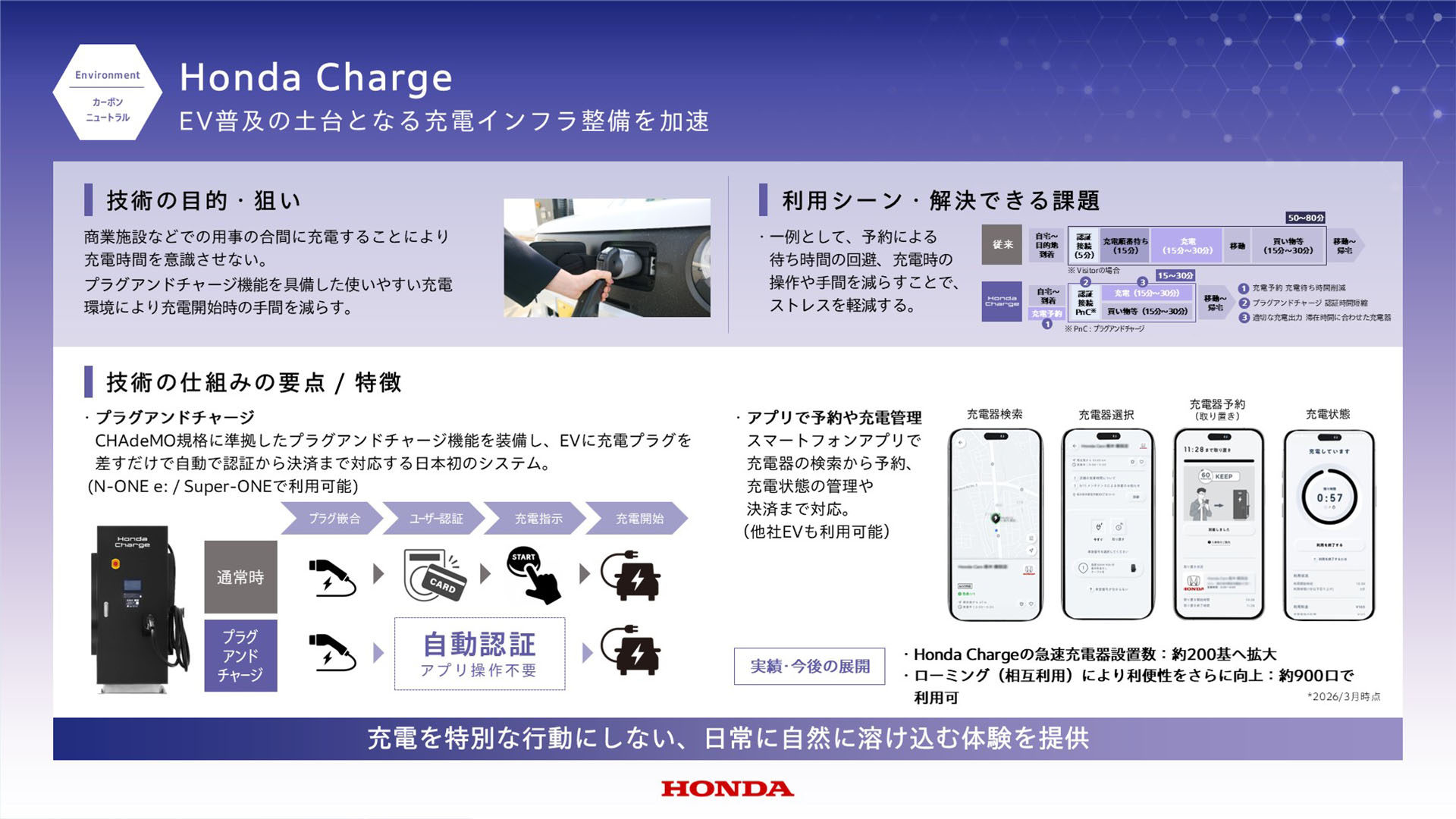
We also present the Honda Charge service that makes charging EVs even more accessible and comfortable, and the Honda V2H Stand technology that connects EVs and households at home as a part of clean energy infrastructure supporting life and society.
・Super-ONE
・Honda Charge
・Honda V2H Stand
Honda WN7
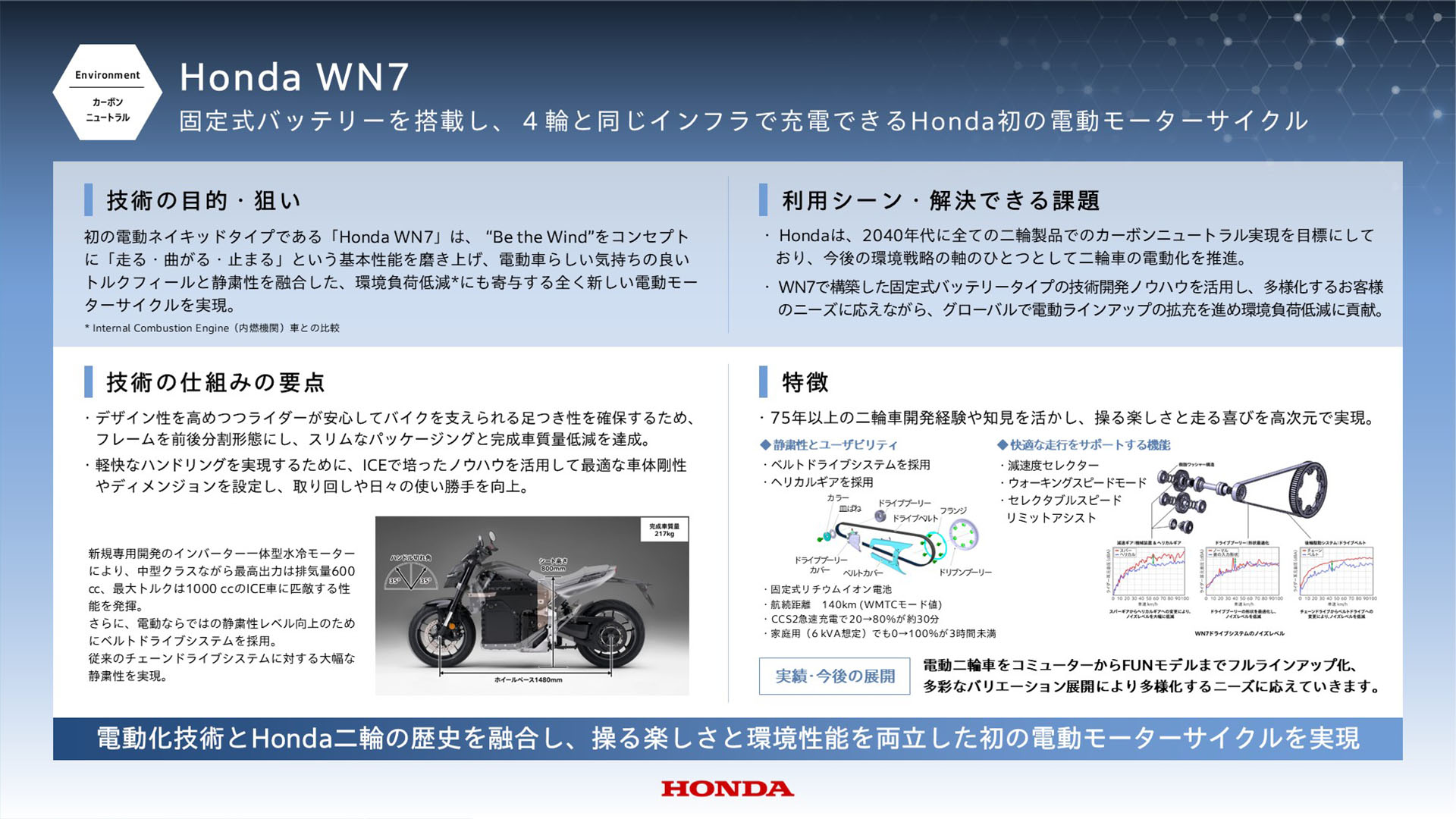
With the concept of “Be the Wind,” we present the Honda WN7. This is Honda’s first electric naked bike. The Honda WN7 features a specially developed lightweight and compact water-cooled motor with an integrated inverter. It combines sophisticated functional beauty with the convenience of CCS2 fast charging and home charging. Together with this, the bike delivers maximum power output equivalent to that of a 600-cc internal combustion engine motorcycle and a maximum torque with performance comparable to that of a 1,000-cc ICE motorcycle. At the same time, it realizes instant torque and agile handling.
Resource Circulation Technology
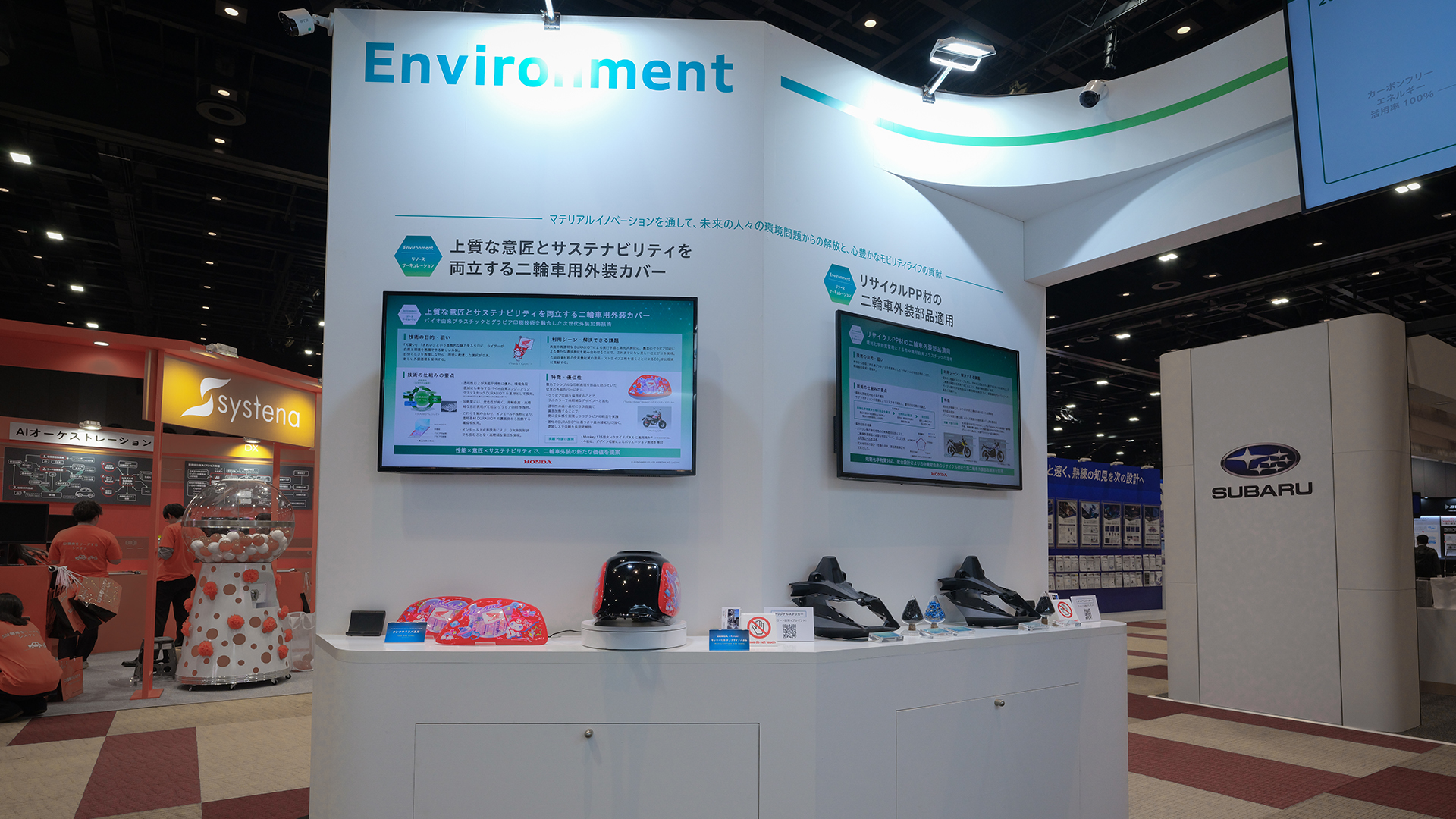
We present some examples of resource circulation technology. This technology has seen us take up the challenge of developing products made 100% from sustainable materials to continue providing the joy and freedom of mobility.
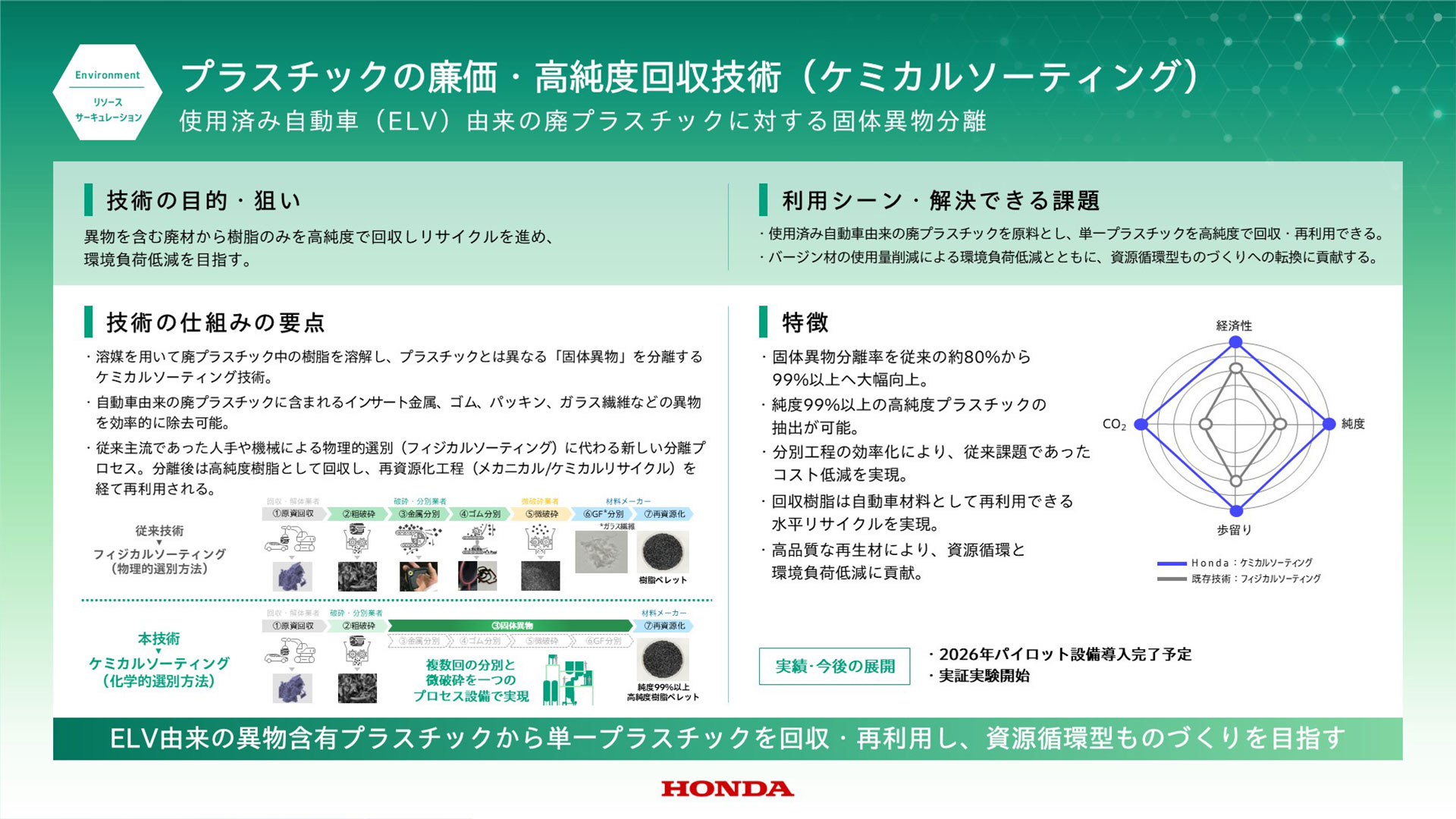
●Moderately-priced and high-purity plastic recovery technology (chemical sorting)
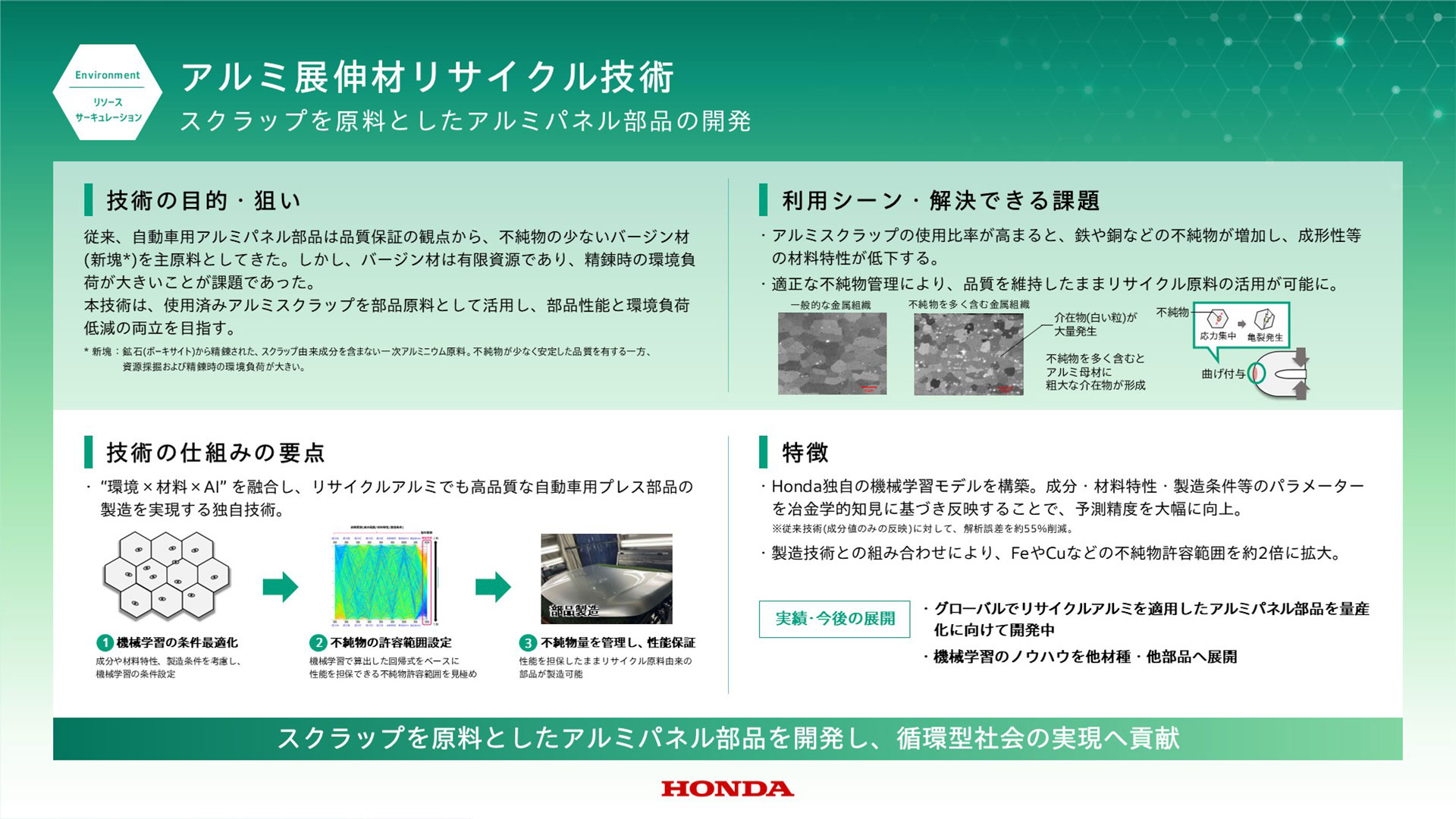
●Wrought aluminum recycling technology
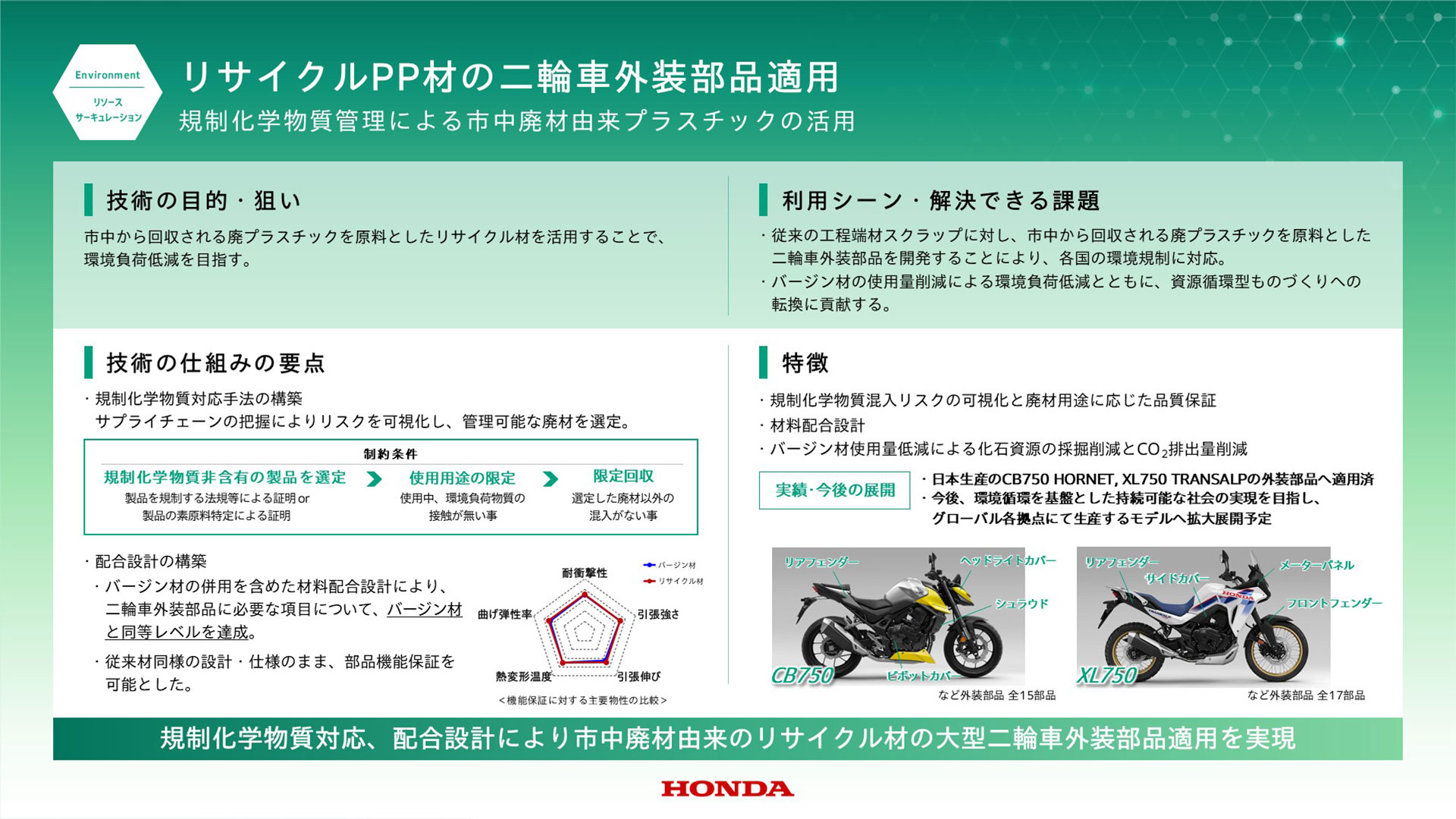
●Technology for applying recycling plastic derived from post-consumer waste
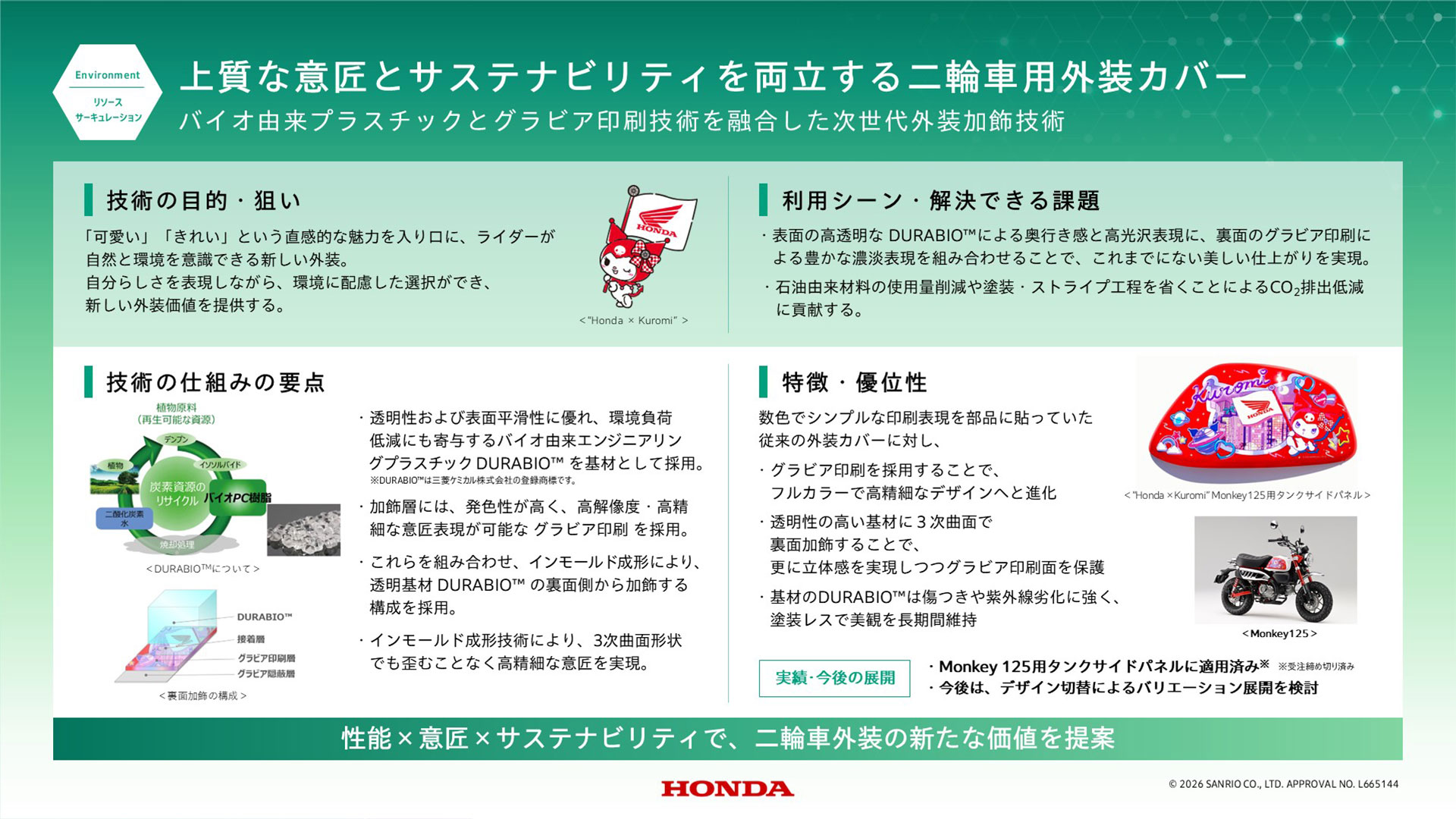
●Motorcycle exterior covers that combine high-quality design and sustainability
Safety Initiatives Aimed at achieving Zero Traffic Collision Fatalities Involving Honda’s Motorcycles and Automobiles
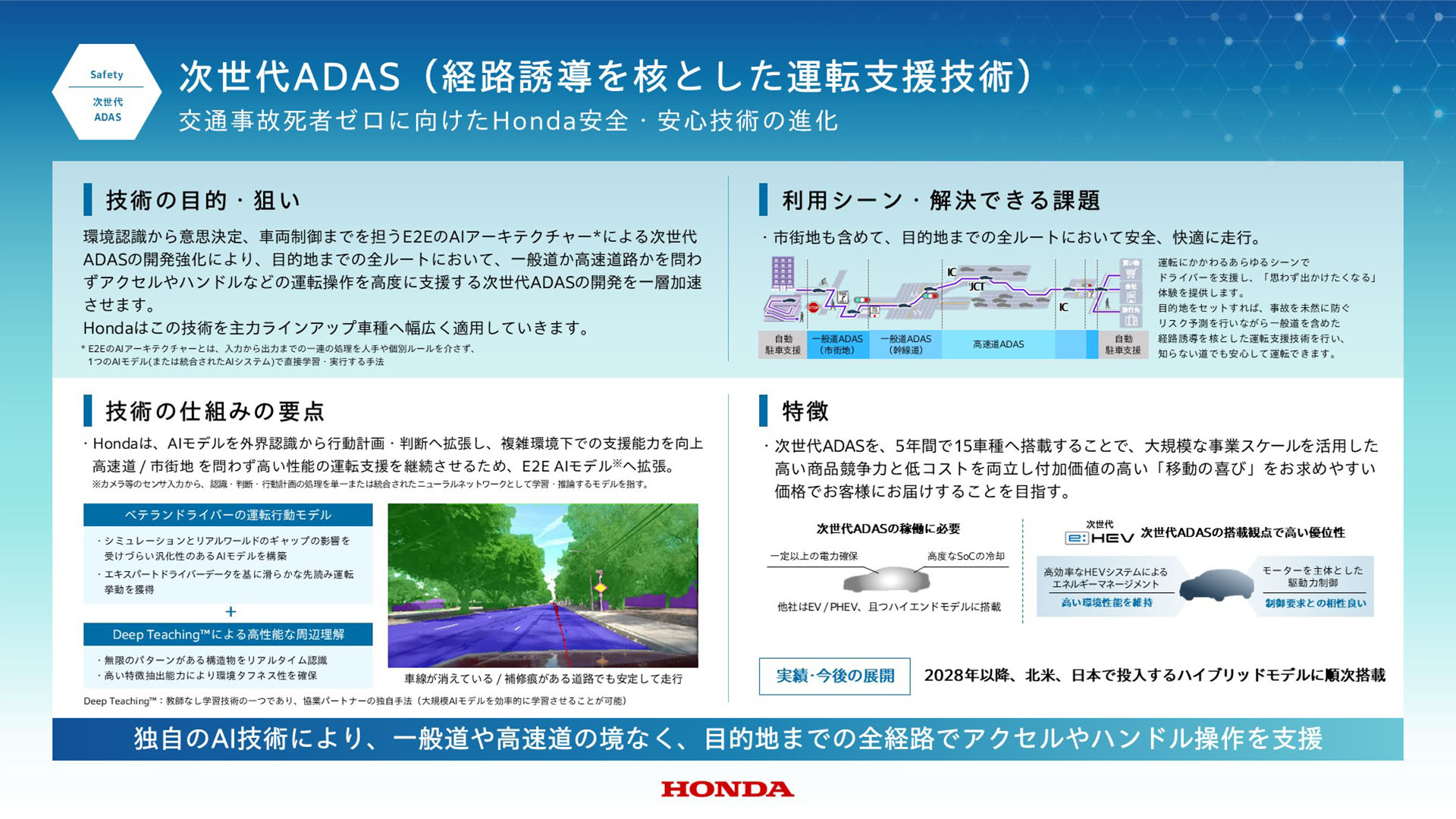
Next-generation ADAS (Driving Assistance Technology Centered on Route Guidance)
We present next-generation ADAS technology. This technology leverages the recognition technology and action planning technology we have cultivated in AD development as one of the key technologies in enhancing the intelligence of mobility. Once a destination is set in the navigation system, the car assists with acceleration, steering, and other driving operations throughout the entire route, whether on ordinary roads or highways, to enable a safe and comfortable journey to various destinations, including urban areas.
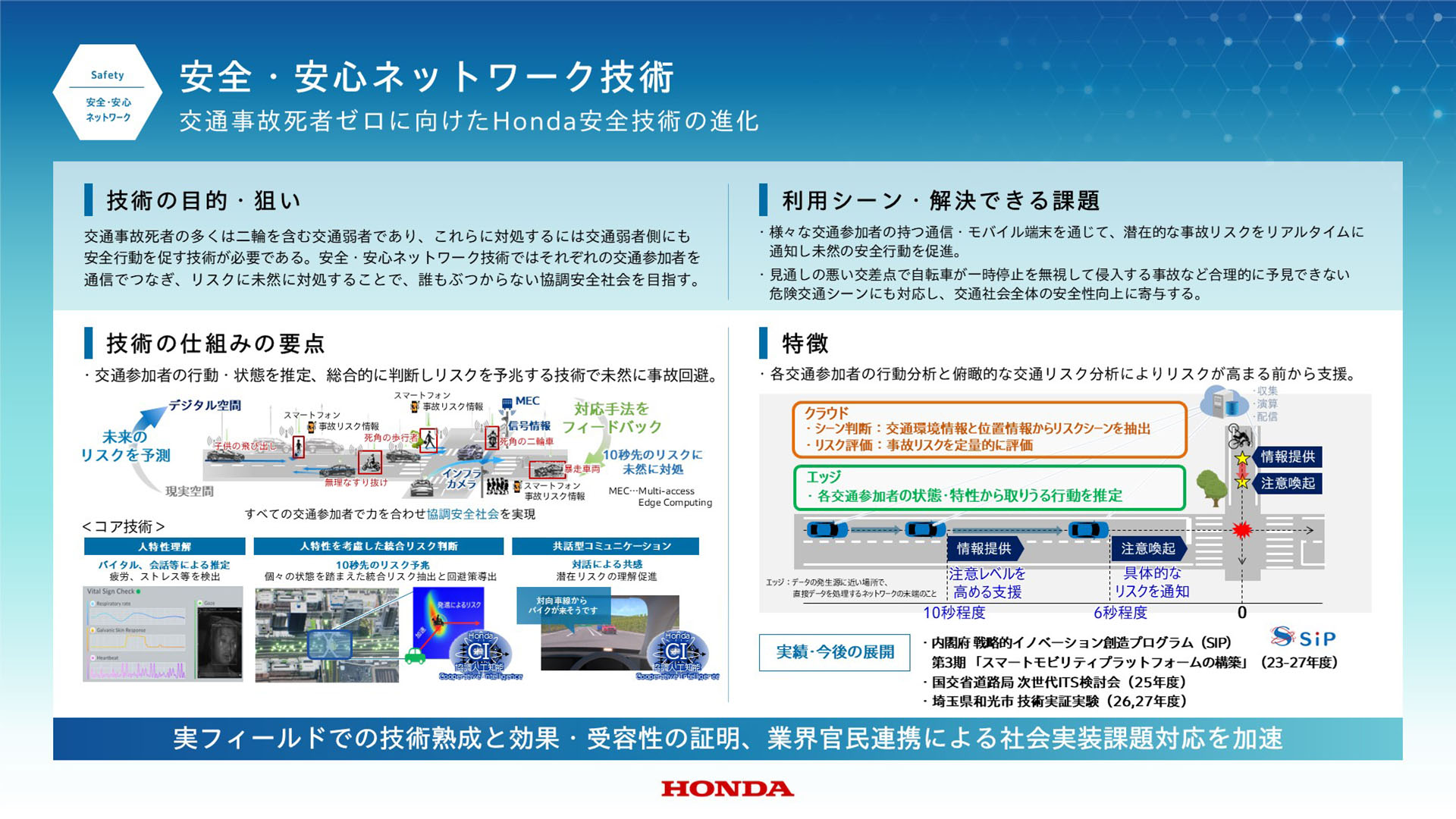
Safe and Sound Network Technology
We present research on safe and sound technology that even extends to the domain outside of the car. This technology reproduces the traffic environment by aggregating road users data acquired from in-vehicle sensors and mobile devices in the cloud. We aim to achieving a cooperative and safety society in which road users understand and cooperate with each other to enhance safety, and digital twin AI that takes into account the conditions and characteristics of those road users, predicts accident risks and derives information to support safe behavior. The technology then conveys that information to the road users through voice-interactive AI and other means to encourage safe behavior before accidents occur.
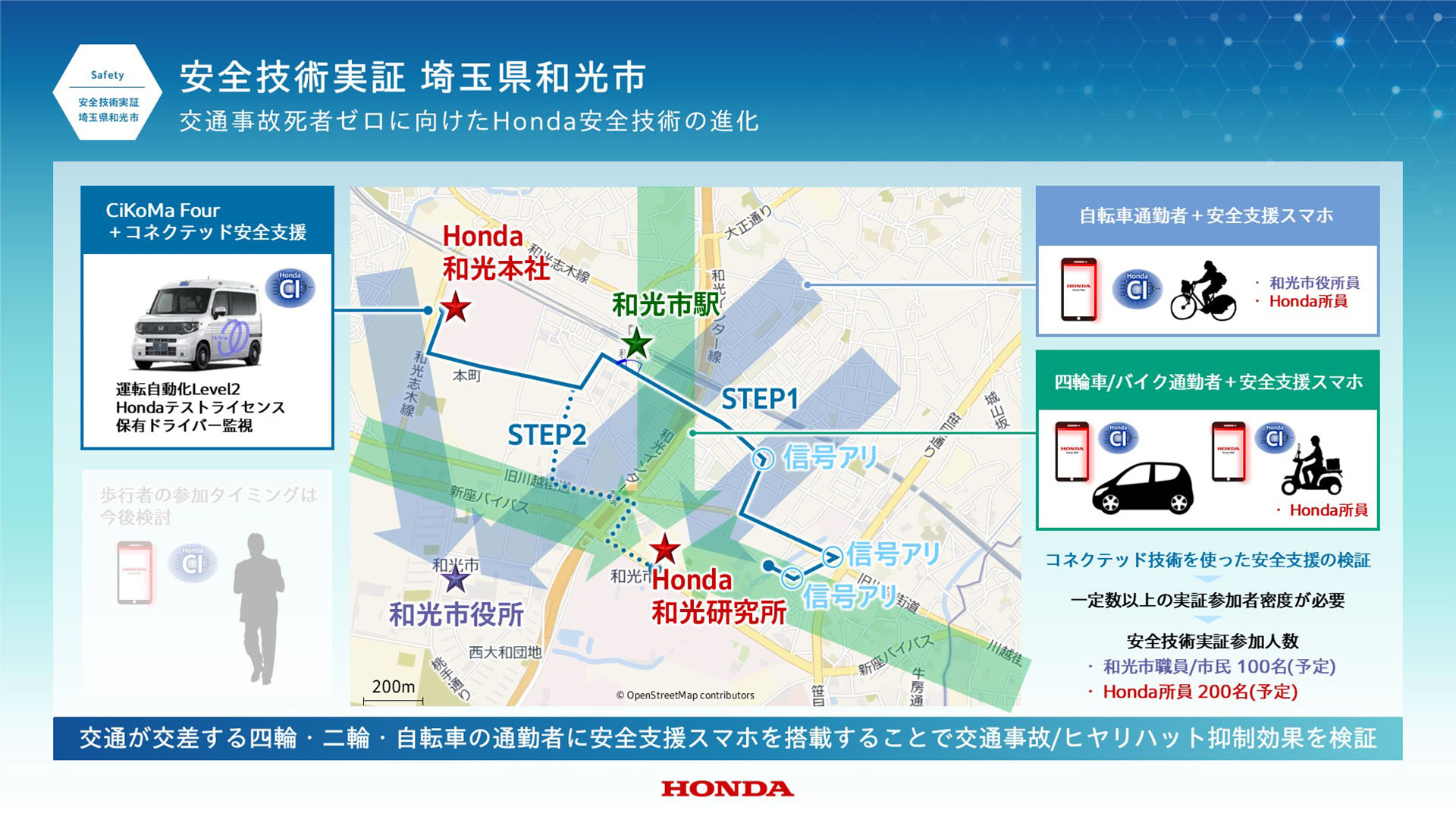
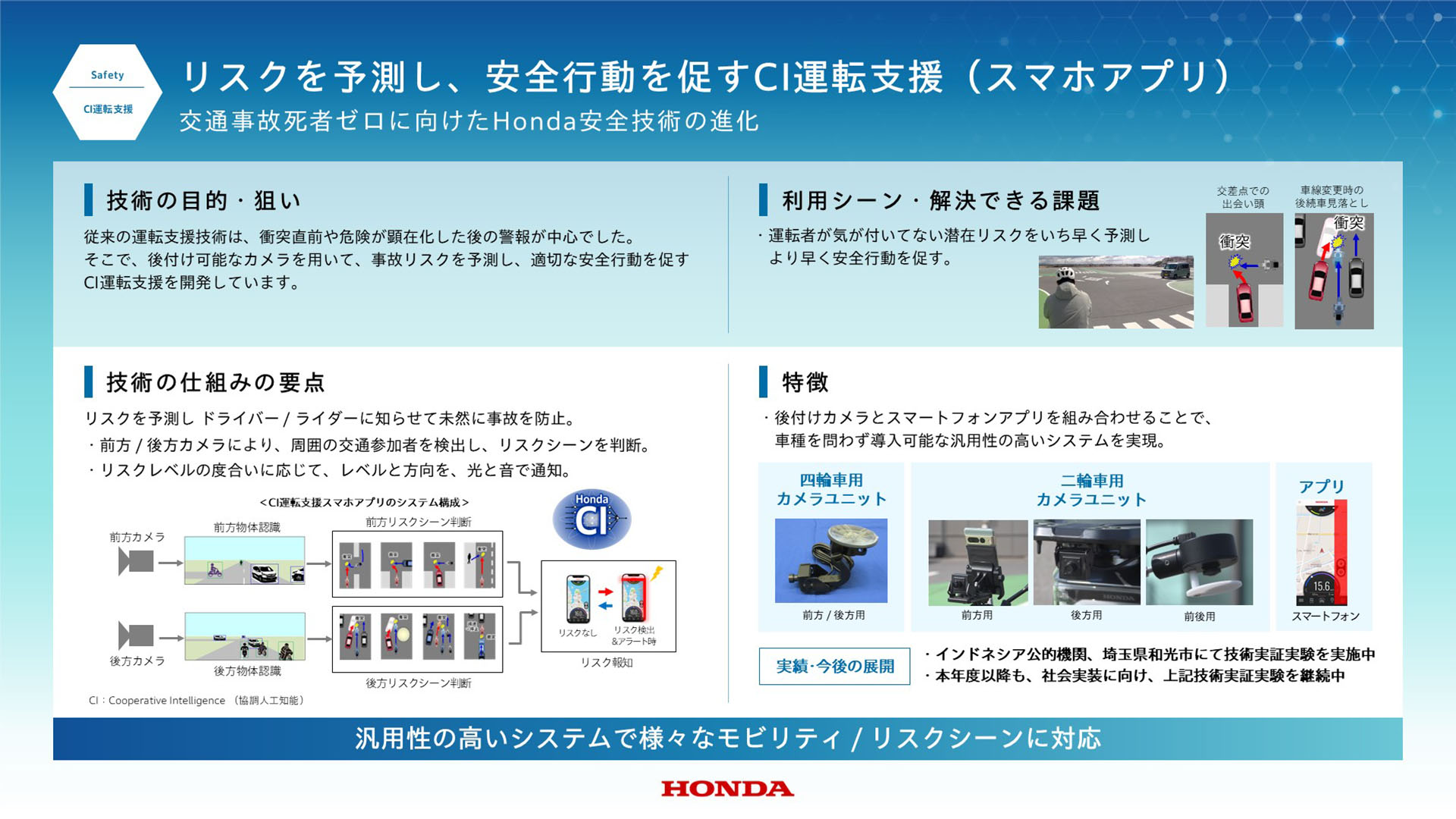
Cooperative Intelligence Driving Assistance Technology that Predicts Risks and Encourages Safer Driving Behavior
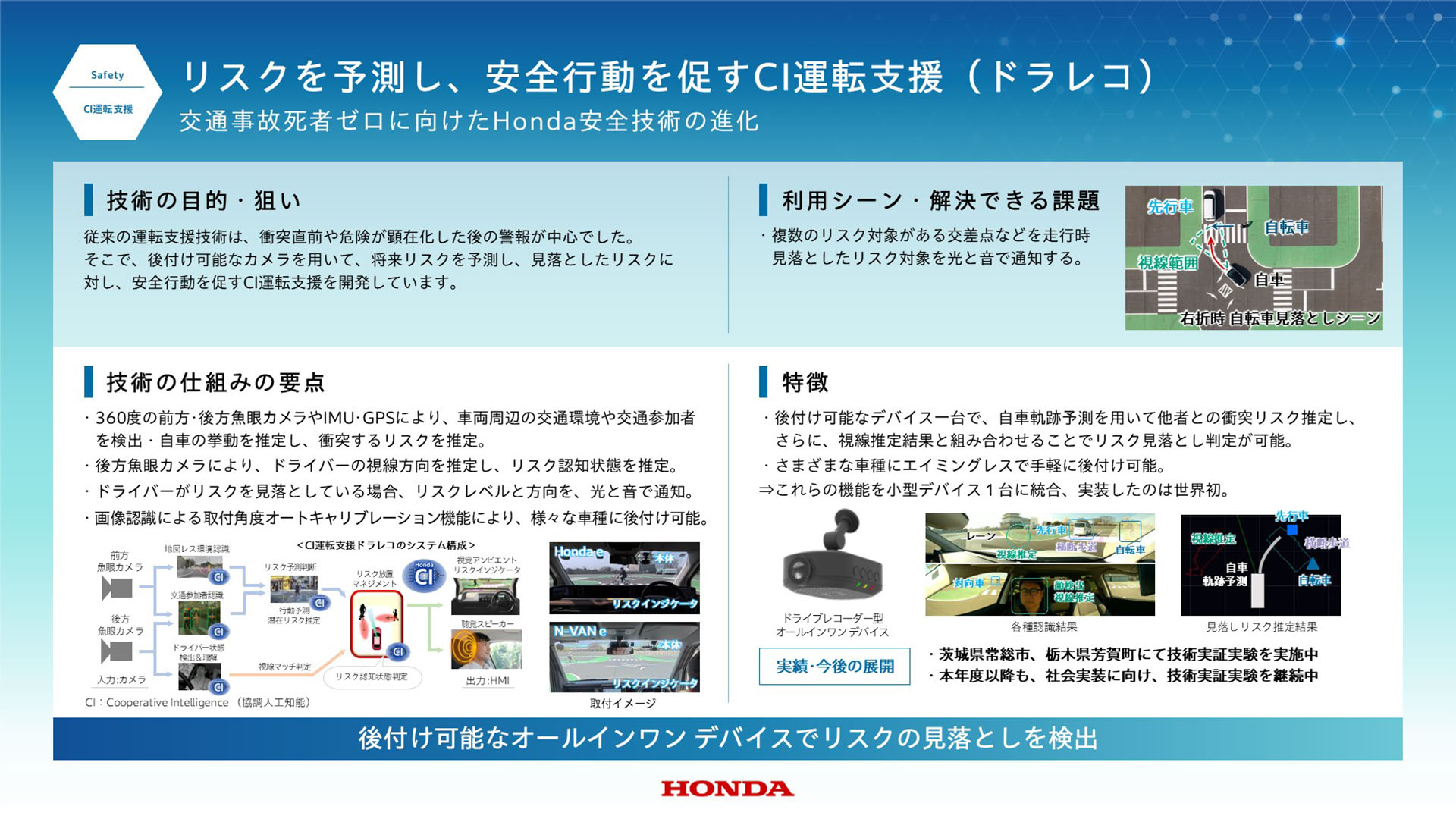
Conventional driver assistance systems primarily focus on issuing warnings immediately before a collision or after a hazardous situation has already become apparent. To realize a new generation of driver assistance, Honda has developed technologies powered by its unique Cooperative Intelligence (Honda CI), which predict potential risks at an earlier stage and encourage drivers to take safer actions. We introduce two technologies: a CI Driving Assistance Smartphone App that uses AI to predict accident risks from front and rear camera images, and a CI Driving Assistance System that estimates the driver's awareness and cognitive state through an in-cabin camera, providing guidance only when necessary and at the appropriate timing.
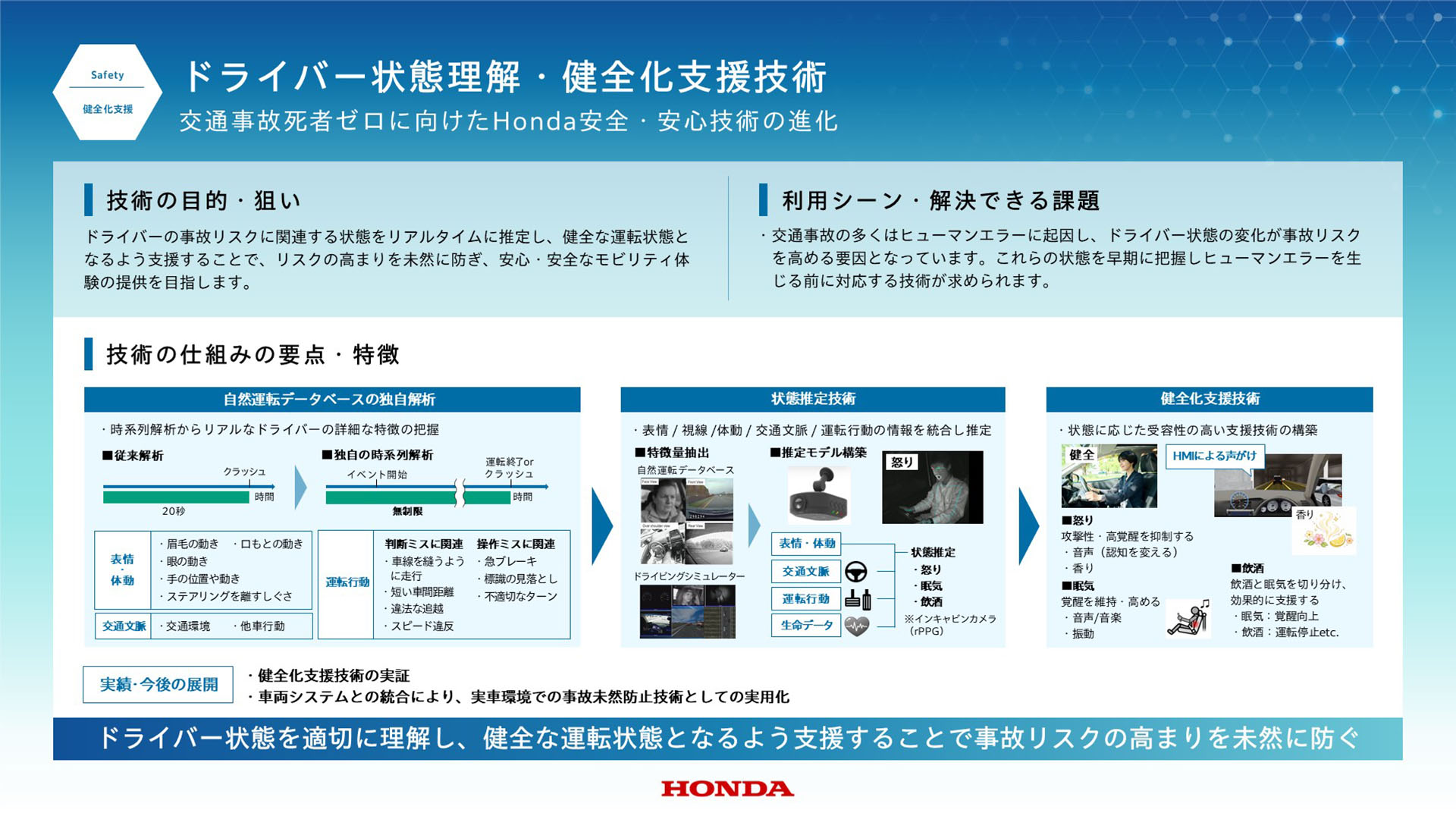
Driver State Estimation and Normalization Technology
We leverage a naturalistic driving database containing data from approximately 3,000 drivers and 50 million miles of real-world driving to analyze drivers' facial expressions, body movements, and other behavioral characteristics. Combined with insights obtained from driving simulator experiments, these data enable the development of highly accurate driver state estimation models. Based on the estimated driver state, our technology provides highly acceptable, non-coercive support for driver state normalization, helping reduce crash risk before accidents occur.
Honda Booth
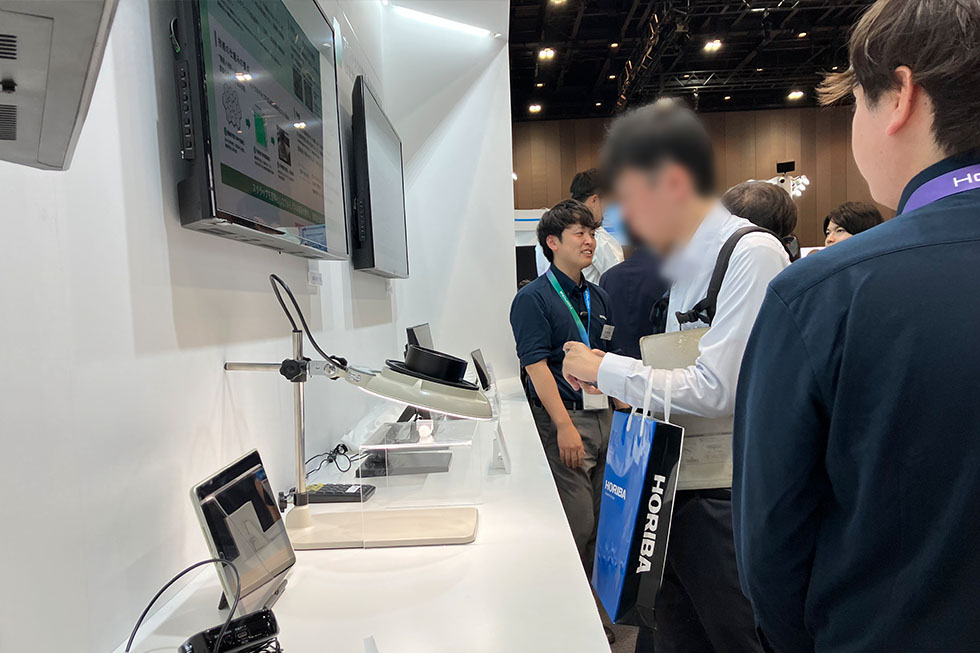
Technology Exhibition
We projected technologies from each field onto large monitors to exhibit them using explanatory panels and videos. We also exhibited our latest actual models, raw materials currently under development, products and prototype samples incorporating those materials, and more.
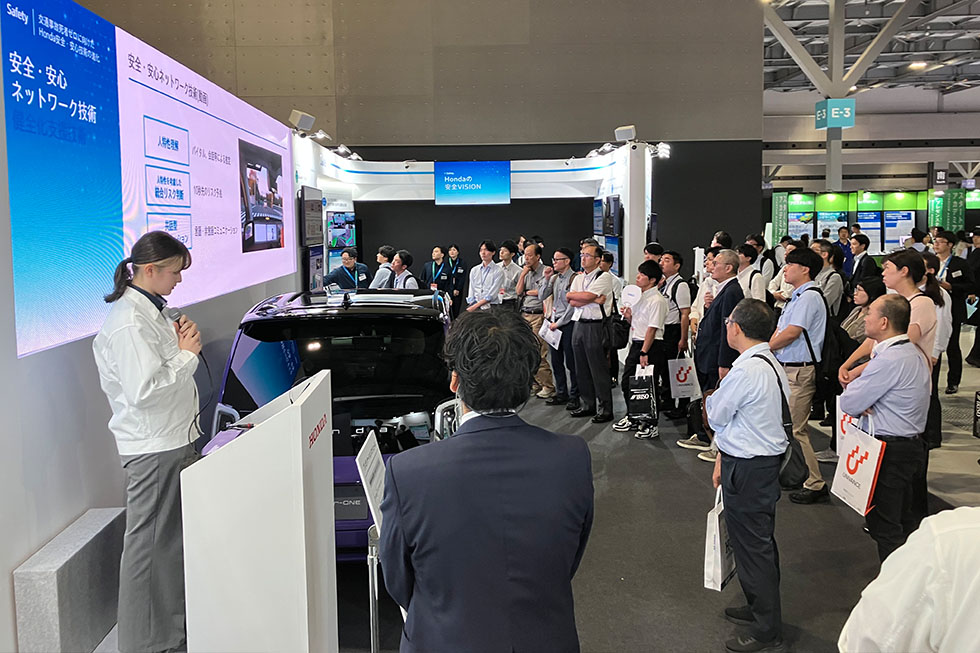
Technical Presentations
Engineers responsible for each of a total of six themes gave approximately 10-minute presentations using the large LED display in the center of the booth.
The engineers explained the key features and unique aspects of the technology combined with presentation materials and videos to many visitors.
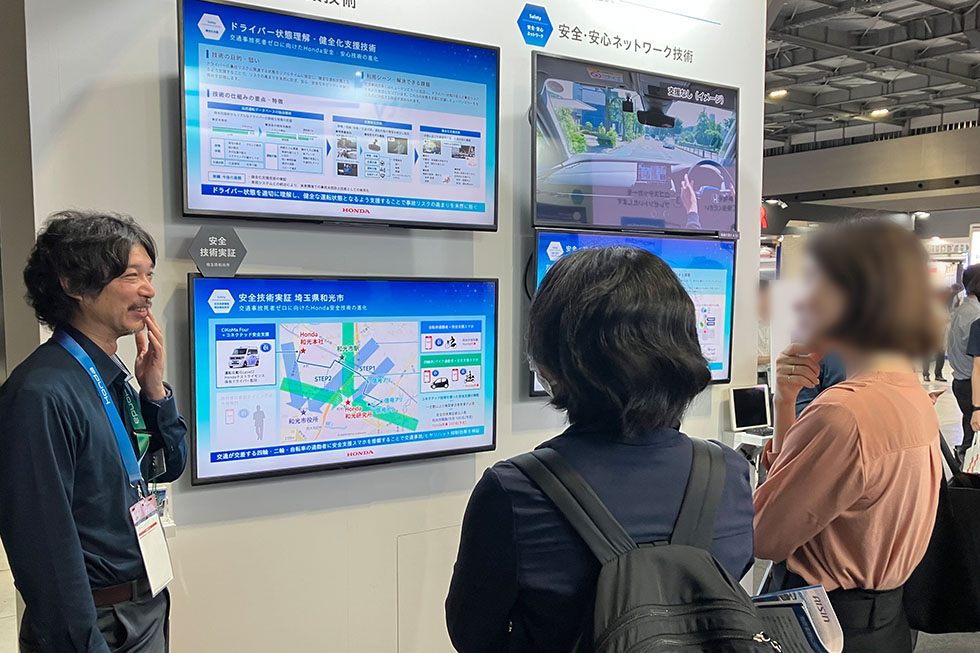
Communication with Technical Representatives
The developers of each technology acted as technical representatives. In addition to explaining the technologies to visitors, they engaged in technical discussions with them and also listened to their opinions about Honda. Thus the event served as a valuable forum for communication.
Special Exhibition
In addition to the Honda booth, we also participated in a special exhibition organized by the Society of Automotive Engineers of Japan (JSAE).
The theme of this year’s JSAE special exhibition was “The Future of Cars and Mobility Created Through Integration with New Technologies – Automotive Technology Innovated Through DX and Co-Creation –.” Honda displayed one hybrid specialty sports car and two large sports motorcycle models featuring exteriors made using bio-derived and end-of-life-vehicle-derived plastics at the Exhibition of New Cars and Vehicles Featuring New Technologies, which has become an annual event at the Nagoya exhibition. Both the car and motorcycles were equipped with our proprietary electronic control technology for their power units and clutch operation.
Exhibition of New Cars and Vehicles Featuring New Technologies (Nagoya)
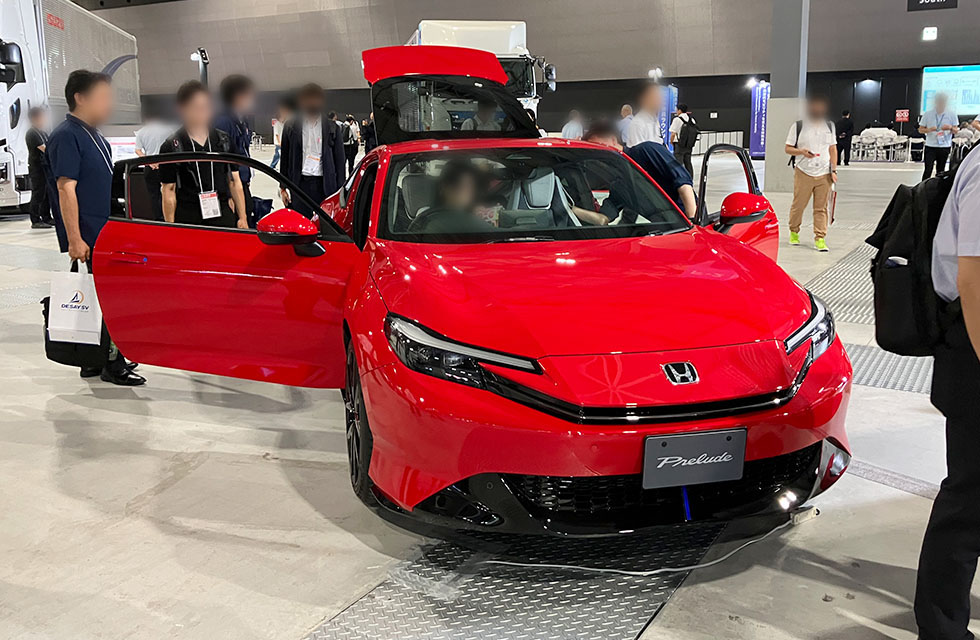
PRELUDE
We exhibited a next-generation specialty sports model equipped with the Honda S+ Shift power unit control technology in Honda’s proprietary e:HEV hybrid system. Honda S+ Shift incorporates the know-how Honda has cultivated in control technology to take the joy of handling to a new level.
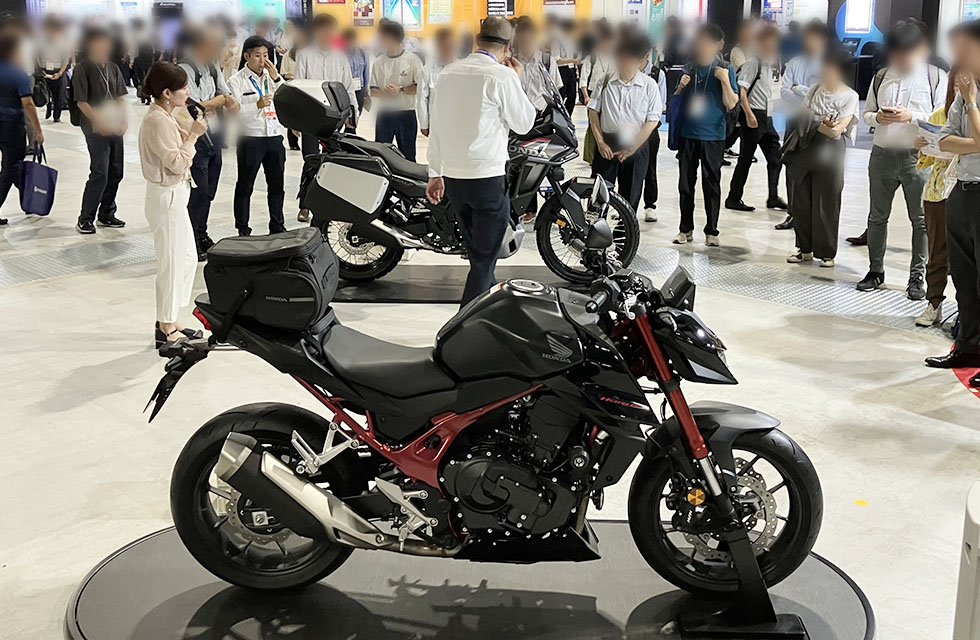
CB750 HORNET / XL750 TRANSALP
We exhibited two large sports motorcycle models equipped with Honda E-Clutch electronic control technology. These motorcycles feature an exterior made from environmentally-friendly bio-engineered plastics and recycled materials. Meanwhile, Honda E-Clutch automatically controls the clutch lever to enable smooth starts and gear shifts without manual input.