Gold Wings on Duty
with Japan’s Imperial Guard
The Machines and the Professionals
Behind the Mission
Gold Wings on Duty
with Japan’s Imperial Guard
The Machines and
the Professionals
Behind the Mission
photo = KENJI SATO
interview = SHIGEKI UENO
Cooperation: Imperial Guard Headquarters
Japan operates under a symbolic imperial system. A single police organization is dedicated exclusively to the protection of the Imperial Family—including Their Majesties the Emperor and Empress—and to security the Imperial Palace. This organization is known as the Imperial Guard.
During imperial ceremonies and state occasions, the Imperial Guard provides security and escort duties for foreign dignitaries entering the Imperial Palace, a role that has long been part of its public-facing responsibilities.
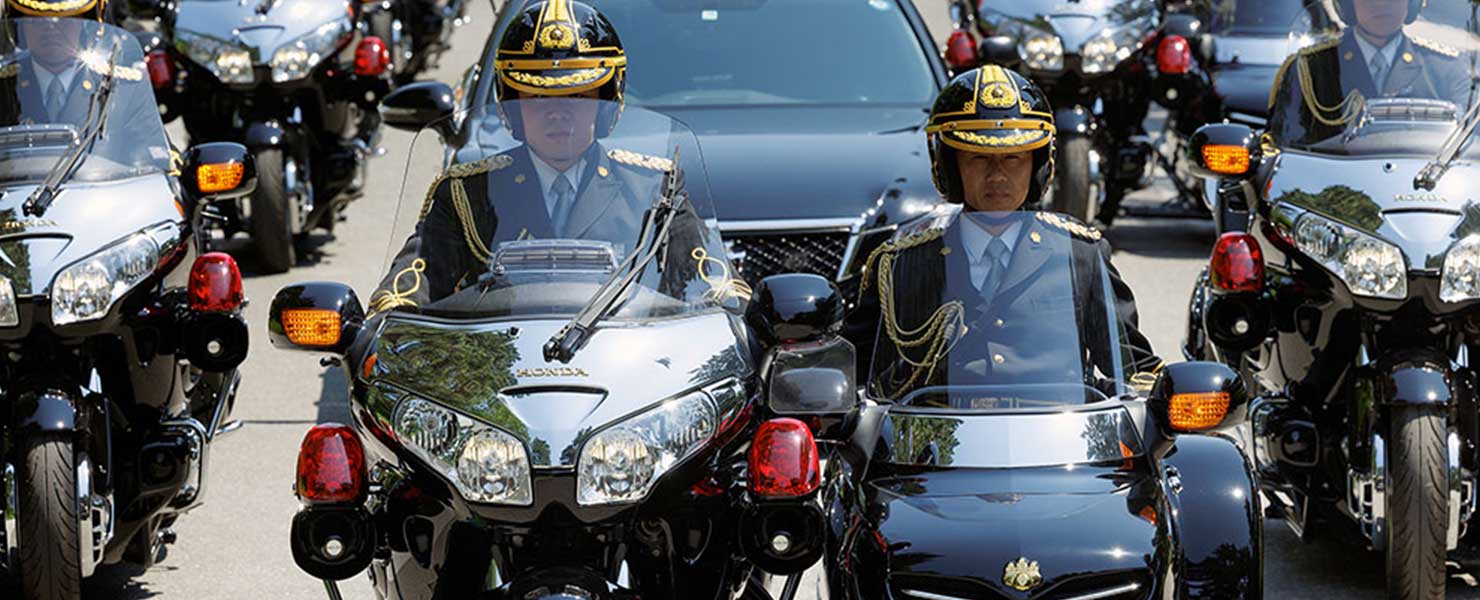
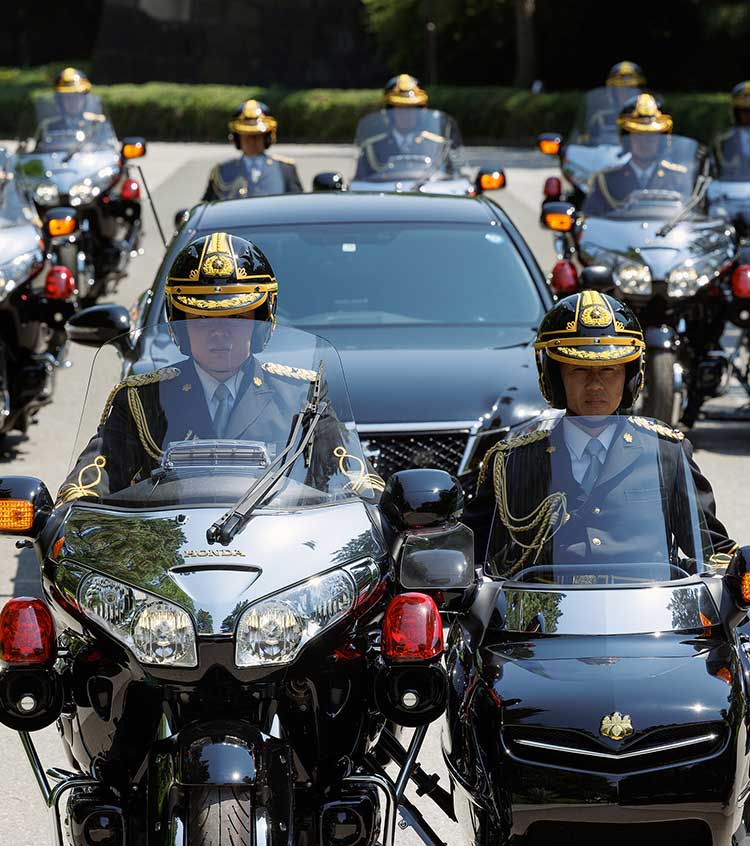
Among its most distinctive assets are motorcycles fitted with sidecars, officially designated as sidecar equipped motorcycles. These are special-purpose Honda vehicles based on the flagship motorcycle called “Gold Wing”.
Featuring a large body powered by a flat six-cylinder 1,800 cc engine and equipped with mission-specific modifications developed for Imperial Guard duties, these motorcycles require an exceptionally high level of skill to operate.
Here, we take a closer look at the motorcycles that support missions of the highest importance—and the professionals who train steadily and relentlessly, preparing for every contingency.
What Is the Imperial Guard Headquarters?
Since its establishment, the Imperial Guard Headquarters has been dedicated exclusively to protecting Their Majesties the Emperor and Empress and other members of the Imperial Family, as well as providing security for the Imperial Palace, the Imperial Residence, and related facilities.
In 1886, the Imperial Guard was established within the Imperial Household Agency. Following the enactment of the new Police Law in 1954, it became an affiliated organization of the National Police Agency.
With an authorized strength of approximately 940 personnel, the organization is composed of highly disciplined elite officers who have passed a highly competitive selection process, operating within a disciplined and rigorously structured framework.
Sidecar motorcycles built for maneuverability
Jet-black side car motorcycles surround the automobiles carrying those under protection. They are ridden by sidecar unit officers of the Imperial Guard Headquarters.
With an officer also stationed in the sidecar, multiple two-officer units move in flawless, breathtakingly precise formation. Their ability to cross positions and reorganize the formation in an instant is truly impressive.
There is a reason sidecar motorcycles—neither standard automobiles nor conventional motorcycles—are used for escort missions: they combine mobility with immediate response capability.
In terms of mobility, standard police motorcycles also offer a high degree of responsiveness. However, for the officer riding the motorcycle to take action, the vehicle must first be brought to a halt, stabilized and dismounted—steps that are inherent delays in emergency response.
With a sidecar motorcycle, officers can rush immediately to the vehicle carrying the protected people, positioning the side car motorcycle like a shield. At the same time, the sidecar officer can dismount and respond instantly.
Another major advantage is the ability to carry escort-related equipment in positions where the sidecar officer can access it immediately. In addition, the two-person configuration—consisting of a rider and a sidecar officer—allows both to remain fully focused on surrounding security while maintaining close, continuous coordination with each other.
Provided the vehicle is operated by elite officers with the skill to handle this difficult motorcycle correctly, the sidecar motorcycle becomes a form of mobility well suited to escort missions—where not a single mistake is permitted.
Special-purpose vehicles based on the Gold Wing
All sidecar motorcycles used by the Imperial Guard are special-purpose vehicles manufactured by Honda, based on the Gold Wing.
The Gold Wing is Honda’s flagship motorcycle, distinguished by its 1,800 cc flat six-cylinder engine, an unusual configuration in the motorcycle world. It was developed as a premium motorcycle to share the highest level of riding comfort and experience with a passenger. Despite its commanding chassis size befitting a large-displacement engine, the low-mounted horizontally opposed engine provides exceptional stability at low speeds. In addition, Honda’s proprietary suspension technology helps reduce rider fatigue from vibration, even during extended operation. Owing to its singular presence, the Gold Wing is often referred to as the “King of Motorcycles.”
Originally designed for urban riding, long-distance touring, and two-up travel, these very characteristics also prove highly effective when adapted for the specialized demands of escort and security duties.
The sidecar motorcycle has features unique to a special-purpose vehicle—one example is a reverse gear.
Commercialized Gold Wing models include an electrically driven reverse system to assist in moving the big motorcycle backward. As it is intended to support safe parking, the Gold Wing reverses at a constant, low speed.
In contrast, missions carried out by the Imperial Guard sidecar units require quicker, more responsive movement—for example, reversing instantly and making a rapid multi-point turn in spaces where a U-turn is not possible.
To enable such maneuvers, the motorcycle is equipped not with an electrically driven constant-speed reverse motor, but with a reverse gear powered directly by the engine. This allows the officer to control reversing speed through precise throttle and clutch modulation, making full use of the engine’s powerful low-speed torque. As a result, agile and highly responsive movements—essential for escort duties—can be executed with exceptional maneuverability.
They also have unique handling characteristics due to the asymmetry of the sidecar. To ensure comprehensive protection from both sides, motorcycles are deployed with sidecars mounted on either the right or left, and the steering feel differs accordingly. In addition, the driving force is generated only from the motorcycle, while the sidecar is only linked to the bike, when accelerating the momentum tends to shift to the sidecar, while at deceleration the momentum will be pulled to the motorcycle.
As the motorcycle is linked to the sidecar, acceleration tends to pull the vehicle toward the sidecar side, while deceleration shifts the momentum toward the motorcycle side.
It is the officers—honed by extensive training—who master these unique characteristics.
Capabilities unlocked through advanced training
To maximize the core strength of these special sidecar motorcycles—maneuverability—while preparing for every possible contingency, exceptionally advanced riding skills are essential.
Officers who become riders of the Imperial Guard’s sidecar motorcycle unit undergo rigorous self-directed training alongside their regular duties. Only those who have developed a sufficiently high level of skill through this continual practice are selected for assignment.
After refining their skills through daily training as sidecar unit members, officers must pass multiple examinations before they are finally selected as sidecar motorcycle riders. It requires approximately five years before they are cleared to operate in the field.
Even after qualifying a sidecar motorcycle rider, the days of training never end.
Consider slalom training, as example. With a motorcycle weighing approximately 400 ㎏on one side and an unpowered sidecar on the other, entering a turn at highspeed can quickly cause the sidecar wheel to lift due to centrifugal force. To maintain stability, riders develop techniques that prevent the sidecar from lifting even during high-speed cornering.
At the same time, riders must also master the skill of intentionally lifting the sidecar by a controlled amount to maneuver swiftly through constricted spaces.
Training covers a wide range of skills: switching between vehicles with sidecars mounted on different sides and with or without a sidecar officer (as handling changes significantly), making fast turns in tight spaces using the reverse gear, and performing rapid stops and starts, among many others.
In every situation, riders are expected to handle these massive motorcycles as if they were an natural of their own body—with lightness and agility. Despite the seemingly effortless nature of movement, it is achieved only through advanced skill, physical strength, and intense concentration.
Training is not only about individual proficiency; the unit also refines its collective discipline. The perfectly synchronized formation changes seen during parade riding are the result of repeated team training. Beyond the dignified visual beauty, the ability to instantly form the correct formation as a unit—on a single command—strengthens the integrity of the protective posture.
The officers’ deep sense of responsibility and passion for their mission
Many of these officers have long aspired to sidecar motorcycle duty. They volunteered, persevered endured a demanding path, and ultimately earned roles of great responsibility. Each officer, while upholding the unit’s discipline, carries a strong sense of pride and commitment to the mission.
One female officer describes one of the unique challenges of this assignment—distinct from standard police motorcycle duty—as “balancing a beautiful riding posture with powerful control.”
On a normal motorcycle, steering is largely assisted by shifting body weight. However, because a sidecar remains upright and cannot lean into turns, making it necessary to steer by physically working the handlebars with arm strength alone.
There is no assistance such as power steering, and significant force must be applied to the handlebars. At the same time, for the many citizens who eagerly await a glimpse of the protected guests during parades and ceremonies, officers must maintain readiness for immediate response while preserving formality—riding for long periods with a calm, composed posture.
One veteran officer describes his guiding principle as an Imperial Guard escort officer as “maintaining a constant mindset of immediate readiness.”
He adds, “Even as we continue riding calmly while being watched by many, if something happens, we must immediately protect those in our care as Imperial Guard escort officers. We maintain that readiness until the very end—always prepared to twist the throttle in an instant and respond at a moment’s notice.”
The professionals
who carry out missions aboard
the gleaming sidecar motorcycles
The sidecar motorcycles used for Imperial events and the movement of state guests—and the officers who command them—cut an imposing figure that can appear to add grandeur to solemn, dignified ceremonies. However, the core of their duty is protection: safeguarding those under escort.
“We may stand out, but we remain behind the scenes. We believe our true duty is to protect quietly.”
With pride in their hearts and an unwavering sense of purpose, these professionals dedicate themselves to daily training alongside their jet-black sidecar motorcycles. Honing both responsiveness and mobility, they carry out their mission with absolute commitment—to protect without compromise.