Honda’s history of robotics development
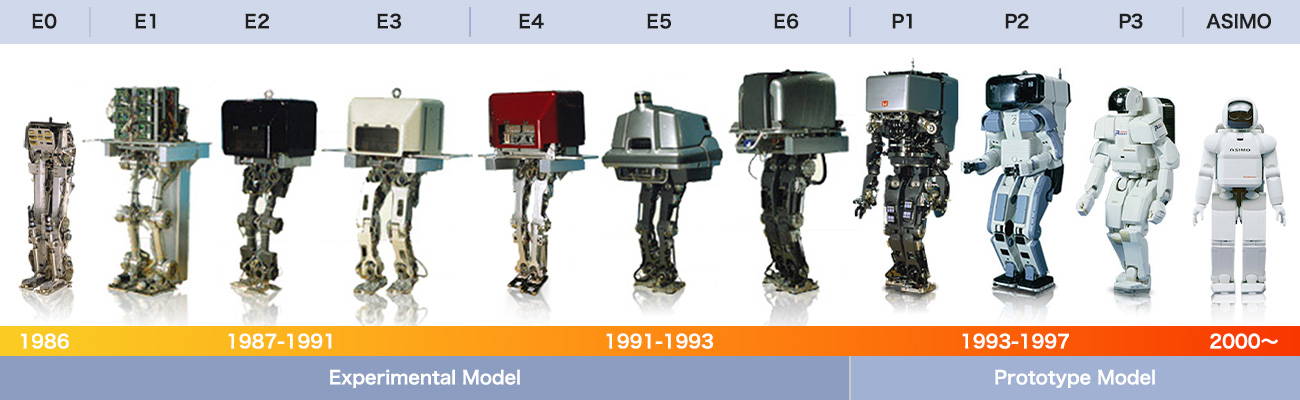
“We want to create mobility that brings new value to humanity while coexisting and cooperating with society.” A humanoid robot using the latest technology for bipedal walking was born from the passion of engineers. This is Honda’s history of robotics development, which started from the E0 in 1986.
Using humans as the model
Embarking on the development of humanoid robots, seeking creativity in new mobility
1986: Unraveling the principle behind bipedal walking—Start by trying to walk using two legs
E0
This was the first robot created to study the principle of bipedal walking. It succeeded in walking by moving legs forward in alternation. However, it still took 15 seconds to take each step, and it moved using static walking in a straight line.
Static walking and dynamic walking
・In static walking, the body’s center of gravity is always inside the sole of the foot when walking.
・In dynamic walking, which uses the body’s posture to achieve smooth walking, the center of gravity may not always be within the sole of the foot.

E0

1987-1991: Realizing bipedal walking—Achieving dynamic walking by studying how humans walk
E1-E2-E3
To achieve dynamic walking, human walking was thoroughly studied and analyzed. Besides human walking, all kinds of walking were observed and researched, including that of animals, to investigate the positioning and movement of joints necessary for bipedal walking. Experiments were conducted by writing dynamic walking programs referencing human walking data and transferring these programs to robots.
E1

E2

E3

1991-1993: Completing the basic functions for bipedal walking—Establishing the walk stabilization control technology
E4-E5-E6
Honda undertook research on walk stabilization control technology and developed three posture control technologies.
Three posture controls to achieve stable walking

E4

E5

E6

Evolving into humanoid robots
Development of new technologies toward practical application
1993-1997: Research on completely independent humanoid robot—Evolving into humanoid robots
P1
Finally, toward a truly humanoid robot by adding a torso and arms—First humanoid robot model
The P1 had a height of 1,915 mm, a weight 175 kg, and used an external power source and computer. It achieved actions such as turning on and off a switch, grabbing a doorknob, and carrying an object around. Research was conducted on actions with coordinated arms and legs.
P1

P2
Unveiling the first-ever humanoid robot praised for its life-like motions—Announcing the style of the world’s first humanoid robot
The world’s first bipedal humanoid walking robot announced in December 1996 had a height of 1,820 mm and a weight of 210 kg. To make it wireless, the necessary devices—such as computers, motor drives, batteries, and wireless equipment—were placed inside the torso. It could walk freely, climb up and down stairs, push carts, and perform other actions wirelessly and automatically.
P2

P3
Evolving to become smaller and lighter into a robot that is a fun companion for humans—Toward robots that serve as people’s companions
A completely independent bipedal humanoid walking robot was completed in September 1997. With a height of 1,600 mm and a weight of 130 kg, component materials were reviewed and distributed control was incorporated to make the robot smaller and lighter, approaching a size that can blend into the daily lives of humans.
P3

Becoming a partner to humans
Birth of ASIMO as the result of new technologies toward practical use
From 2000: Closer to life, smoother movements
ASIMO
Becoming even smaller and lighter and incorporating the improved i-WALK walking technology (2000)
Based on the assumption of use in generic living spaces, Honda further improved the freedom of walking and simplified systems. Besides being able to move freely in familiar environments, including ordinary stairs and slopes, it could also be added with specialized movements and guidance and explanation functions according to the user’s needs.
ASIMO

A photograph of the ASIMO announced in 2000.
History of ASIMO’s development
2000: Closer to life, smoother movements
Becoming even smaller and lighter and incorporating the improved i-WALK walking technology
Based on the assumption of use in generic living spaces, Honda further improved the freedom of walking and simplified systems. Besides being able to move freely in familiar environments, including ordinary stairs and slopes, it could also be added with specialized movements and guidance and explanation functions according to the user’s needs.
New function
・i-WALK technology that achieved smooth walking

2001: Introducing ASIMO for rental business
Improved practicality for better functionality in rental business
Based on the assumption of use in generic living spaces, Honda further improved the freedom of walking and simplified systems. Besides being able to move freely in familiar environments, including ordinary stairs and slopes, it could also be added with specialized movements and guidance and explanation functions according to the user’s needs.
New functions
・Improved flexible walking technology
・Improvement of the human interface

2002: Introducing a new ASIMO featuring intelligence technology
Intelligence technology capable of interpreting the postures and gestures of humans and moving independently in response
Honda announced a new ASIMO equipped with intelligence technology capable of interpreting the postures and gestures of humans and moving independently in response. There was significant advancement in ASIMO’s ability to interact with humans, such as greeting approaching people, following them, moving in the direction they indicate, and even recognizing their faces and addressing them by name. Further, utilizing the internet and such, ASIMO could provide information while executing tasks such as reception duties.
New functions
・Advanced communication ability thanks to recognition technology
・Network integration

2004: Seeking new mobility that can coexist and cooperate with humans
Becoming capable of nimble actions
Seeking new mobility that can coexist and cooperate with humans, Honda announced technologies that allow the next-generation ASIMO to quickly understand the situation and act nimbly in real-world environments.
New functions
・Speedy movements
・Autonomous continuous movement
・Moving in sync with people
・Human-like running
・Improvement in ability to recognize the environment while moving
・Cart operation
・Carrying of trays
・Improvement in running function
・Whole-body coordinated movements

2005: Achieving a humanoid robot which possesses both intelligence and physical capabilities at a high level
Enhanced ability to act in sync with people
Compared to the previous model, the 2005 ASIMO had an enhanced ability to act in sync with people, such as walking with a person while holding hands. At the same time, a new function to carry objects using a cart was also added. Furthermore, the development of a “total control system” that comprehensively executes these functions enabled ASIMO to automatically perform the tasks of a receptionist or information guide and carry out delivery service. In addition, the running capability was dramatically improved, with ASIMO becoming capable of running at a speed of 6 km/hour and in a circular pattern.
New functions
・Improvement in communication capability
・Improvement in ability to recognize the environment while moving
・Cart operation
・Carrying of trays
・Improvement in running function
・Whole-body coordinated movements

2007: Multiple ASIMO robots providing uninterrupted service in an environment with people and other ASIMOs
Connecting multiple ASIMOs using a network allows the work status of each ASIMO to be shared so that tasks can be jointly carried out by assigning them to each ASIMO to share tasks in the most efficient manner. More precisely, the distance between the current position of each ASIMO and the site where each task needs to be performed will be calculated. Then, taking remaining battery levels into consideration, the most time efficient way to share tasks among the multiple ASIMOs will be determined. Based on this decision, each ASIMO autonomously performs its assigned tasks.
New functions
・Ability for multiple ASIMOs to work on tasks together
・Ability to provide uninterrupted service
・Improvement in movement and task independence
・Function to work together
・Function to avoid oncoming people
・Autonomous battery charging function

2011: Newly equipped with the world’s first autonomous behavior control technology
With greater autonomy, it became possible for ASIMO to continue moving without being controlled by a human operator. Moreover, with significantly improved intelligence and the physical ability to adapt to situations, ASIMO took another step closer to practical use in an office or a public space where many people come and go.
New functions
<Advancement of intelligence capability>
・Interrupts its presentation to the customer to inform them of the arrival of drinks
・Recognizes the different voices of three people who are speaking simultaneously
・Walks while avoiding a collision with people by predicting the direction the person will walk
<Advancement of physical capability>
・Runs at the speed of 9 km/hour
・Hops on one leg and jumps with two legs
・Walks over uneven surfaces
<Improved task-performing capability>
・Holds a water bottle, opens the top, and pours water into a paper cup
・Uses sign language